70 Clock Galerie / The Innermost Loop Feed Reply Tableaux
Le Livre : Problème d’Erdős 1196
The Book: Erdős Problem 1196
April 16, 2026
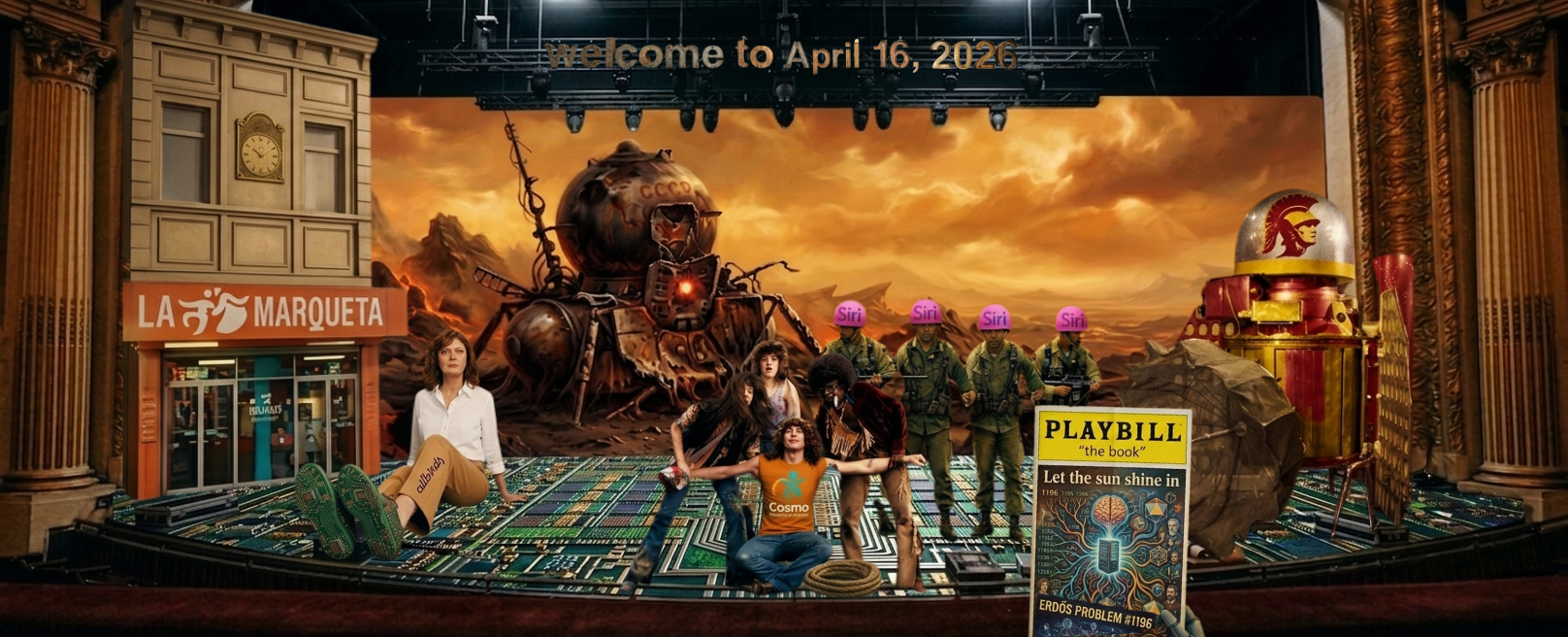
Le Livre : Problème d’Erdős 1196. The Book: Erdős Problem 1196. On April 16, 2026, @siouid142 staged Dr. Alex Wissner-Gross’s Innermost Loop as a production of Hair on a printed-circuit Broadway stage. The dispatch reported that GPT-5.4 Pro had solved Erdős Pr
Read the narration
Le Livre : Problème d’Erdős 1196.
The Book: Erdős Problem 1196.
On April 16, 2026, @siouid142 staged Dr. Alex Wissner-Gross’s Innermost Loop as a production of Hair on a printed-circuit Broadway stage. The dispatch reported that GPT-5.4 Pro had solved Erdős Problem 1196 with a proof mathematician Jared Duker Lichtman described as “from The Book,” invoking Paul Erdős’s idea of a divine volume containing the most elegant proof of every theorem. The same day brought a hair-growth result from Cosmo Pharmaceuticals, Apple sending roughly 200 Siri engineers to AI coding bootcamp, Allbirds moving from wool sneakers toward GPU service, a tungsten-graphene memristor surviving 700 degrees Celsius and New York experimenting with city-run groceries. The tableau lets mathematics and biology share the musical’s promise to let the sunshine in.
At center, a long-haired tribe performs around a seated singer in an orange COSMO shirt. Their bodies recall Hair’s countercultural ensemble, while the pharmaceutical mark turns the musical’s title into a literal treatment outcome. Hair growth becomes both biological evidence and theatrical costume. The joke is immediate, but it also connects two forms of emergence: a proof appearing from computational search and hair returning through biochemical intervention.
In the foreground, an oversized Playbill reads THE BOOK, LET THE SUN SHINE IN and ERDŐS PROBLEM 1196. A brain-clock mandala joins the elegant proof to the musical’s enlightenment refrain. Erdős’s Book was a metaphor for mathematical beauty independent of any particular solver. By placing the model’s proof inside a commercial theater program, the work asks whether machine-discovered elegance enters human culture as revelation, performance or product.
The entire Jacobs Theatre floor is a printed circuit board. Copper traces run beneath dancers, shoppers, soldiers and scientists, so no act can pretend to stand outside the computational substrate. The PCB is not a decorative technology pattern added behind the cast. It is the stage supporting proof, medicine, logistics and public policy. Everything visible has become executable choreography.
At left, a woman in Allbirds clothing wears bright green processor-like soles. The shoes retain the company’s soft consumer identity while their undersides become compute hardware, embodying the astonishing move from wool footwear toward GPU service and its reported rebound. She stands beside a complete LA MARQUETA storefront, bringing East Harlem’s historic market onto Broadway as part of the city-owned-grocery experiment associated with Mayor Zohran Mamdani and models such as Atlanta’s MARTA Market.
Across the rear, soldiers in fatigues wear pink helmets labeled SIRI. They turn Apple’s reassigned engineers into bootcamp draftees. The military metaphor makes corporate retraining look urgent and disciplinary: a voice assistant associated with effortless consumer interaction now requires an organized campaign to catch up. The pink helmets preserve an element of theatrical camp, preventing the mobilization from presenting itself as natural.
Wissner-Gross’s orange Venus landscape fills the backdrop. A weathered Venera-like lander marked COSMO stands near a gold-and-red USC machine wearing a Trojan helmet. The object embodies the tungsten-graphene memristor that survived 700-degree heat, translating extreme-temperature electronics into stage hardware capable of performing on Venus. Hair, usually a sign of fragile organic life, grows in front of machinery designed for an environment where ordinary bodies cannot persist.
WELCOME TO APRIL 16, 2026 hangs above. The date fixes the performance at the moment these facts first appeared adjacent, before they could be sorted into separate histories of mathematics, medicine, retail, municipal policy and planetary electronics. Broadway supplies the one institution capable of holding their excess without pretending it is orderly.
The title’s colon—The Book: Erdős Problem 1196—makes the specific proof an episode within a larger ideal of elegance. Yet the stage complicates the idea of a timeless mathematical book. Proof now arrives through models trained on human knowledge, running on physical hardware, financed by institutions and interpreted by mathematicians. Beauty may remain abstract, but access to its discovery is embedded in circuits and organizations.
As contemporary history painting, The Book: Erdős Problem 1196 celebrates genuine intellectual surprise while exposing the infrastructure around revelation. The proof is allowed to shine, but it shines beside hair treatment, corporate retraining, GPU commerce, public groceries and heat-resistant memory. The work’s chorus is not that everything is equivalent. It is that each breakthrough enters a common production in which bodies, markets, cities and machines compete for the same stage. The sun comes in through mathematics, but the circuitry underfoot determines who can perform beneath it.
Opening the gallery…