70 Clock Galerie / The Innermost Loop Feed Reply Tableaux
HappyHorse sur l’Essex
HappyHorse Upon Essex
April 9, 2026
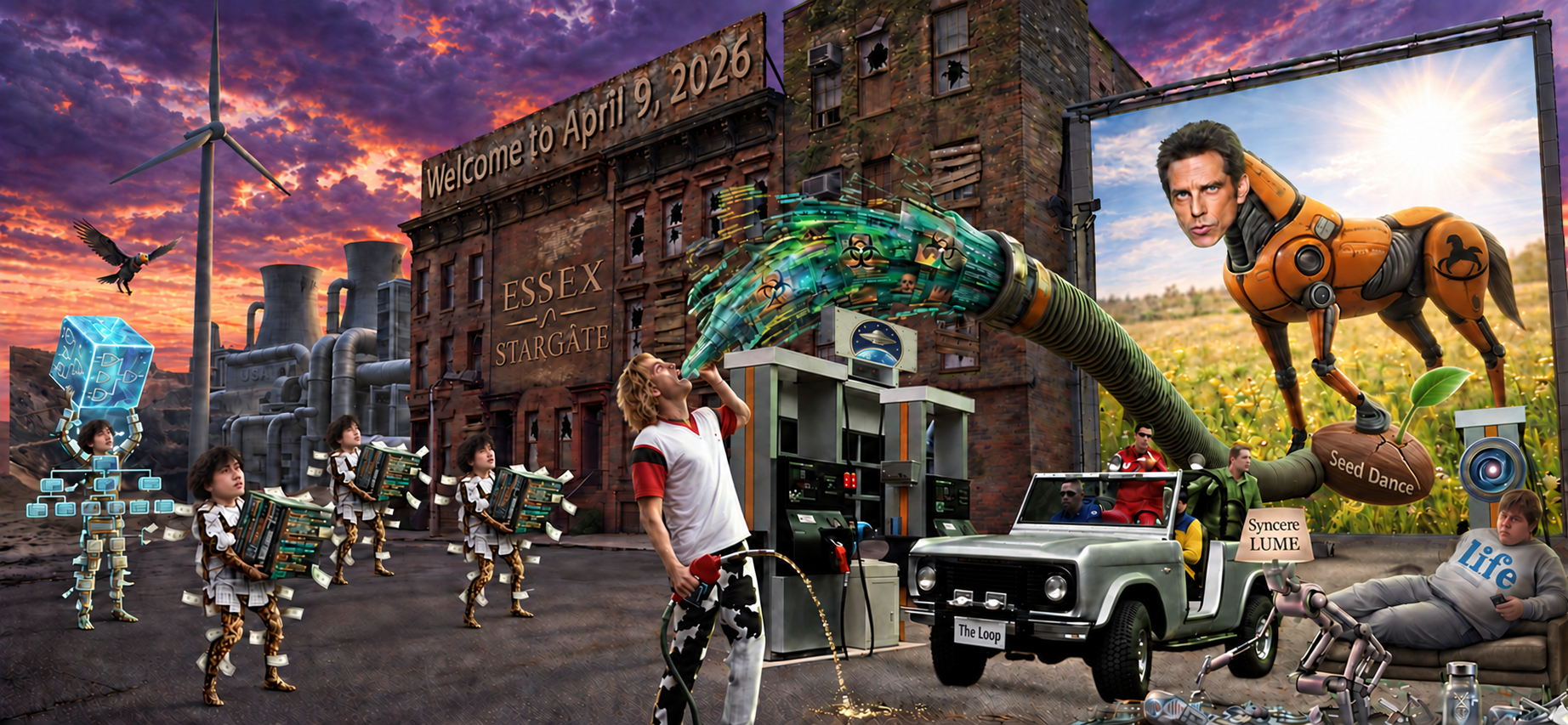
HappyHorse sur l’Essex. HappyHorse Upon Essex. On April 9, 2026, @siouid142 relocated the gasoline fight from Zoolander to a stalled data-center project in Essex. Dr. Alex Wissner-Gross’s Innermost Loop had reported Anthropic’s Mythos classifying artisanal hum
Read the narration
HappyHorse sur l’Essex.
HappyHorse Upon Essex.
On April 9, 2026, @siouid142 relocated the gasoline fight from Zoolander to a stalled data-center project in Essex. Dr. Alex Wissner-Gross’s Innermost Loop had reported Anthropic’s Mythos classifying artisanal human-written code as hazardous, Alibaba’s HappyHorse-1.0 overtaking ByteDance’s Seedance 2.0 on video benchmarks, and OpenAI’s Loughton Stargate remaining an unfinished shell amid British electricity prices roughly four times those in the United States. The dispatch also ranged through AI capital, rejuvenation, retail enthusiasm, robotics and UAP governance. The tableau binds them through a single combustible resource: the flow of capability into an infrastructure that may not have the power to absorb it.
At center, Owen Wilson as Hansel from Zoolander drinks a bright green cinematic stream directly from a gas-pump hose. Biohazard symbols, fragments of code and dollar bills circulate inside the liquid. The hose fuses Mythos’s warning about handcrafted code with the torrent of high-definition video generated and consumed by frontier models. The gesture is beautiful, reckless and structurally absurd. An application layer intoxicated by output behaves as though supply were infinite even while the physical facility behind it cannot open.
The brick structure is labeled ESSEX STARGATE and dated April 9, 2026. Its dark windows and incomplete industrial body make it an architecture of promised scale without available current. The name evokes cosmic passage, but the site remains bounded by local grids, planning and price. This tension is the work’s central corrective to frictionless AI imagery: a model can leap a benchmark overnight; a power system cannot be summoned with the same speed.
At left, an immense wind turbine rises over cooling towers and coal infrastructure. Its exaggerated height cites the new generation of giant turbines while showing renewable capacity erected inside an inherited energy landscape rather than replacing it cleanly. Coal, cooling, wind and data halls coexist because transitions accumulate before they simplify. The electricity problem is therefore not a missing logo or a technical footnote. It is the ground on which every other claim must stand.
Four workers carry luminous cubes marked AND, OR, XOR and NOT past the powerless building. Cash peels from their clothing as they move. The logic gates give physical form to the irony surrounding Meta’s Muse-related data organization: extraordinary strength in data operations alongside embarrassing weakness on reasoning tests. The cubes are elementary yet indispensable. They can be carried away from Essex, implying that talent, data and capital remain mobile even when fixed infrastructure is stranded.
On a large billboard, a Ben Stiller-faced HappyHorse stamps on a sprout labeled SEED DANCE. The image turns a benchmark victory into fashion-advertising spectacle. HappyHorse’s rise is real within the frame, but the grotesque equine branding prevents leaderboard movement from masquerading as stable sovereignty. Today’s champion is already performing on borrowed cultural terrain, one model release away from being the sprout under another hoof.
A LIFE-clad consumer stands nearby in clothes suddenly too large for the body, echoing Life Biosciences’ financing and estimates of enormous GLP-1-driven wardrobe turnover. Folded phones and retail interfaces cluster around the shrinking figure, while enthusiasm for an OpenAI public offering appears on the screen. Biological change, apparel demand and capital-market appetite become one consumer silhouette. The body loses mass as valuation language gains it.
Smaller details extend the mismatch between motion and capacity. A Syncere LUME robot cleans the site, continuing maintenance around an absent productive core. A saucer and a pump carrying government seals invoke Aliens.gov and disputes involving AARO, turning disclosure into another contested utility. Each system promises visibility or service, yet none can provide the missing watts that would animate the building.
The Zoolander citation transforms ignorance of material risk into choreographed glamour. Here, code, video and money receive the same ecstatic carelessness. The green stream looks like digital abundance, but the pump situates it within extraction, price and fire. Cultural excitement conceals the physical systems on which progress remains dependent.
As contemporary history painting, HappyHorse Upon Essex turns the grid constraint into tragicomic stagecraft. Models race, capital cheers, bodies change and robots clean while Stargate stands dark behind them. The viewer is invited to admire the spectacle and then notice that its fuel line leads nowhere secure. The tableau preserves a moment when AI’s visible layer accelerated so quickly that the infrastructure beneath it began to resemble an unfinished set—large enough for the performance, but not yet wired to survive the flame.
Opening the gallery…