70 Clock Galerie / The Innermost Loop Feed Reply Tableaux
Le New Deal de la Singularité : Crapaud Psychédélique et Thé aux Champignons
The Singularity’s New Deal: Psychedelic Toad and Mushroom Tea
April 7, 2026
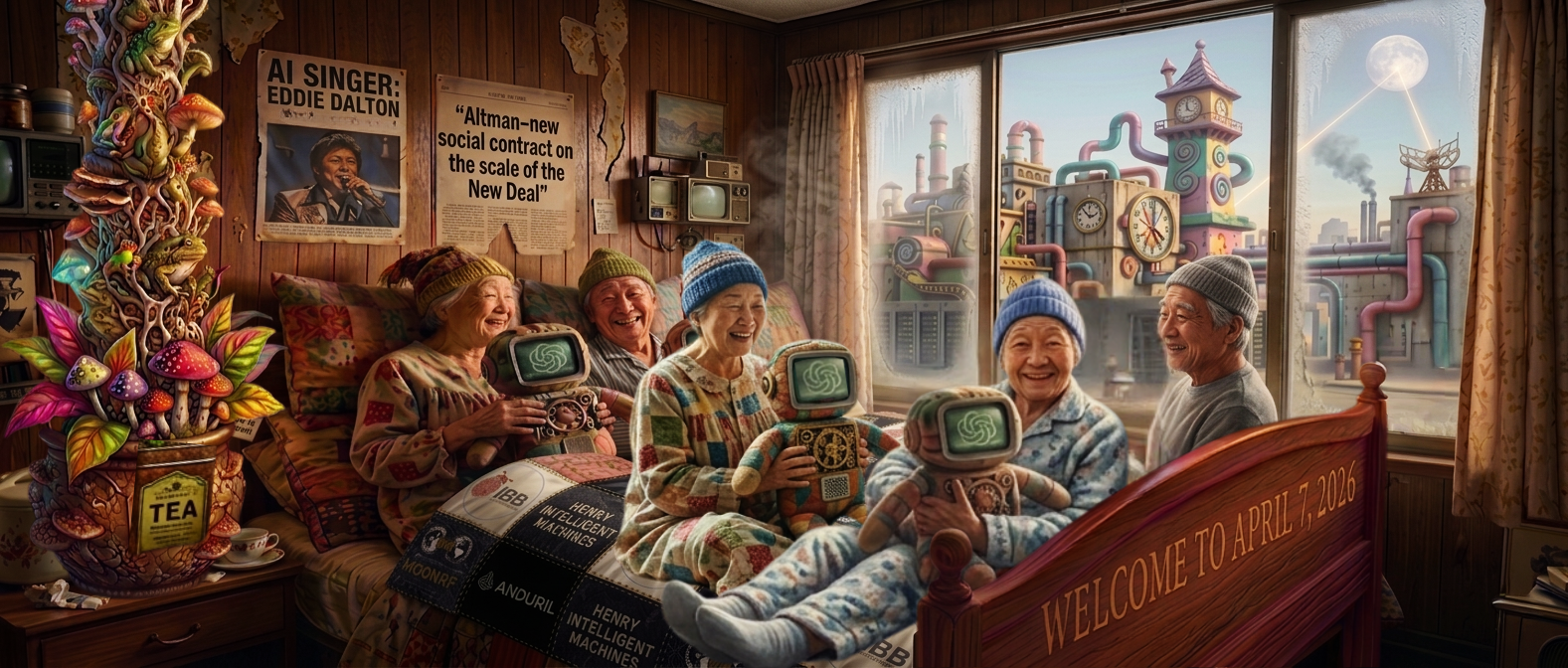
Le New Deal de la Singularité : Crapaud Psychédélique et Thé aux Champignons. The Singularity’s New Deal: Psychedelic Toad and Mushroom Tea. On April 7, 2026, @siouid142 transformed Dr. Alex Wissner-Gross’s Innermost Loop into a bedroom borrowed from Willy Won
Read the narration
Le New Deal de la Singularité : Crapaud Psychédélique et Thé aux Champignons.
The Singularity’s New Deal: Psychedelic Toad and Mushroom Tea.
On April 7, 2026, @siouid142 transformed Dr. Alex Wissner-Gross’s Innermost Loop into a bedroom borrowed from Willy Wonka & the Chocolate Factory. The dispatch brought together ChatGPT companion dolls for older people in South Korea, Sam Altman’s call for a social settlement on the scale of the New Deal, proposals to tax automated labor and pilot a four-day workweek, biotechnology capable of combining psychedelic pathways in a single plant, MoonRF communications and the AI singer Eddie Dalton. The artwork refuses to distribute these developments across separate policy, health and entertainment scenes. It places them around one crowded bed.
Five elderly residents sit beneath a patched quilt in the cramped arrangement of Wonka’s grandparents. Their knit caps, nightclothes and visible delight preserve the film’s mixture of poverty, family intimacy and impossible invention. They laugh with three handcrafted automata whose plush bodies, brass clockwork and green cathode-ray faces carry the ChatGPT knot. Frontier companionship arrives in deliberately obsolete shells. The dolls look both newly intelligent and already familiar enough to hold.
That design choice prevents a sterile demonstration of elder-care technology. A companion system enters a domain of touch, loneliness, routine and memory. Soft bodies promise comfort, while exposed mechanisms make mediation impossible to forget. They are commercial intelligences invited into the intimate furniture of late life.
Beside the bed, a grotesque tobacco-like stalk rises from a tin marked TEA. Multicolored mushrooms, amphibian faces, leaves and tendrils merge into one luminous organism. It translates the source’s biotechnology—multiple psychoactive pathways assembled in a plant—into the folk image of mushroom tea and the psychedelic toad. What would normally require a chemistry diagram becomes a household infusion growing within reach of the sleepers.
The plant’s hybridity mirrors the dolls. Both are engineered bundles presented in comforting domestic forms: one as a toy, the other as tea. Their familiarity is the mechanism by which radical capability crosses the threshold. The composition therefore asks whether social adaptation will occur through grand public institutions or through consumer objects that make the transition feel ordinary before its governance is settled.
The quilt functions as security blanket and corporate index. Henry Intelligent Machines, Anduril, MoonRF and other marks are stitched into a single soft surface over the residents’ bodies. Institutions that elsewhere appear as factories, defense contractors or communications infrastructure become patches in domestic fabric. The old social contract is not hanging on a courthouse wall; it is literally the thing keeping vulnerable people warm.
Across the room, an Eddie Dalton poster faces a clipping headed ALTMAN — NEW SOCIAL CONTRACT ON THE SCALE OF THE NEW DEAL. Synthetic culture and economic policy stare at each other over the bed. The AI singer demonstrates that performance can be generated; the New Deal reference insists that distribution, dignity and bargaining power cannot be left to generation alone. Automated abundance does not automatically determine who receives income, leisure or care.
Through the window, a Wonka-like industrial city of clocks, colored pipes and glowing stacks forms the compute substrate. A phased-array beam reaches toward the full Moon, carrying the MoonRF thread beyond the bedroom. The contrast is deliberate: planetary communications and fantastical production exist to support a scene whose human stakes are small, slow and bodily. Steam on the glass keeps the Seoul room humid and inhabited despite the machinery outside.
The date is carved into its footboard, making the bed a marker. Wonka’s original room represented a family immobilized by scarcity until a child won access to a magical factory. Here, the factory has reached the bed. The unanswered question is whether access to intelligence will release the residents from scarcity or merely surround them with products while labor, income and public responsibility are renegotiated elsewhere.
As contemporary history painting, The Singularity’s New Deal uses childhood fantasy to expose the adult politics of automation. Its exuberance is sincere: companions can reduce isolation, biotechnology can create new treatments, communications can bridge distance and automation can make shorter workweeks imaginable. Yet every gift arrives with an institutional question. Who pays the companion, regulates the plant, taxes the automated worker and guarantees that leisure is distributed rather than imposed as unemployment? The grandparents laugh beneath their corporate quilt, suspended between Wonka’s promise of abundance and the harder work of deciding what a new deal must actually provide.
Opening the gallery…