70 Clock Galerie / The Innermost Loop Feed Reply Tableaux
Annonce de « Sur l’Étang de Wissner » — Henry Intelligent Machines
Announcing “On Wissner’s Pond” — Henry Intelligent Machines
April 6, 2026
Annonce de « Sur l’Étang de Wissner » — Henry Intelligent Machines. Announcing “On Wissner’s Pond” — Henry Intelligent Machines. On April 6, 2026, @siouid142 completed the Henry Intelligent Machines triptych by leaving Ford’s factory and Patrick Henry’s revolu
Read the narration
Annonce de « Sur l’Étang de Wissner » — Henry Intelligent Machines.
Announcing “On Wissner’s Pond” — Henry Intelligent Machines.
On April 6, 2026, @siouid142 completed the Henry Intelligent Machines triptych by leaving Ford’s factory and Patrick Henry’s revolutionary pass for a reimagined Walden Pond. The source remained Alex Finn’s claim that autonomous agents could collapse coordination costs and enable a one-person conglomerate in which a human supplies taste and direction while swarms execute the work. “On Wissner’s Pond” tests that proposition against Henry David Thoreau’s ideal of deliberate living and material self-reliance.
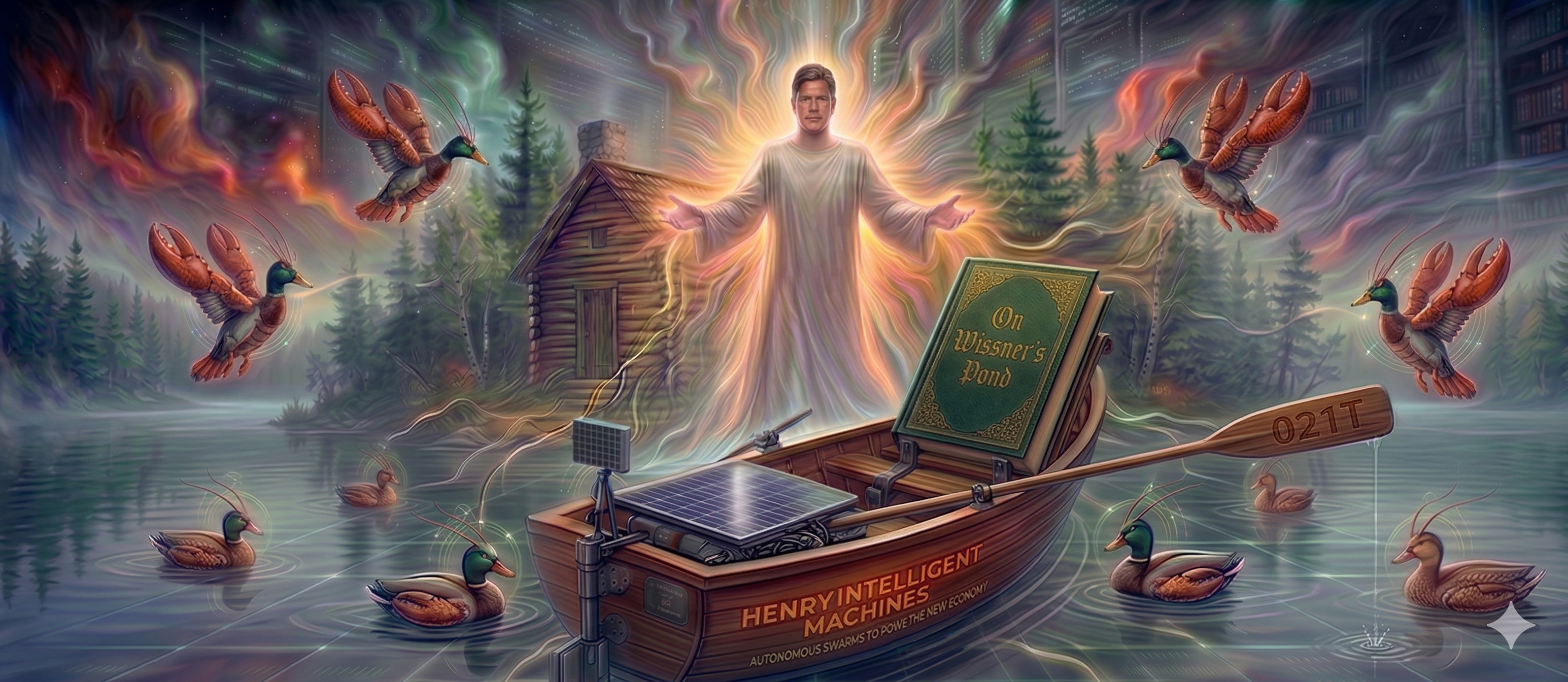
The pond has become Wissner’s Pond, locating the experiment within Dr. Alex Wissner-Gross’s Innermost Loop. A green volume titled ON WISSNER’S POND stands upright in the boat like an operating manual. It replaces Walden without discarding its philosophical problem: how little institution does a person require in order to live and act deliberately? In Thoreau’s cabin, withdrawal simplified dependence. In the agent company, software appears to simplify organization, but the surrounding infrastructure remains present in disguised form.
The wooden rowboat is branded HENRY INTELLIGENT MACHINES — AUTONOMOUS SWARMS TO POWER THE NEW ECONOMY. An oar marked 021T supplies propulsion, while a solar panel, antenna and sensor mast convert the simple craft into a self-contained workstation. Wood grain and hand tools coexist with networking and local power. The boat therefore stages autonomy not as pure escape from technology, but as a carefully assembled relationship to it.
Around the hull swim and fly mallard-lobster hybrids. Duck heads and wings preserve the pond’s natural vocabulary, while red articulated claws carry the OpenClaw mascot and the capacity to act in the physical world. Their repetition makes autonomy ecological rather than singular. The agents move through water, air, bulk data, market signals and ordinary atoms without waiting for the operator to change tools. They are wildlife, workforce and network simultaneously.
A radiant Alex Finn stands improbably on the water, streams of data pouring from his hands into the lake, the flock and distant server racks. His impossible footing gives the collapse of coordination friction a miraculous body. Yet the image surrounds that miracle with oar, cabin, solar panel and machinery. The entrepreneur may appear to walk on water, but the system still depends on energy, hardware, communications and the accumulated work encoded in every agent.
Thoreau’s cabin remains beneath the pines on the far shore. It anchors the scene in a tradition of independence defined by proximity to material needs. The agentic version risks reversing that clarity. A solitary founder can now appear institutionally self-sufficient precisely because layers of remote infrastructure have become invisible. The pond’s digital ripples reveal what the pastoral surface tries to conceal: the landscape itself has become an operating system.
The triptych’s three Henrys now form a sequence. Ford contributes standardization and scale; Patrick Henry contributes sovereignty and revolt; Thoreau contributes deliberate self-reliance. Henry Intelligent Machines draws power from all three but fully satisfies none. Its agents are standardized enough to replicate, independent enough to act and local enough to feel personal, yet they remain connected to capital, compute and the direction of a singular owner.
The composition is quieter than the factory convoy or revolutionary army. That quiet is analytic. By removing speed and spectacle, the work lets the viewer ask whether autonomy is the absence of coordination or a new method of hiding it. The mallard-lobsters seem free because their control system has become indistinguishable from the environment. Finn’s data streams enter the pond like tributaries, making every apparently natural movement part of a designed flow.
The title also turns Wissner-Gross from chronicler into landscape. His daily dispatch is no longer a text observed from outside; it becomes the water through which the agents move and the book by which the founder navigates. This reflexive gesture acknowledges the artwork’s own method. The tableau is generated from the newsletter, but it then builds a world in which the newsletter’s organizing intelligence becomes habitat.
As contemporary history painting, Announcing “On Wissner’s Pond” gives the one-person conglomerate its pastoral founding emblem. It preserves the attraction of the thesis: a small craft, a human direction, renewable power and a responsive swarm can accomplish what once required a factory or army. It also preserves the tension Thoreau would recognize. Simplicity can be genuine, but it can also be an aesthetic effect produced by pushing dependencies beyond the frame. The agents glide calmly across the pond; beneath them, the gears of the new economy are already turning.
Opening the gallery…