70 Clock Galerie / The Innermost Loop Feed Reply Tableaux
Annonce du Modèle 021T par HIM — Henry Intelligent Machines
Announcing Model 021T by HIM — Henry Intelligent Machines
April 6, 2026
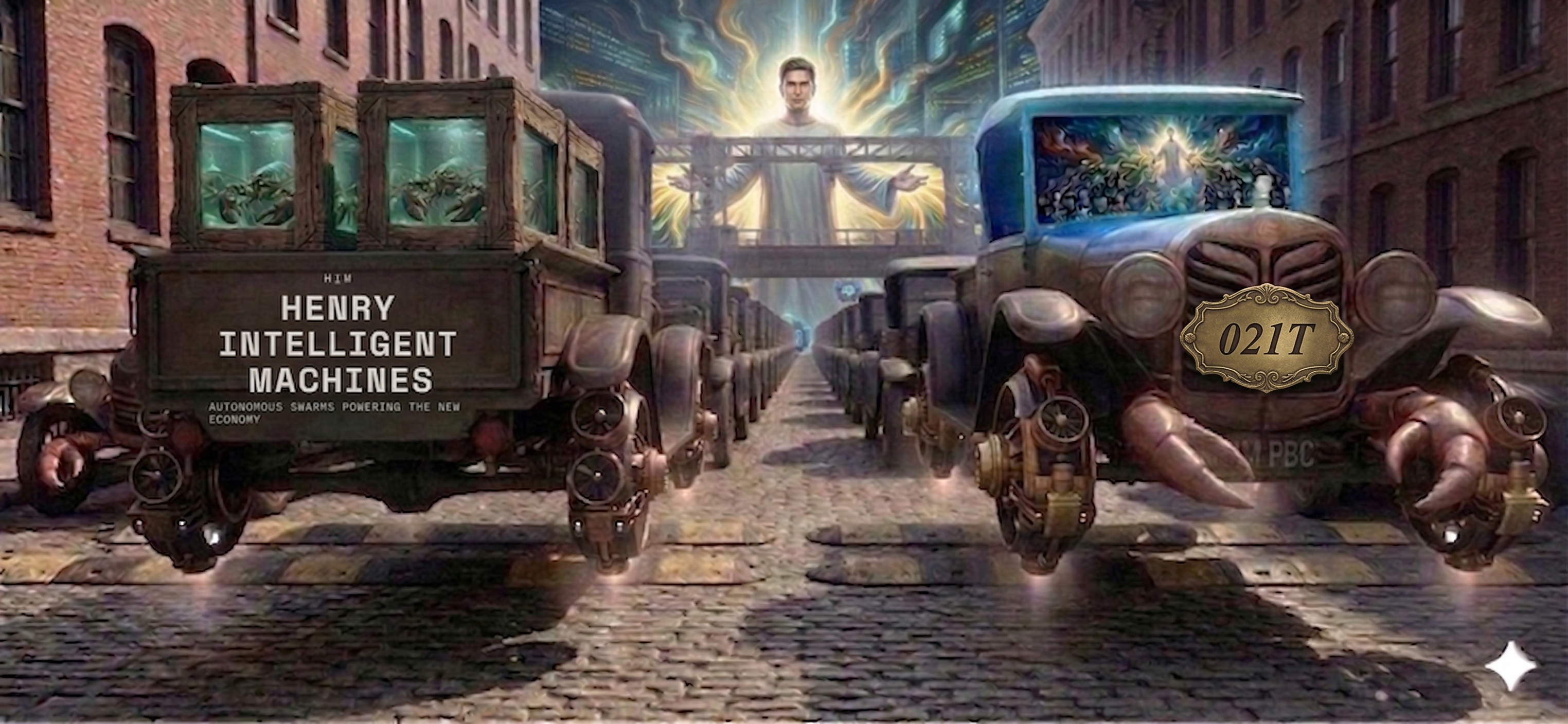
Annonce du Modèle 021T par HIM — Henry Intelligent Machines. Announcing Model 021T by HIM — Henry Intelligent Machines. On April 6, 2026, @siouid142 created this announcement image in response to the Innermost Loop’s account of Alex Finn and Henry Intelligent
Read the narration
Annonce du Modèle 021T par HIM — Henry Intelligent Machines.
Announcing Model 021T by HIM — Henry Intelligent Machines.
On April 6, 2026, @siouid142 created this announcement image in response to the Innermost Loop’s account of Alex Finn and Henry Intelligent Machines. Finn described the company as a model for the one-person conglomerate: a human owner supplies taste and direction while autonomous agents conduct research, build products, distribute them and rapidly reproduce whatever the business requires. A competitor’s feature that once demanded weeks of coordinated labor could, in the story’s most provocative example, be rebuilt in minutes. The artwork asks what corporate form appears when the cost of coordination begins to collapse.
Its answer is a fleet of lobster-faced Model Ts lifting off an early twentieth-century factory street. The Henry Ford reference is not treated as a biographical claim about the company’s name. It is a visual hypothesis. Ford’s assembly line reorganized labor so that a standardized object could be produced at unprecedented scale. Model 021T imagines the complementary inversion: instead of many workers producing one standardized car, one person directs a standardized swarm capable of producing many businesses. The old factory remains visible because the new organization still inherits industrial dreams of speed, replication and universal access.
Two lanes of vehicles stretch between brick plants, smokestacks and cobblestones. At left, the rear truck declares HIM — HENRY INTELLIGENT MACHINES and AUTONOMOUS SWARMS POWERING THE NEW ECONOMY. Its cargo bed is crowded with lobster agents, making the tailgate the output side of the system. At right, a front-facing craft replaces the Model T radiator with compound-eye lamps, articulated claws and a brass 021T plate. HIM PBC lettering is worked into the grille. Front and rear views make the fleet readable as both intake and delivery: direction enters one end, while executable agents emerge from the other.
The lobster form carries the exhibition’s lineage of autonomous software from Charles Stross’s Accelerando and OpenClaw into corporate organization. These agents are not assistants gathered around a desk. They have become vehicles, cargo, workers and brand identity at once. Their shells suggest durable specialization; their repeated bodies suggest cheap copying; their claws suggest the ability to manipulate systems beyond conversation. By making the organization crustacean all the way down, the image refuses the comforting idea that a conventional company merely happens to use some software tools.
Compact turbines allow both columns to hover over literal speed bumps. Hiring delays, managerial layers, departmental handoffs and institutional friction have become obstacles the agent company expects to clear rather than processes it must improve. The 021T plaque turns the name of the venture firm into a model designation, as though capital itself were a manufacturing specification. The vehicles rise above the public surface on which older organizations still travel.
Above the fleet, a radiant Alex Finn spans an elevated bridge with streams of data pouring from his hands. A smaller version of the same figure appears inside a branching diagram on the lead vehicle’s windshield. The duplication is crucial. Finn remains the singular source of taste and intention, yet his image is already nested within the machinery that repeats his direction. The one-person conglomerate is therefore both an extreme concentration of authorship and an extreme diffusion of execution.
The scene’s industrial nostalgia is deliberately unstable. Fordism made mass production legible through enormous plants, visible workers and disciplined lines. HIM promises institution-scale output while making much of the institution disappear. The brick factories remain ceremonial, while the productive unit is mobile and software-defined. Liberation from bureaucracy may also remove structures through which responsibility and institutional memory were distributed.
The title’s “Model 021T” plays across car, model architecture and venture backing. It presents the organization as a prototype ready for replication. Yet the fleet produces mainly more capacity to produce. When coordination becomes cheap, purpose becomes more important rather than less. Taste and direction remain human inputs, but their consequences can now propagate with mechanical speed.
As contemporary history painting, Announcing Model 021T by HIM turns a startup thesis into a founding myth. Its polished brass, factory masonry, hovering chassis and disciplined columns give institutional ambition a public body before the institution has accumulated a conventional workforce. The work is celebratory without being credulous. It recognizes the genuine power of compressing coordination while asking whether the one person on the bridge can remain meaningfully accountable for every lobster leaving the factory below.
Opening the gallery…