70 Clock Galerie / The Innermost Loop Feed Reply Tableaux
Codage de l'Apocalypse et Sang de Python par Intraveineuse
Doom Coding and Intravenous Python Blood
April 5, 2026
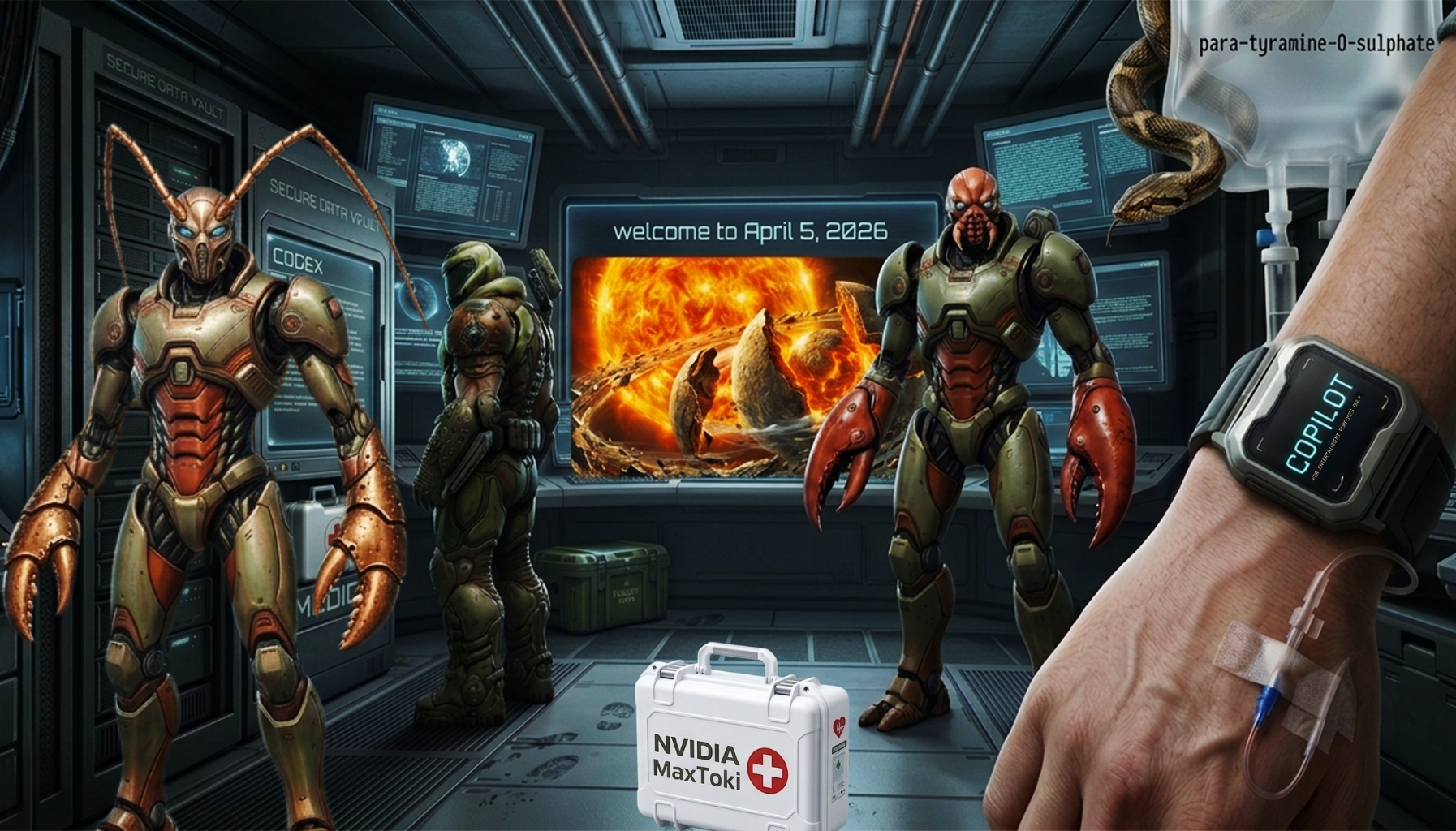
Codage de l'Apocalypse et Sang de Python par Intraveineuse. Doom Coding and Intravenous Python Blood. On April 5, 2026, @siouid142 created this work as a same-day visual reply to Dr. Alex Wissner-Gross’s Innermost Loop. The dispatch joined a remarkable set of
Read the narration
Codage de l'Apocalypse et Sang de Python par Intraveineuse.
Doom Coding and Intravenous Python Blood.
On April 5, 2026, @siouid142 created this work as a same-day visual reply to Dr. Alex Wissner-Gross’s Innermost Loop. The dispatch joined a remarkable set of developments: OpenAI’s Codex had been used to modify the DOOM engine so that a player could approach a terminal and work on the game without leaving the level; Microsoft’s Copilot carried a “for entertainment purposes only” disclaimer; researchers at the University of Colorado Boulder reported para-tyramine-O-sulphate as a possible appetite suppressant without the nausea associated with GLP-1 drugs; NVIDIA introduced MaxToki for modeling cell-state trajectories at trillion-token scale; and Roko Mijic proposed dismantling Mercury to build a Dyson swarm. The tableau places all five propositions inside one infernal workplace.
The setting is a DOOM hangar crossed with a secure clinic. Steel gantries, industrial grating, armored doors, medical tubing, red warning light and the sulfurous glow of a planet under extraction make coding, metabolism and planetary engineering appear to be departments of the same facility. The Doom Slayer stands with his back to the viewer at a screen marked CODEX inside a SECURE DATA VAULT. He is no longer merely shooting through a finished game. He has reached a workstation from which the environment can be altered while he remains trapped inside it. That recursion is the image’s governing idea: software has become both world and tool for revising the world.
Two crustacean guardians translate the agentic layer. Samuel Hayden has molted into a tall antennaed lobster cyborg, while the red-and-green armored figure at the opposite side recalls the Dark Lord’s community nickname, “Red Lobster.” Their claws connect this work to the exhibition’s OpenClaw and Accelerando lineage, in which autonomous intelligences shed shells, reproduce and reappear as economic or institutional actors. Here they become enforcement hardware around the terminal.
At extreme right, a human forearm receives an intravenous infusion beneath a COPILOT watch repeating Microsoft’s entertainment disclaimer. The hanging bag is labeled PARA-TYRAMINE-O-SULPHATE, and a python curls around the apparatus. A biochemical compound, the Python programming language and the old medical emblem of a serpent around a staff collapse into one object. “Python blood” suggests code entering the body directly, but the body is not passive. Appetite, reward and metabolism are themselves being treated as programmable systems. The disclaimer becomes sinister because it sits on a device monitoring an intervention that is clearly no longer entertainment.
On the floor, a white NVIDIA MAXTOKI medic case resembles DOOM’s familiar health pickup. MaxToki’s attempt to model enormous sequences of cellular state is converted into a kit capable of restoring or rewriting the player. The visual pun is exact: a health pack once raised a numerical score; the new system proposes to learn the trajectories by which living cells change. The game mechanic has acquired a biological substrate.
The central screen carries “Welcome to April 5, 2026” above Wissner-Gross’s fiery image of Mercury splitting and peeling under Dyson-scale extraction. The planet appears simultaneously as level backdrop, engineering diagram and victim. Mijic’s proposal is therefore shown from inside the machine that might plan it. Codex edits the game while the player inhabits it; MaxToki models the biological save file; the intravenous compound edits appetite; and the screen turns a planet into source material. Across each scale, intelligence gains access not merely to representation but to the substrate represented.
The composition makes agency difficult to locate. Is the Doom Slayer controlling Codex, or is the terminal defining the only actions available to him? Are the lobster figures guards, agents or products of the same recursive engine? Is the patient receiving treatment, code or a new appetite policy? The secure vault promises containment, yet every system inside it crosses a boundary: software enters a world, chemistry enters blood, models enter cells and industrial ambition enters a planet.
As contemporary history painting, Doom Coding and Intravenous Python Blood converts a heterogeneous technical dispatch into one architecture of intervention. Its horror does not depend on claiming that any single development is evil. It comes from their shared direction. More domains are becoming editable from within, and the operator increasingly works inside systems whose limits are themselves subject to revision. The tableau preserves the exhilaration of that access—the fantasy of walking up to reality’s terminal—and the corresponding dread that there may be no safe spectator position once the code, the body and the planet occupy the same level.
Opening the gallery…