70 Clock Galerie / The Innermost Loop Feed Reply Tableaux
Entrée dans l'Arc de Medvi : Le Port de Southampton
Entering Medvi's Arc: The Port of Southampton
April 3, 2026
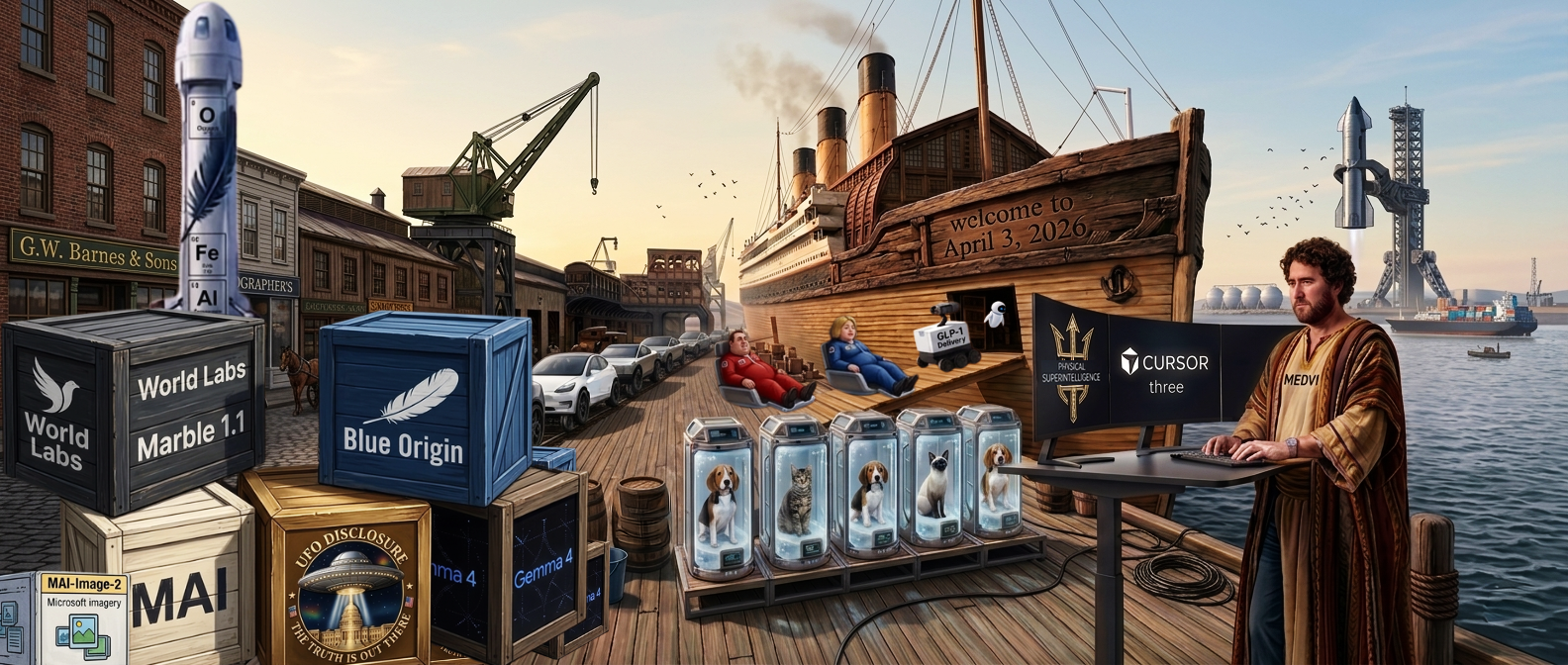
Entrée dans l'Arc de Medvi : Le Port de Southampton. Entering Medvi's Arc: The Port of Southampton. On April 3, 2026, @siouid142 responded to Dr. Alex Wissner-Gross’s Innermost Loop with a departure scene at the Port of Southampton. The dispatch described Matt
Read the narration
Entrée dans l'Arc de Medvi : Le Port de Southampton.
Entering Medvi's Arc: The Port of Southampton.
On April 3, 2026, @siouid142 responded to Dr. Alex Wissner-Gross’s Innermost Loop with a departure scene at the Port of Southampton. The dispatch described Matthew Gallagher’s agent-built telehealth company Medvi as a model of the one-person unicorn and placed that organizational compression beside Cursor 3, tools for physical superintelligence, world models, biological preservation, lunar materials, new foundation models, and launch infrastructure. The image asks what one person can load into an enterprise once agents perform the work of an institution.
Gallagher stands at right in a robe marked MEDVI, operating a laptop at a narrow desk. Two black panels beside him read “PHYSICAL SUPERINTELLIGENCE” and “CURSOR three.” He resembles a techno-Noah, but he is not sawing wood or managing a visible workforce. His role is coordination. The one human founder types while software, robots, vehicles, containers, and preservation systems assemble the voyage around him.
The vessel is a deliberate fusion of Noah’s Ark and the Titanic. A rough wooden hull and loading ramp establish the biblical rescue story, while multiple ocean-liner funnels and the Southampton setting introduce the twentieth century’s most famous confidence in an “unsinkable” technological system. “Welcome to April 3, 2026” is carved into the planks like both date stamp and ship name. Salvation and catastrophe are built into the same hull before it leaves port.
The dock functions as a manifest. Crates at left are labeled World Labs and Marble 1.1, Microsoft’s MAI-Image-2, Gemma 4, and Blue Origin. Their different products—world modeling, image generation, language intelligence, and launch capacity—are rendered as compatible freight. A separate UFO DISCLOSURE crate places institutional secrecy among ordinary cargo. Knowledge, capability, and unresolved evidence are all treated as things that can be packed for departure.
A tall feathered column stacks the symbols O, Fe, and Al: oxygen, iron, and aluminum associated with extraction from lunar regolith. The plume gives raw materials the heraldic form of a ship’s standard. At the far right, a rocket stands on a launch tower beyond the harbor. The old port and the new launch site occupy the same horizon, aligning maritime expansion with the proposed industrialization of the Moon.
Five transparent pods preserve dogs and cats in frosted suspension. They are the work’s technological “two by two,” but they also retain the specific Cryopets thread from the source. The animals are not walking voluntarily up the ramp. They have become archived biological passengers whose future depends on containers, cooling, and trust in a later revival. Preservation turns the ark from shelter into database.
A small vehicle labeled GLP-1 Delivery climbs the ramp ahead of two Wall-E-like robots pushing or guiding red and blue floating chairs. The passengers appear comfortable, almost passive, while the service machine manages metabolic care and movement. A line of Teslas waits behind them. Human transport, autonomous mobility, telehealth, and pharmaceutical delivery merge into one boarding process. The enterprise does not merely carry patients; it reconstructs the systems through which patients are moved, monitored, and treated.
The harbor is layered with older brick warehouses, cranes, wooden barrels, sailing rigging, an ocean liner, container shipping, and contemporary launch hardware. These transport eras are not presented as a smooth chronology. They coexist on one quay, showing that each new logistics system inherits the ambitions and blind spots of the previous one. The Titanic reference makes that inheritance impossible to romanticize.
The title uses “Arc” rather than only “Ark,” suggesting both vessel and trajectory. Medvi is a company, but it is also a curve from one-person coordination toward institution-scale reach. Agents allow a founder to compress departments into software, yet every box on the dock represents a dependency: models, infrastructure, biology, materials, logistics, and public trust. The one-person unicorn is visually singular only at the keyboard. The system surrounding him is vast.
As contemporary history painting, Entering Medvi’s Arc turns organizational automation into an embarkation myth. Its optimism is real: small teams can coordinate capabilities once reserved for enormous institutions, preserved animals can be carried forward, and new tools can widen access to care. Its warning is equally real: the ark carries Titanic funnels, secrets, speculative bodies, and untested machinery. The work records the excitement of bulk-uploading civilization into an agentic enterprise while asking who checks the manifest, who chooses the destination, and who remains responsible when the confident ship meets the ocean.
Opening the gallery…