70 Clock Galerie / The Innermost Loop Feed Reply Tableaux
Agent Billy : Caisse Autonome Ikea
Agent Billy Autonomous Ikea Checkout
April 2, 2026
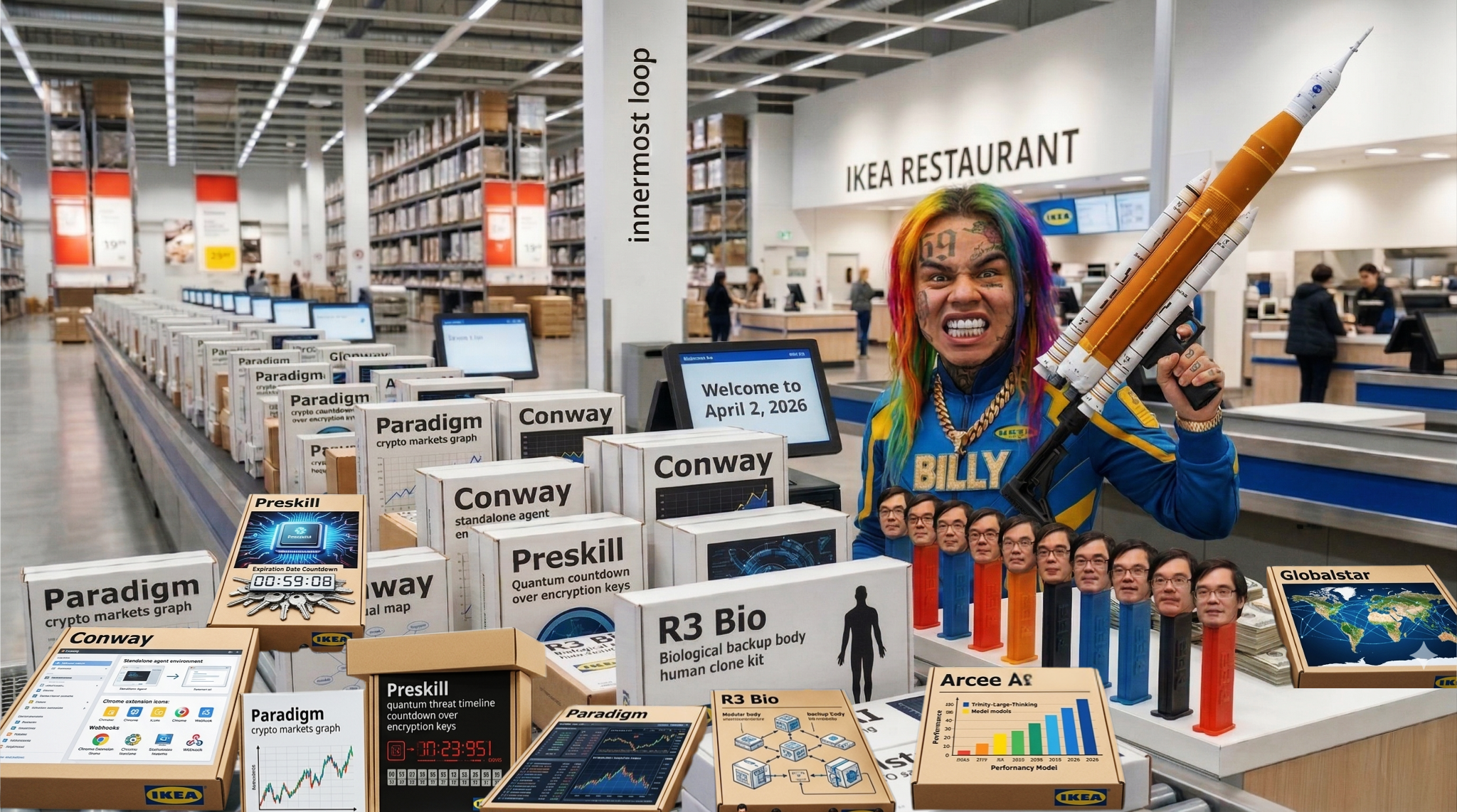
Agent Billy : Caisse Autonome Ikea. Agent Billy Autonomous Ikea Checkout. On April 2, 2026, @siouid142 converted Dr. Alex Wissner-Gross’s Innermost Loop into an IKEA checkout lane staffed by Agent Billy. The dispatch reported IKEA’s artificial-intelligence cus
Read the narration
Agent Billy : Caisse Autonome Ikea.
Agent Billy Autonomous Ikea Checkout.
On April 2, 2026, @siouid142 converted Dr. Alex Wissner-Gross’s Innermost Loop into an IKEA checkout lane staffed by Agent Billy. The dispatch reported IKEA’s artificial-intelligence customer-service agent Billy and its measured approval rate of 57 percent, alongside autonomous-agent environments, prediction markets, quantum threats to encryption, biological backup systems, model progress, satellite infrastructure, and the human heartbeat still required by a lunar mission. The image treats every development as a flat-pack product ready to be scanned.
Billy appears through a collision of names. IKEA’s agent shares its name with “Billy,” the Tekashi 6ix9ine track, so the corporate service bot is embodied as the rapper: rainbow hair, facial tattoos, gold chain, bright blue-and-yellow uniform, and an aggressive expression. The recovered creation discussion repeatedly pushed the likeness away from a calm employee and toward the menacing energy of the song. A bland approval metric becomes a human figure too unruly for the store’s standardized visual order.
The gold chain spells BILLY across his chest, while small IKEA marks make the corporate identity part of the costume. He stands behind the terminal but does not hold an ordinary scanner. Instead, he grips a bundle of Artemis II rockets like a pistol or handheld barcode device. The lunar program’s “column of fire” has been domesticated into checkout hardware. National-scale aerospace passes through the same retail gesture used to price a box of shelving.
The counter is finite and fully visible, a point emphasized throughout the recovered revisions. Products arrive from the left, pass the register, and stop near Billy rather than disappearing into an infinite conveyor. That geometry matters because the day’s technologies are not portrayed as an unbounded stream of generic innovation. They are a countable inventory, each with a box, label, diagram, price-like presentation, and place in the queue.
Paradigm cartons carry crypto-market graphs, presenting the company’s prediction-market interface as a “Bloomberg for the future.” Conway boxes show a standalone agent environment and its conceptual map. Preskill packages place expiration countdowns over encryption keys, translating the quantum threat into a consumer product with a deadline. R3 Bio sells a “biological backup body human clone kit” with a modular silhouette. Arcee AI displays model-performance bars, while Globalstar offers orbital coverage as a boxed network map.
Near the register, repeated dispensers carry the face of mathematician Terence Tao. They resemble PEZ containers, turning extraordinary cognition into a replaceable retail unit. The joke answers a thought experiment about multiplying genius across thousands of copies and hundreds of subjective years. Intelligence is no longer represented by one revered thinker at a desk. It stands in a row at checkout, identical heads mounted on cheap distribution mechanisms.
The store environment is deliberately ordinary. Warehouse shelves, fluorescent grids, price placards, checkout screens, and the IKEA restaurant sign extend into the background. “Welcome to April 2, 2026” appears on the register between stacks of boxes. The bright, neutral architecture is designed to make complex household goods feel understandable and self-service. That same architecture now contains clone kits, autonomous agents, cryptographic deadlines, satellite networks, and lunar rockets.
This is the image’s central critique of packaging. IKEA’s genius is not merely inexpensive furniture; it is the conversion of complex manufacturing and logistics into standardized boxes accompanied by diagrams. The artwork applies that cultural system to frontier technologies. Once capability can be boxed, named, graphed, and placed on a belt, it begins to look ordinary before its consequences are ordinary. Retail legibility outruns social comprehension.
Billy’s 57-percent approval rate sharpens the scene. The number is neither triumph nor failure. It is the kind of middling metric through which automated systems enter institutions: useful enough to continue, imperfect enough to frustrate, measurable enough to manage. The rapper embodiment refuses the soothing language of customer service and makes that unresolved performance impossible to ignore.
As contemporary history painting, Agent Billy Autonomous Ikea Checkout turns the Singularity into a transaction. Every box preserves a specific source item, but their adjacency reveals a larger system: markets predict, agents operate, encryption expires, bodies become modular, models improve, and satellites distribute access while a human-looking figure scans the lot. The work’s humor depends on excess, yet the checkout remains calm. That calm is the warning. Once the future reaches the belt, the institution’s next question is not what it means, but whether the barcode reads.
Opening the gallery…