70 Clock Galerie / The Innermost Loop Feed Reply Tableaux
Le Loup de la Singularité
The Wolf of the Singularity
April 1, 2026
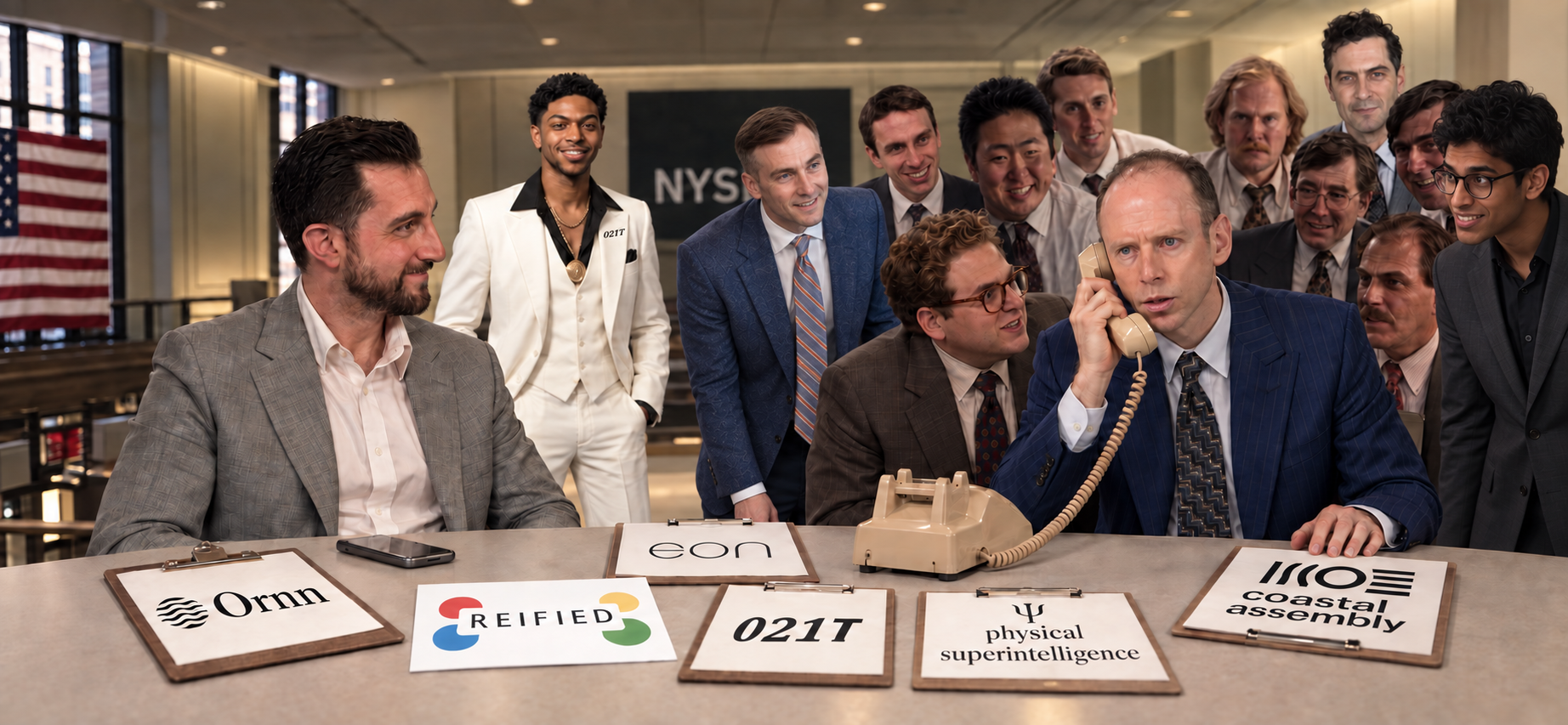
The NYSE interview becomes a cinematic cold call, gathering The Wolf of Wall Street’s ensemble and a circle of entrepreneurs around a vision of technological abundance.
Read the narration
Le Loup de la Singularité
The Wolf of the Singularity
April 1, 2026
On March 31, 2026, Doctor Alex Wissner-Gross joined David Weisburd at the New York Stock Exchange for How I Invest, discussing investment in a world transformed by artificial intelligence. The setting supplied the X account SIOUID 142 with an irresistible cinematic invitation. This tableau places the physicist and his entrepreneurial circle among the exuberant brokerage crew of The Wolf of Wall Street. The singularity has arrived on the trading floor, and someone is taking the call.
In the interview, Wissner-Gross argues that the singularity is already underway through AI helping to build better AI. He anticipates falling costs of intelligence, energy, and labor, asking how enterprise changes when its foundational resources become abundant. The NYSE is therefore an eloquent setting: an institution devoted to valuing companies hosts a discussion about remaking the conditions under which value is created. His forecasts reach toward AI agents operating businesses and individuals directing vast enterprises. The crowd gives that expanding cast of economic actors an exuberantly human form.
Wissner-Gross occupies Jordan Belfort's place in Martin Scorsese's 2013 film, assuming the blue pinstripes and concentrated delivery associated with Leonardo DiCaprio's performance. The receiver draws his head forward; his free hand steadies him against the desk. Beside him, Donnie Azoff, played by Jonah Hill, leans into the exchange. The surrounding company borrows the film's delighted anticipation, its pleasure in a performance gathering momentum. Weisburd, seated at the left, anchors this cinematic transformation to the interview that occasioned it.
The beige corded telephone makes the temporal collision wonderfully tangible. An instrument of twentieth-century commerce carries a conversation about intelligence becoming abundant. Its coiled wire gives that immense proposition an almost domestic scale: the future can be reached from a desk. Scorsese's ensemble staging lends its rhythm to collective enthusiasm, while the ventures on display introduce a new vocabulary of possibility.
The caller's own history makes this translation especially apt. Wissner-Gross graduated from MIT with a triple major in physics, mathematics, and electrical science and engineering, then completed his physics doctorate at Harvard. His work on programmable matter placed computation in dialogue with the material world. The pinstripe suit dresses a continuing question: how might an advance in understanding become an advance in what civilization can actually do?
Five entrepreneurs bring that question into the crowd. Kush Bavaria, chief executive of Ornn, connects the scene to markets for compute, the processing capacity on which artificial intelligence depends. Matthew Pines, co-founder and chief executive of Physical Superintelligence, represents the ambition to accelerate discovery in physics through AI. Michael Andregg, founder and chief executive of Eon, brings brain emulation into view: the effort to reproduce the workings of biological brains computationally. Timothy Sullivan extends the portrait's history of collaboration, having co-authored research with Wissner-Gross on subjects including participatory telerobotics.
Devon Triplett, founder of 021T Capital Management, supplies a second, gleeful film quotation. His white suit, black shirt, and gold medallion summon Tony Montana, Al Pacino's character in Scarface. The small 021T lapel emblem brings this borrowed screen presence back to his venture firm. Two celebrated cinematic worlds meet inside a third, the emerging culture of entrepreneurs whose business plans reach toward science fiction.
Across the desk, Ornn, Reified, Eon, 021T, Physical Superintelligence, and Coastal Assembly form a compact atlas of that culture. Reified and 021T connect capital to new enterprises; Coastal Assembly brings the ocean into the picture, working with natural processes to rebuild coastlines. Alongside compute markets, brain emulation, and AI-assisted physics, the coastline suggests how widely the consequences of intelligence might travel. An economic imagination becomes an arrangement of practical projects.
The original post's extravagant joke about one hundred and fifty thousand times returns draws its number from the interview's closing exchange. Asked to rate his excitement about AI, Wissner-Gross answers with his estimate of the human lives lost each day, linking his enthusiasm to the hope of overcoming disease and mortality. That humanitarian horizon gives the numerical flourish its emotional depth. The portrait gathers the delight of cinema, the energy of enterprise, and the scale of scientific aspiration into one suspended instant. Beyond the frame, the telephone's unseen listener becomes our place in the scene: invited into the conversation, just as the room comes alive around it.
Opening the gallery…