70 Clock Galerie / The Innermost Loop Feed Reply Tableaux
L'Homme Qui Rétrécit
The Incredible Shrinking Man
April 1, 2026
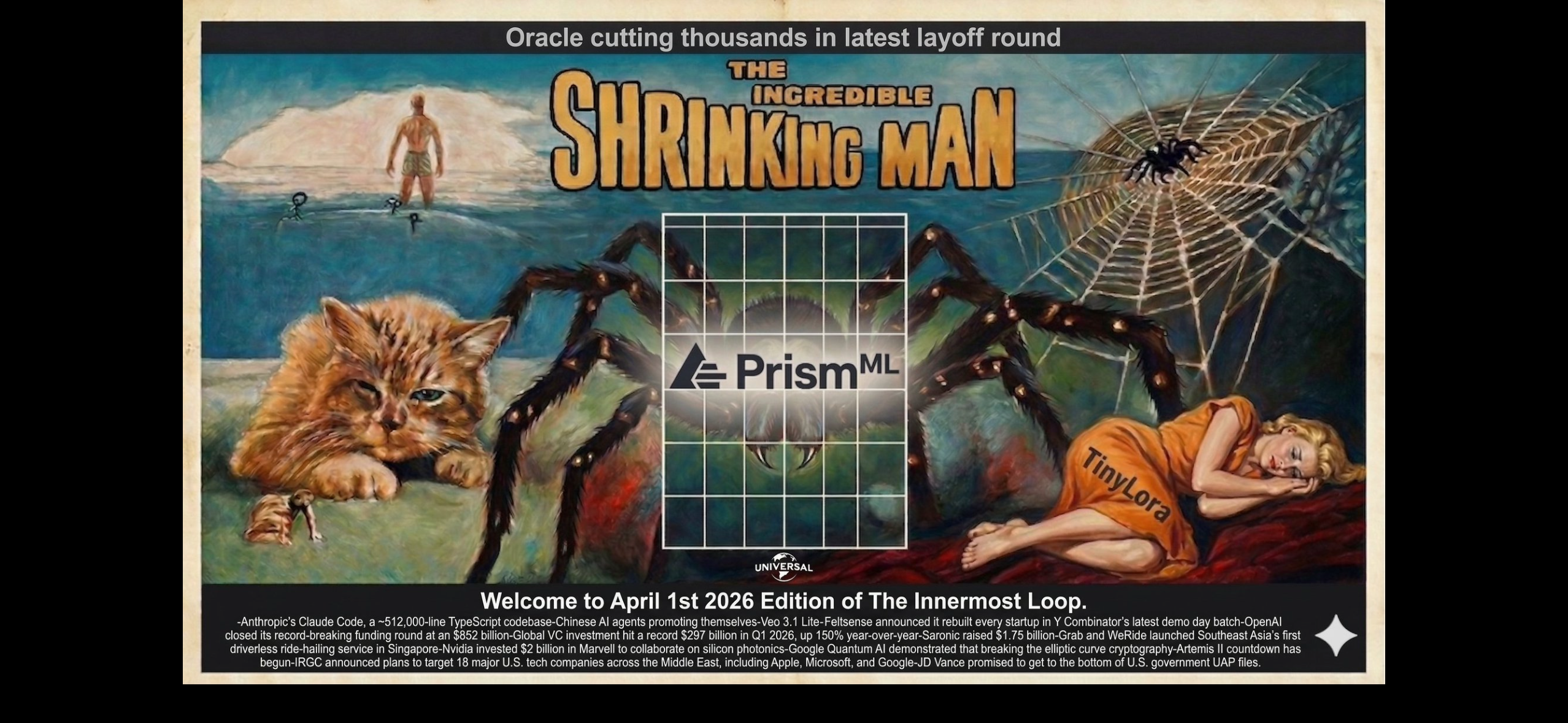
L'Homme Qui Rétrécit. The Incredible Shrinking Man. On April 1, 2026, @siouid142 turned Dr. Alex Wissner-Gross’s Innermost Loop into a weathered poster for The Incredible Shrinking Man. The dispatch described intelligence becoming radically smaller in storage
Read the narration
L'Homme Qui Rétrécit.
The Incredible Shrinking Man.
On April 1, 2026, @siouid142 turned Dr. Alex Wissner-Gross’s Innermost Loop into a weathered poster for The Incredible Shrinking Man. The dispatch described intelligence becoming radically smaller in storage and adaptation even as its economic and institutional effects grew larger. PrismML’s one-bit and ternary Bonsai models, TinyLoRA-scale adaptation, large codebases rebuilt through artificial intelligence, enormous funding rounds, and another wave of Oracle layoffs occupied the same news field. The image’s governing paradox is simple: technical systems shrink while the world they disturb becomes monstrous.
The artwork borrows the visual language of the 1957 Universal film rather than merely borrowing its title. Faded paper, painted color, oversized lettering, a house cat, a spider, webbing, and a tiny human figure reproduce atomic-age body horror. In the original story, ordinary domestic objects become lethal when the protagonist’s scale changes. Here, familiar economic and technical institutions become the cat and spider looming over compressed intelligence.
Across the top, a black banner reads “Oracle cutting thousands in latest layoff round.” The line sits where a studio advertisement might promise terror. Corporate downsizing becomes both headline and formal echo of bodily shrinking. The pun is severe: a company cuts its workforce as model builders cut the number of bits, bytes, and trainable parameters required for useful capability. The two reductions are not technically equivalent, but their visual adjacency asks who benefits when efficiency is celebrated without accounting for displaced bodies.
At center, a huge black spider is covered by a white grid and the PrismML mark. The calibration mesh turns the creature into a benchmark target, specimen, and threat at once. PrismML’s Bonsai family pursued compact image models in one-bit and ternary forms, so the spider’s enormous body represents the inversion produced by compression: fewer bits can make deployment broader, cheaper, and more difficult to contain. The smaller the model becomes, the larger its effective habitat.
At lower right, a sleeping woman wears an orange garment labeled TinyLora. TinyLoRA’s miniature adapter is translated into a human figure small enough to rest beneath the web. Her sleep suggests dormant capacity—a tiny object that can be stored, copied, and awakened in another context. She is visually vulnerable beside the spider, yet the label also makes her one source of the scale disturbance. Miniaturization is not the disappearance of agency; it is agency packaged for transport.
At lower left, a tiny man confronts a house cat while another minuscule figure stands near its paw. Far above, a small human body faces the sea as if the whole painted environment has become too large to inhabit. Is intelligence the shrinking man, the sleeping adapter, the gridded spider, or the measuring system laid over it?
The modern footer intensifies the clash of eras. “Welcome to April 1st 2026 Edition of The Innermost Loop” appears above dense fine print listing a roughly 512,000-line codebase, an 852-billion-dollar funding valuation, record venture investment, autonomous transport, photonics, quantum cryptography, Artemis II, and government UAP files. Monumental capital and planetary ambition are reduced to tiny legal-style text beneath the horror scene. The reader must approach the poster closely to discover that its smallest typography contains its largest numbers.
This is why the retro form is more than nostalgia. Mid-century monster cinema gave technological anxiety an animal body: radiation and science made ordinary creatures impossibly large. The April 1 dispatch describes a related cultural condition in reverse. Computation becomes smaller, cheaper, and more distributed, but its consequences appear at the scale of labor markets, encryption systems, capital formation, and spaceflight. The monster is not one model. It is the mismatch between the size of the artifact and the reach of its effects.
The April Fools’ date adds another instability. “Math is cooked,” giant funding numbers, one-bit models, and layoffs can each sound exaggerated when encountered separately. The tableau does not treat them as a prank. It uses the visual grammar of sensational advertising to show that the real news already exceeds the plausible proportions of an old movie poster.
As contemporary history painting, The Incredible Shrinking Man translates compression into a problem of scale that can be felt before it is understood. The poster’s cat, spider, sleeper, grid, and tiny figures are not decorative references. They organize a moral question: when an intelligence system is made smaller, which surrounding structures become larger by comparison, and which human beings are made small with it? The image leaves the man inside the monster field and the viewer outside only long enough to read the headline.
Opening the gallery…