70 Clock Galerie / The Innermost Loop Feed Reply Tableaux
La Licorne Starcloud contre les Centres de Données Terrestres
The Starcloud Unicorn versus Terrestial Data Centers
March 31, 2026
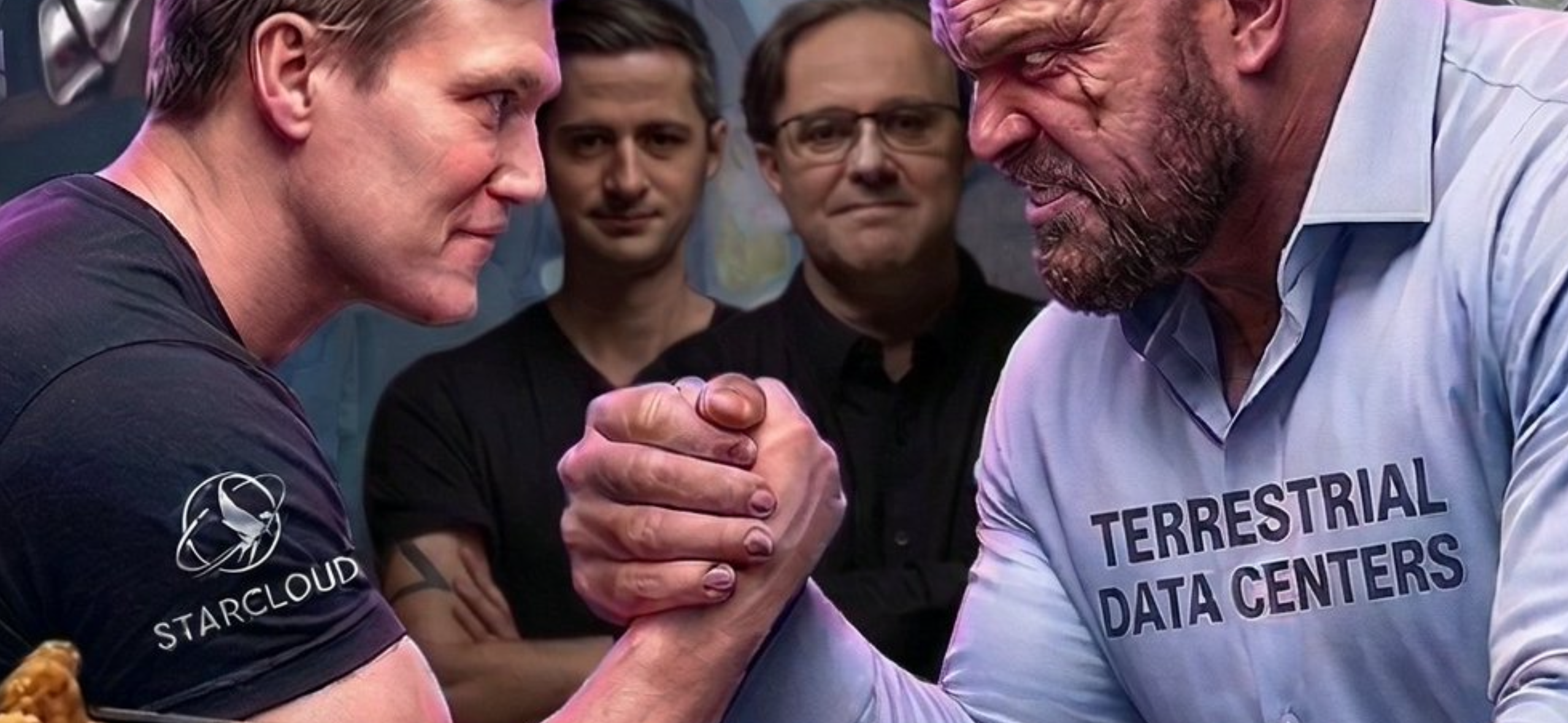
La Licorne Starcloud contre les Centres de Données Terrestres. The Starcloud Unicorn versus Terrestial Data Centers. The third March 31, 2026 Starcloud work is a close crop of the Magic City arm wrestle. Its source remains Dr. Alex Wissner-Gross’s Innermost Lo
Read the narration
La Licorne Starcloud contre les Centres de Données Terrestres.
The Starcloud Unicorn versus Terrestial Data Centers.
The third March 31, 2026 Starcloud work is a close crop of the Magic City arm wrestle. Its source remains Dr. Alex Wissner-Gross’s Innermost Loop account of Starcloud’s 170-million-dollar funding round, 1.1-billion-dollar valuation, successful model work in orbit, and plan to fly Starcloud-3 with advanced NVIDIA hardware. But where the wider tableau surrounded the contest with dancers, money, food, a chrome unicorn, and a glowing Earth, this image removes nearly everything except faces, fabric, forearms, and the locked hands between two infrastructure systems.
Philip Johnston occupies the left. His black shirt bears Starcloud’s orbital emblem across the chest and shoulder. The recovered creation history treated his unusual height and muscular build as essential visual evidence, not incidental biography. In the final image, that physique becomes the company’s compressed thesis: a relatively young challenger appears smaller than the terrestrial incumbent but capable of holding the line through leverage, focus, and a different geometry of power.
The opponent at right is larger, red-faced, and visibly straining. “TERRESTRIAL DATA CENTERS” is printed across his pale shirt in block letters. The label is intentionally categorical. He is not one named company or facility; he personifies the whole inherited arrangement of land, substations, cooling, water, permitting, and grid access. His greater mass communicates the installed base. His grimace communicates the pressure that artificial-intelligence demand is placing on it.
Their hands dominate the center. Enlarged by the crop, fingers and knuckles become a mechanical coupling between two possible locations for computation. Arm wrestling is an unusually apt metaphor because the opponents do not strike from a distance. They share one table, one grip, and one boundary. Orbital and terrestrial systems remain connected through capital, launch, networking, chip supply, and demand even while they compete. Each side’s force is meaningful only through resistance from the other.
Behind the clasp stand Adi Oltean and Ezra Feilden. The wider work positions them as members of the technical team behind Starcloud’s orbital model experiments and next spacecraft. Here, their faces are isolated on the center line, like judges or engineers watching a stress test. Their presence prevents the portrait from becoming founder mythology alone. Johnston supplies the branded body, but the work of placing and operating computation in orbit belongs to a team.
A fragment of the chrome unicorn survives at the upper-left edge, while a sliver of Lemon Pepper Lou wings presses against the bottom. These remnants are important. The close-up could otherwise resemble a conventional corporate rivalry or sports photograph. The unicorn preserves the billion-dollar valuation joke; the food preserves Magic City and Atlanta. The cropped image remains tethered to the larger cultural world from which it was cut.
The difference between this work and the preceding tableau is therefore not merely scale. The wide version explained the contest through abundance. The close-up tests whether the contest remains legible after the surrounding evidence is removed. It does. Logos, labels, likeness, strain, and the central grip carry the argument on their own. The image becomes almost heraldic: one shirt displays a compact orbital mark; the other must spell out an entire legacy category.
That contrast also clarifies the rhetoric of infrastructure. Starcloud can present itself as a singular, elegant escape from terrestrial bottlenecks. Ground-based data centers are necessarily plural and cumbersome because they include many owners, locations, grids, regulators, and physical dependencies. The artwork uses the asymmetry but does not mistake elegance for proof. A logo can be compact even when the system behind it still requires launches, solar arrays, thermal control, radiation tolerance, communications, and replacement hardware.
The title retains the website’s spelling of “Terrestial,” preserving the work as a dated artifact rather than silently normalizing its record. More importantly, the word “versus” names the image as a proposition, not a result. Neither arm has touched the table. The viewer sees effort rather than victory.
As art criticism, The Starcloud Unicorn versus Terrestial Data Centers functions like a detail cut from a larger history painting and elevated into its own work. Cropping converts atmosphere into pressure. The club disappears, yet the embodied economic conflict becomes more intense. Faces reveal confidence and strain; fabric carries corporate categories; skin replaces an engineering chart. The picture records a moment when orbital compute could credibly put its hand on the table, while refusing to declare that the contest had already been won.
Opening the gallery…