70 Clock Galerie / The Innermost Loop Feed Reply Tableaux
Intérieur de la Licorne Starcloud à Magic City : Bras de Fer pour les Ailes Lemon Pepper Lou
Starcloud Unicorn Interior of Magic City Arm Wrestling for Lemon Pepper Lou Wings
March 31, 2026
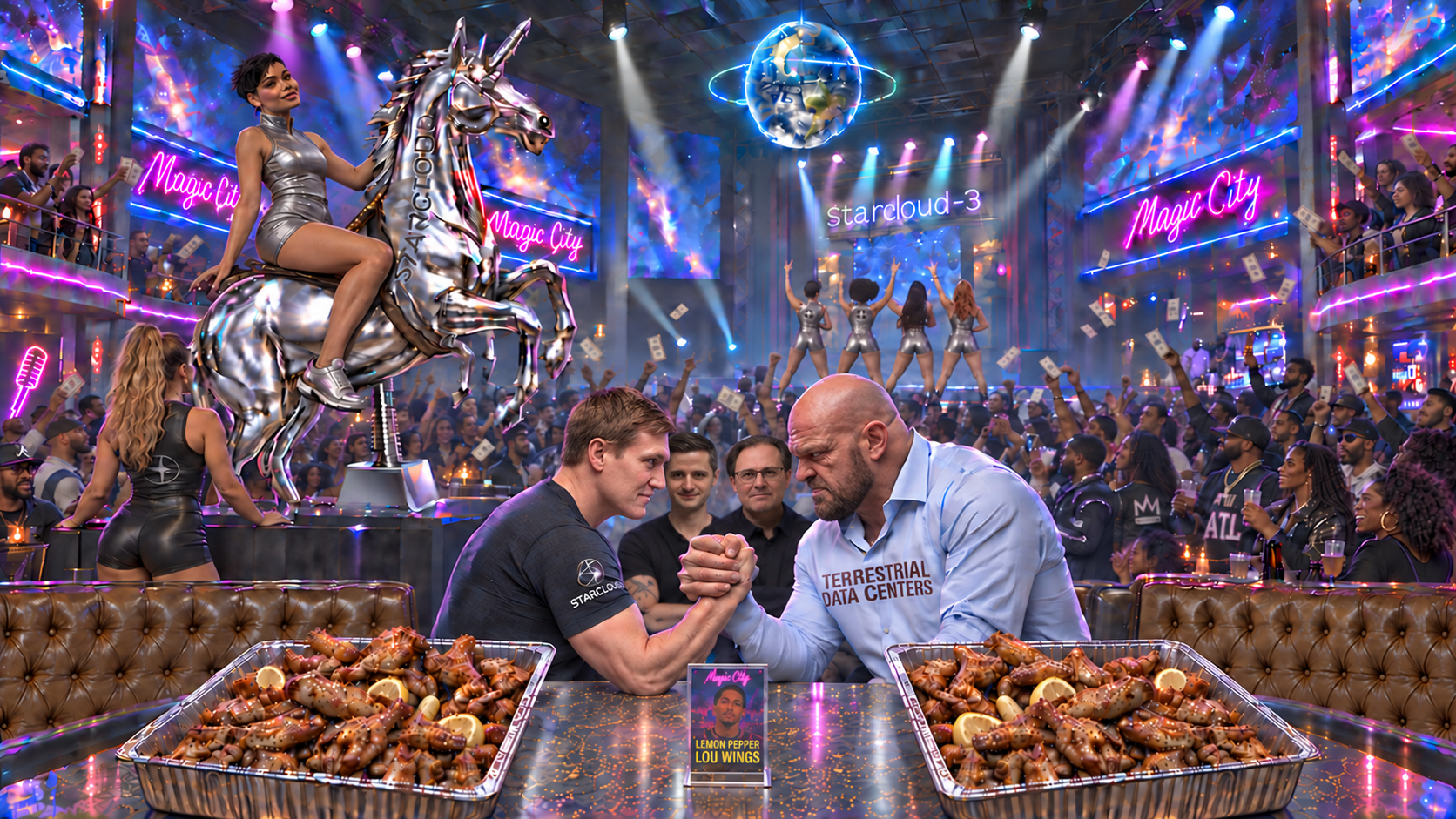
Intérieur de la Licorne Starcloud à Magic City : Bras de Fer pour les Ailes Lemon Pepper Lou. Starcloud Unicorn Interior of Magic City Arm Wrestling for Lemon Pepper Lou Wings. This second March 31, 2026 Starcloud work moves inside Magic City and narrows Dr. A
Read the narration
Intérieur de la Licorne Starcloud à Magic City : Bras de Fer pour les Ailes Lemon Pepper Lou.
Starcloud Unicorn Interior of Magic City Arm Wrestling for Lemon Pepper Lou Wings.
This second March 31, 2026 Starcloud work moves inside Magic City and narrows Dr. Alex Wissner-Gross’s Innermost Loop dispatch to an infrastructure contest. Starcloud’s 170-million-dollar raise and 1.1-billion-dollar valuation had made orbital compute financially visible. Its larger thesis was that abundant orbital solar energy and off-world placement could relieve the power, cooling, land, and permitting constraints confronting terrestrial data centers. The image converts that technical and capital-intensive argument into arm wrestling over a plate of Atlanta wings.
Philip Johnston, Starcloud’s cofounder and chief executive, sits at the left of the table in a fitted black Starcloud shirt. The recovered creation discussion repeatedly insisted on his likeness, height, muscular build, and visible arms. That specificity turns the founder’s body into part of the corporate argument. Starcloud does not arrive as an abstract logo or satellite diagram; it enters through Johnston’s forearm and leverage.
Across from him is a much larger opponent wearing “TERRESTRIAL DATA CENTERS” across his pale shirt. The man’s scale represents installed capacity, institutional weight, and the inherited advantages of ground infrastructure. Yet his face strains harder than Johnston’s. Their clasped hands are perfectly centered, making the image a diagram of competing constraints. The incumbent possesses mass. The challenger claims a better angle on energy and location.
Adi Oltean and Ezra Feilden stand behind the joined hands like cornermen. Their placement reconnects the spectacle to the team that ran an artificial-intelligence model in orbit and developed the next Starcloud mission. The figures do not simply cheer. They occupy the visual hinge between founder and opponent, reminding the viewer that the orbital thesis depends on engineering, deployment, and model operations rather than muscular metaphor alone.
The club’s rear wall is labeled Starcloud-3 beneath a glowing Earth. The planned mission, associated with an October 2026 flight and NVIDIA Blackwell-class hardware, becomes a stage set waiting behind the present contest. Earth’s illuminated ring sits directly above the match, turning the atmosphere into the boundary Starcloud wants to clear. The moonlike floor, galactic openings, and spacecraft-scale décor make Magic City feel temporarily annexed by an orbital showroom.
At left, a dancer rides a spring-mounted chrome unicorn branded STARCLOUD. The mechanical animal is part trophy, part amusement, and part startup icon. Its coiled base makes the company’s valuation literally bounce. Banknotes float through the room while spectators watch from the shadows. Capital appears not as a term sheet but as weather inside a venue already expert at converting attention into cash.
The prize anchors everything in Atlanta appetite. Foil trays overflow with sauced and fried wings. A handwritten sign promises “lemon pepper Lou wings,” and bottles of Lou’s ketchup crowd the lower edge. The work’s title preserves the comic specificity of Lemon Pepper Lou rather than allowing the match to drift into generic sports imagery. A billion-dollar dispute over the future location of compute is judged beside food meant to be eaten with the same hands now locked in combat.
This collapse of scale is the image’s critical method. Orbital solar arrays, launch costs, thermal management, terrestrial grids, venture financing, and data-center expansion are too abstract to occupy one human glance. Arm wrestling gives them gesture; wings give them stakes; a club gives them an audience. The solution is deliberately undignified. It refuses the clean visual language through which infrastructure companies usually present themselves and instead subjects the thesis to local ritual, sweat, spectacle, and appetite.
The composition also makes a subtle point about embodiment. Starcloud promises computation liberated from earthly constraints, yet its case is argued by bodies: Johnston’s arm, the opponent’s weight, dancers, spectators, and food. Even the unicorn requires a spring and rider. The orbital future is not disembodied. It depends on rockets, chips, solar surfaces, cooling systems, founders, engineers, and the cultural narratives through which investors decide what strength looks like.
As contemporary history painting, Starcloud Unicorn Interior of Magic City records a company at the instant it became mythic enough to be personified. It does not settle whether space or Earth wins. The hands remain upright and the match remains unresolved. That suspended center is the argument: orbital compute has forced itself onto the same table as terrestrial infrastructure, but valuation, charisma, and spectacle are not yet victory. For now, both systems strain under neon while the wings wait.
Opening the gallery…