70 Clock Galerie / The Innermost Loop Feed Reply Tableaux
Licorne Starcloud à l'Extérieur de Magic City Atlanta
Starcloud Unicorn at Magic City Atlanta Exterior
March 31, 2026
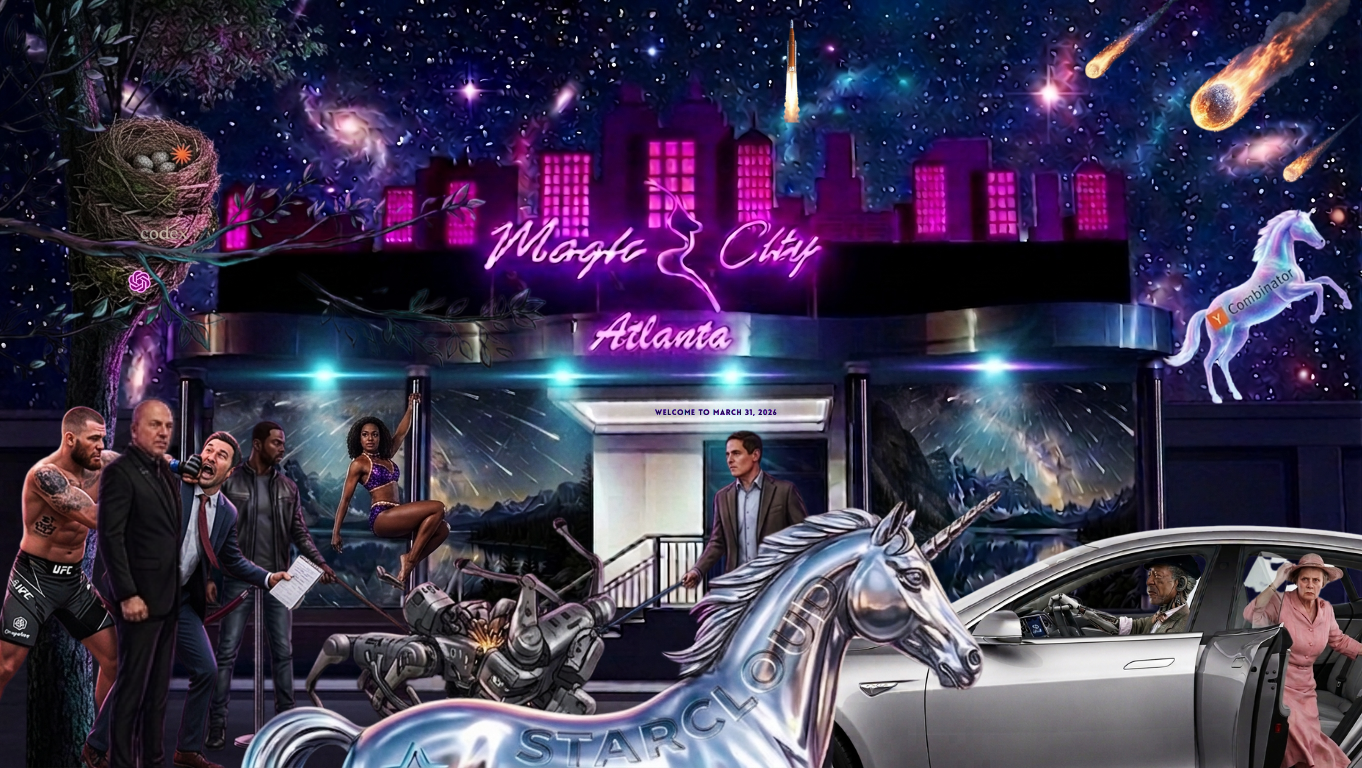
Licorne Starcloud à l'Extérieur de Magic City Atlanta. Starcloud Unicorn at Magic City Atlanta Exterior. On March 31, 2026, @siouid142 responded to Dr. Alex Wissner-Gross’s Innermost Loop report on Starcloud’s orbital-compute ambitions by staging the company’s
Read the narration
Licorne Starcloud à l'Extérieur de Magic City Atlanta.
Starcloud Unicorn at Magic City Atlanta Exterior.
On March 31, 2026, @siouid142 responded to Dr. Alex Wissner-Gross’s Innermost Loop report on Starcloud’s orbital-compute ambitions by staging the company’s new unicorn status outside Magic City in Atlanta. Starcloud had raised roughly 170 million dollars at a valuation of 1.1 billion dollars only seventeen months after Y Combinator Demo Day. The same dispatch brought together robotic patrols, autonomous vehicles, wearable sensing, nested coding systems, the return of human lunar flight, and an unusual concentration of fireballs. The work gives that abundance one curb.
The chrome unicorn in the foreground is both valuation joke and corporate body. STARCLOUD is stamped across its flank in lettering large enough to behave like an automotive badge. Its polished surface reflects the pink and blue club lights while its horn points toward the meteors overhead. The creature is not just the familiar venture-capital label for a billion-dollar startup. It materializes a company whose proposition already sounds mythical: put data-center hardware into orbit, use abundant solar energy, and shift the geography of compute away from terrestrial grids.
A second white unicorn floats at upper right with the Y Combinator emblem across its body. The duplication connects financial status to the accelerator lineage that helped produce it. Meanwhile, a bird’s nest at upper left contains Codex and OpenAI symbols. The nest makes “nested” coding literal and turns the software stack into eggs or fledglings waiting above the street. These small jokes establish a sky in which companies, tools, and celestial events belong to the same ecosystem.
The lower-right scene rewrites Driving Miss Daisy. An elderly woman in a pink dress steps from a silver Tesla while an elderly man remains at the wheel and a segmented humanoid form occupies the vehicle’s operating space. The dispatch’s story about very old users regaining mobility through full self-driving is translated through Atlanta’s best-known cinematic relationship between passenger, driver, dependence, and dignity. The question is intentionally unresolved: is the Tesla driving itself, is the robot the chauffeur, or has autonomy simply acquired another body through which to perform Hoke’s work?
Robotic dogs gather near the entrance. Michael Vick and Mark Cuban handle the mechanical animals, connecting Atlanta celebrity and business culture to reports of robots patrolling the city. The reference is deliberately uncomfortable in Vick’s case: the history attached to his public image collides with a new class of dogs that can be owned, trained, deployed, and damaged without being biological. Cuban introduces a different register of spectacle, investment, and technology. Together they make the robotic patrol story culturally local rather than generic.
At left, Dana White and a shirtless fighter restrain or crowd a suited media figure outside the club. The gesture carries the dispatch’s abrasive “shut up and watch the fights” energy into a scene already organized by competition. It also mirrors the infrastructure struggle embedded in Starcloud’s business model: terrestrial and orbital systems are not politely exchanging white papers; they are fighting for capital, power, cooling, and legitimacy. The club exterior behaves like the threshold where those conflicts become entertainment.
Magic City is not an interchangeable nightlife backdrop. Its neon script, Atlanta identity, performers, money, sports personalities, and curbside choreography provide a “sophisticated hustle” through which the valuation can be understood. A billion-dollar space-compute company lands not at a pristine launch complex but at a place famous for converting display, attention, and money into local mythology. That relocation prevents the work from treating infrastructure as culturally neutral.
The meteors and galactic sky heighten the unreality, yet they also preserve the day’s reports of frequent fireballs and renewed lunar ambition. Earthly events are framed by streaks of material entering the atmosphere while Starcloud proposes moving computation out of it. The entire façade becomes a boundary surface: club and cosmos, road and orbit, passenger and machine, animal and robot, startup and unicorn meet at the door.
As contemporary history painting, Starcloud Unicorn at Magic City Atlanta Exterior works through collision rather than explanation by caption. The chrome animal dominates because valuation is the visible headline, but the surrounding figures show what that headline depends on: mobility, security, venture culture, software nesting, public spectacle, and a specific city’s iconography. The work does not predict that orbital data centers will triumph. It records the instant when the thesis became culturally large enough to require a creature, a skyline, a film, and a nightclub to hold it.
Opening the gallery…