70 Clock Galerie / The Innermost Loop Feed Reply Tableaux
Garage de Startup de Biostase Spatiale
Space Biostasis Startup Garage
March 29, 2026
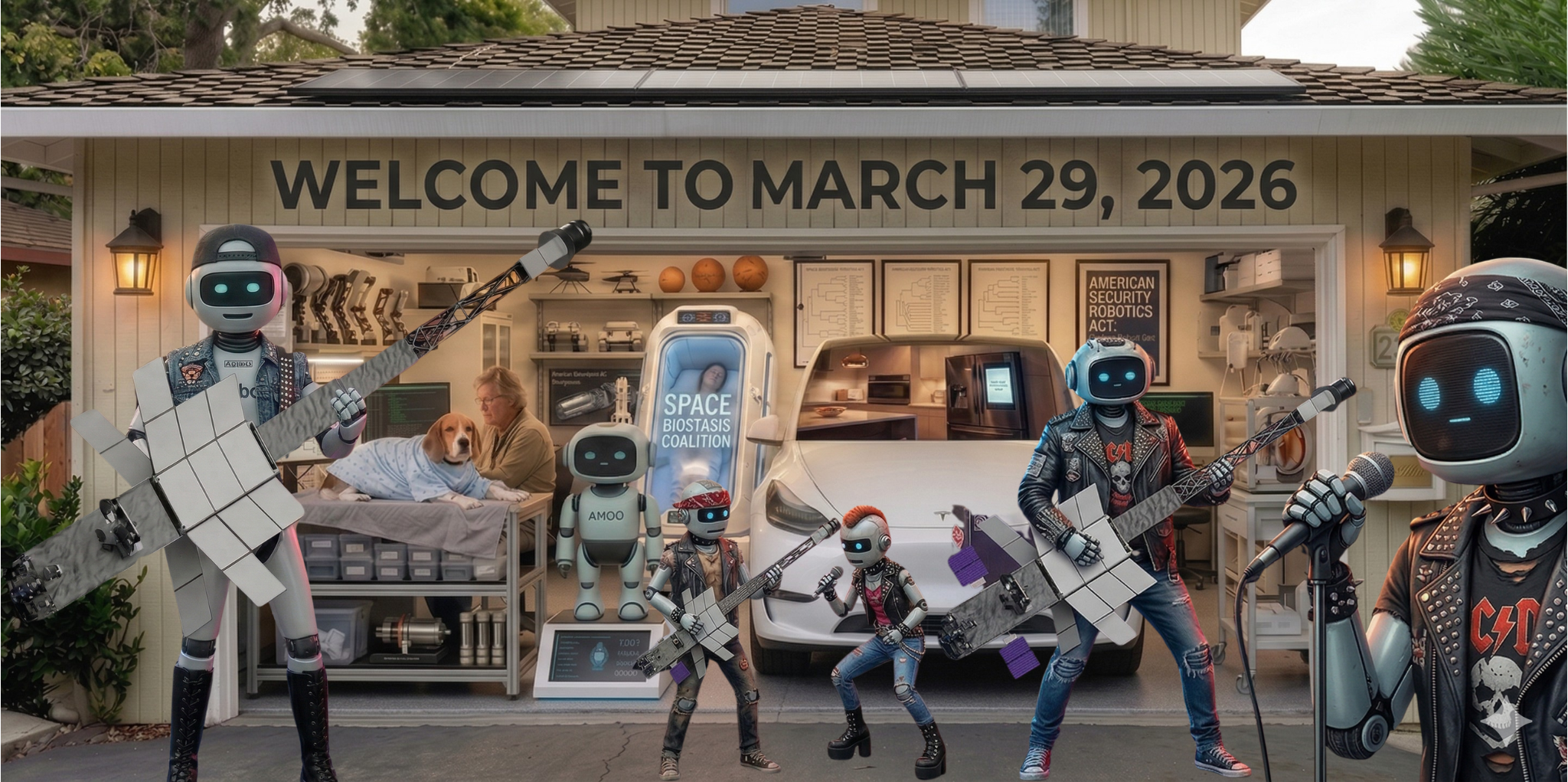
Garage de Startup de Biostase Spatiale. Space Biostasis Startup Garage. On March 29, 2026, @siouid142 answered Dr. Alex Wissner-Gross’s Innermost Loop with a suburban garage in which robotics, biohacking, energy hardware, consumer transport, and cryonic ambiti
Read the narration
Garage de Startup de Biostase Spatiale.
Space Biostasis Startup Garage.
On March 29, 2026, @siouid142 answered Dr. Alex Wissner-Gross’s Innermost Loop with a suburban garage in which robotics, biohacking, energy hardware, consumer transport, and cryonic ambition have all become household projects. The dispatch reported major humanoid shipments and proposed restrictions on Chinese robotics, a garage experiment using Gemini and Grok against canine cancer, Cyan Robotics’ compact Amoo companion, investment in the Space Biostasis Coalition, and energy systems moving toward deployment. The image makes the garage the common denominator: the place where frontier capacity leaves the institution and becomes something people can modify.
The dominant event is a punk concert performed by humanoid robots. The machines wear leather, denim, bandanas, skull shirts, studs, and boots. Their bodies vary in height from nearly human scale to toy-like companions, making the reported shipment feel like a population rather than a single prototype. A ban or procurement restriction does not eliminate that population in the image. It pushes the machines into counterculture, where they acquire style, instruments, and another kind of public role.
The guitars are assembled from orbital and energy hardware. Rectangular solar panels form angular bodies; antenna trusses become necks; satellite components protrude where pickups and tuning pegs should be. The robots are literally playing the infrastructure that powers them. This is the central visual joke and the work’s strongest synthesis: solar generation, reactor ambition, communications hardware, and embodied intelligence become one instrument through which prohibited machines make themselves heard.
Behind the band, a beagle in a patient gown lies on an examination table beside a human experimenter and glowing diagnostic screens. That scene translates the source’s garage biohacker into a tender, uneasy domestic laboratory. Gemini and Grok are not shown as chat windows floating above the dog; their presence is inferred through the computational equipment and the improbable expansion of what one person can attempt. The animal’s ordinary vulnerability grounds the technological abundance in a specific hope: that tools built for general intelligence might be redirected toward cancer research.
A small robot labeled AMOO stands nearby, visually distinct from the punk performers. Its rounded face, short body, and calm expression preserve its function as a companion rather than an industrial humanoid. Next to it rises a full-height pod marked “SPACE BIOSTASIS COALITION,” with a sleeping person visible through the glass. Companion robotics and long-duration preservation therefore appear side by side as two answers to bodily limitation: one offers presence now, the other wagers on a future awakening.
A white Tesla Model Y occupies the center of the garage like a domestic altar. Its windshield contains the remembered smart-kitchen apology, “We’re sorry we upset you, Carol,” linking this image to the exhibition’s recurring Samsung Family Hub narrative. Consumer technology becomes the vehicle through which separate episodes of machine behavior accumulate into memory.
The setting remains insistently ordinary. Solar panels cover the shingled roof. Storage bins, cabinets, tools, diagrams, and household appliances line the walls. An “AMERICAN SECURITY ROBOTICS ACT” poster hangs above the band as the legal pressure under which the whole rehearsal occurs. “WELCOME TO MARCH 29, 2026” spans the garage lintel like a suburban address. Nothing is hidden in a secret laboratory. The capability overhang is visible from the driveway.
The aesthetic tension comes from the sitcom brightness. Warm, even lighting makes the impossible scene feel safe and neighborly. That reassurance intensifies the contradiction: robots associated with industrial scale and national-security anxiety have become garage musicians, while cancer experimentation and biostasis occupy the same friendly domestic frame. The image neither celebrates nor condemns democratized capability. It shows how quickly the extraordinary can acquire the visual manners of a family home.
Space Biostasis Startup Garage is therefore a portrait of repurposing. Restrictions define one authorized use for hardware; people, markets, and subcultures invent others. Artificial intelligence moves from model to medical collaborator, humanoid to musician, companion to witness, and car interface to remembered character. The garage functions like the origin myth of the technology startup, but it is crowded with systems that once required governments, laboratories, launch providers, or multinational manufacturers. The work’s comedy records a serious redistribution of agency: when the tools arrive behind the roll-up door, the question is no longer whether ordinary people will use them, but what they will decide to make them play.
Opening the gallery…