70 Clock Galerie / The Innermost Loop Feed Reply Tableaux
Réunion sur la Tarification de la Surveillance et le Plasma de Pulsar : Macx, Bob Franklin et Annette
Surveillance Pricing and Pulsar Plasma Meeting: Macx, Bob Franklin, and Annette
March 28, 2026
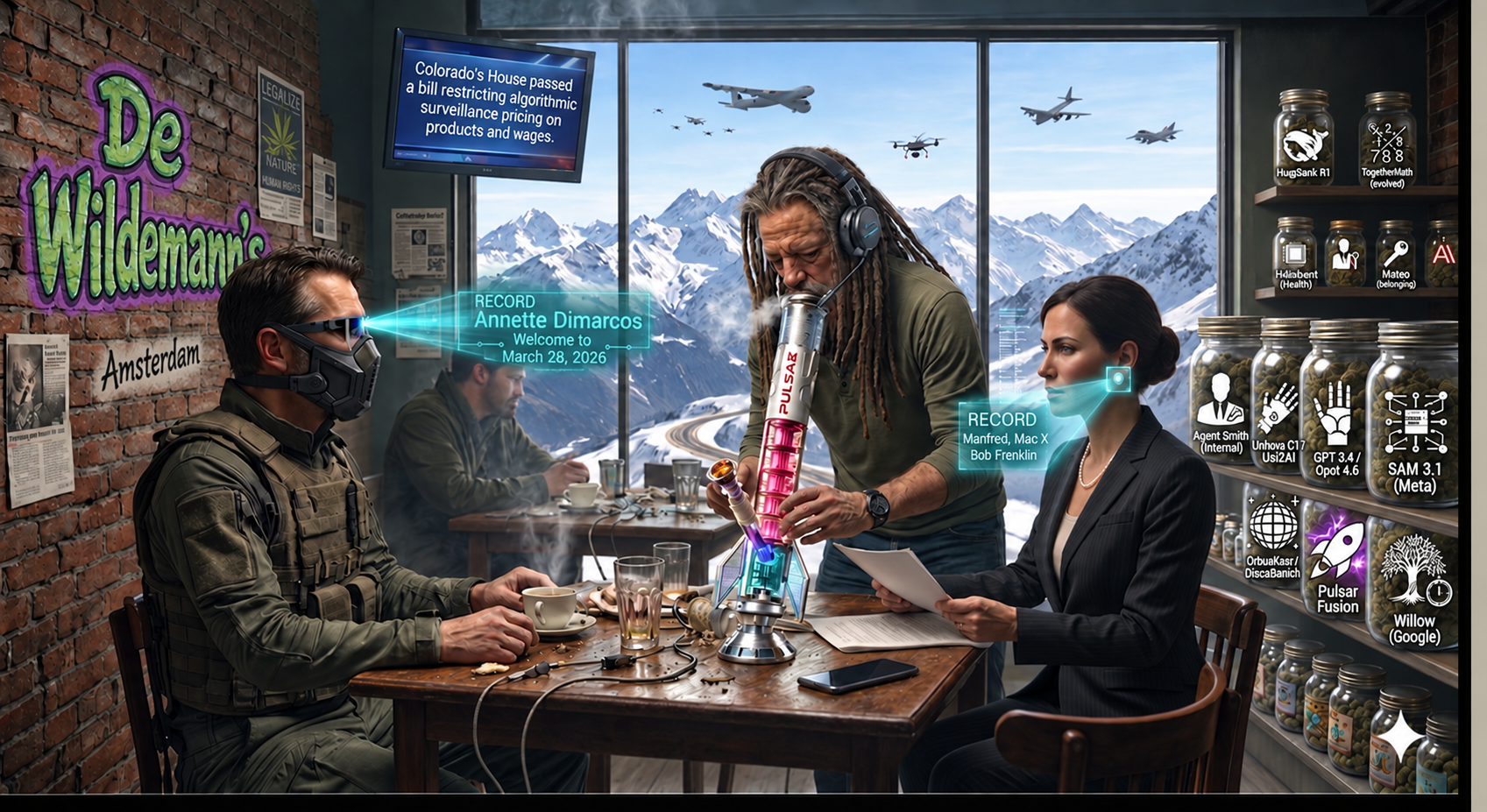
Réunion sur la Tarification de la Surveillance et le Plasma de Pulsar : Macx, Bob Franklin et Annette. Surveillance Pricing and Pulsar Plasma Meeting: Macx, Bob Franklin, and Annette. On March 28, 2026, @siouid142 responded to Dr. Alex Wissner-Gross’s Innermos
Read the narration
Réunion sur la Tarification de la Surveillance et le Plasma de Pulsar : Macx, Bob Franklin et Annette.
Surveillance Pricing and Pulsar Plasma Meeting: Macx, Bob Franklin, and Annette.
On March 28, 2026, @siouid142 responded to Dr. Alex Wissner-Gross’s Innermost Loop by turning a dense inventory of surveillance law, model compression, quantum risk, drones, and fusion into a single meeting. Colorado’s House had passed a bill restricting algorithmic surveillance pricing on products and wages. Elsewhere in the same dispatch, DeepSeek-R1, TurboQuant, Agent Smith, Mythos, GPT and Claude-class systems, Meta’s SAM, Pulsar Fusion, and Google’s Willow crowded the frontier. The image asks how such capabilities might be inspected, priced, consumed, and negotiated once they enter the same market.
The meeting takes place at “the little bud,” a countercultural storefront whose graffiti adds “Amsterdam” below the name even though the broad window opens onto the Rocky Mountains. That geographic contradiction is purposeful. Amsterdam supplies the café-and-dispensary mythology; Colorado supplies the immediate surveillance-pricing law and mountain setting. The hybrid location becomes a frontier exchange where software systems appear as named strains and experimental compounds rather than invisible cloud services.
Charles Stross’s Accelerando provides the participants. Manfred Macx, Bob Franklin, and Annette are figures suited to a world in which reputation, uploaded intelligence, and new forms of property are already destabilizing ordinary economics. The image does not present them as nostalgic literary cameos. It recruits them as experienced negotiators for the emerging market. A holographic record on the table names Manfred, Macx, and Bob Franklin, while the severe woman at right reads from a document as though formal institutions are trying to inventory a reality that has already outgrown their categories.
At left, a tactical figure wears advanced viewing equipment and projects “Welcome to March 28, 2026” in green light. The mask and scanning beam give surveillance a body before the television explains the policy issue in plain language: Colorado’s House passed a bill restricting algorithmic surveillance pricing on products and wages. The pairing is crucial. The law appears on a screen, but the sensor is already operating inside the room. Regulation describes the market while perception technologies help constitute it.
The central character handles a tall tube marked TURBO. Its glowing pink interior turns quantization and model compression into an inhaled or processed substance. TurboQuant’s promise of making large models smaller and faster is given the ritual of a dispensary demonstration: open the vessel, inspect the contents, test the effect. The awkwardly literal transformation clarifies the technical point. Compression changes how much intelligence can be carried, where it can run, and who can afford access to it.
The shelves at right are the work’s taxonomy. Glass jars carry emblems for DeepSeek R1, TurboQuant, Agent Smith, Mythos, GPT and Opus-class systems, SAM 3.1, Pulsar Fusion, and Willow. A purple rocket identifies fusion; a white tree and clock identify Willow’s quantum implications and the deadline for quantum-resistant encryption. Other icons suggest recruitment, coding, agents, and vision. Contained in identical vessels, radically different technologies become comparable stock.
Outside, military aircraft and a drone swarm cross the mountain sky. The view prevents the meeting from becoming a cozy salon. The café table is sticky with paperwork, devices, cups, and fragments, while the external landscape is organized by fleets. Domestic commerce and geopolitical force share the same visual horizon.
The composition is built on containment: law contains pricing behavior, jars contain systems, a window contains the mountain war theater, masks contain identity, and a record attempts to contain the people at the table as data. Yet every container leaks meaning into the next. Willow belongs to cryptography and commerce; SAM belongs to vision and surveillance; fusion belongs to energy and aerospace; compression belongs to both efficiency and proliferation. The viewer can read the shelves, but cannot restore the old boundaries between their contents.
As contemporary history painting, Surveillance Pricing and Pulsar Plasma Meeting uses the dispensary as a model of the frontier marketplace. Its humor is analytic: intelligence is treated like a substance because technical capability increasingly arrives in portable, branded, dose-like units. Stross’s characters lend the scene a future history, while the television, labels, and dated projection preserve its documentary origin. The work’s deeper question is not simply what these technologies cost. It is who can observe the price, who is being observed while paying it, and what kind of economy emerges when surveillance itself becomes both product and method of sale.
Opening the gallery…