70 Clock Galerie / The Innermost Loop Feed Reply Tableaux
Le Transporteur Chipotle du Collisionneur de Hadrons - DoorDash de Khan
Hadron Collider Chipotle Transporter - DoorDash of Khan
March 25, 2026
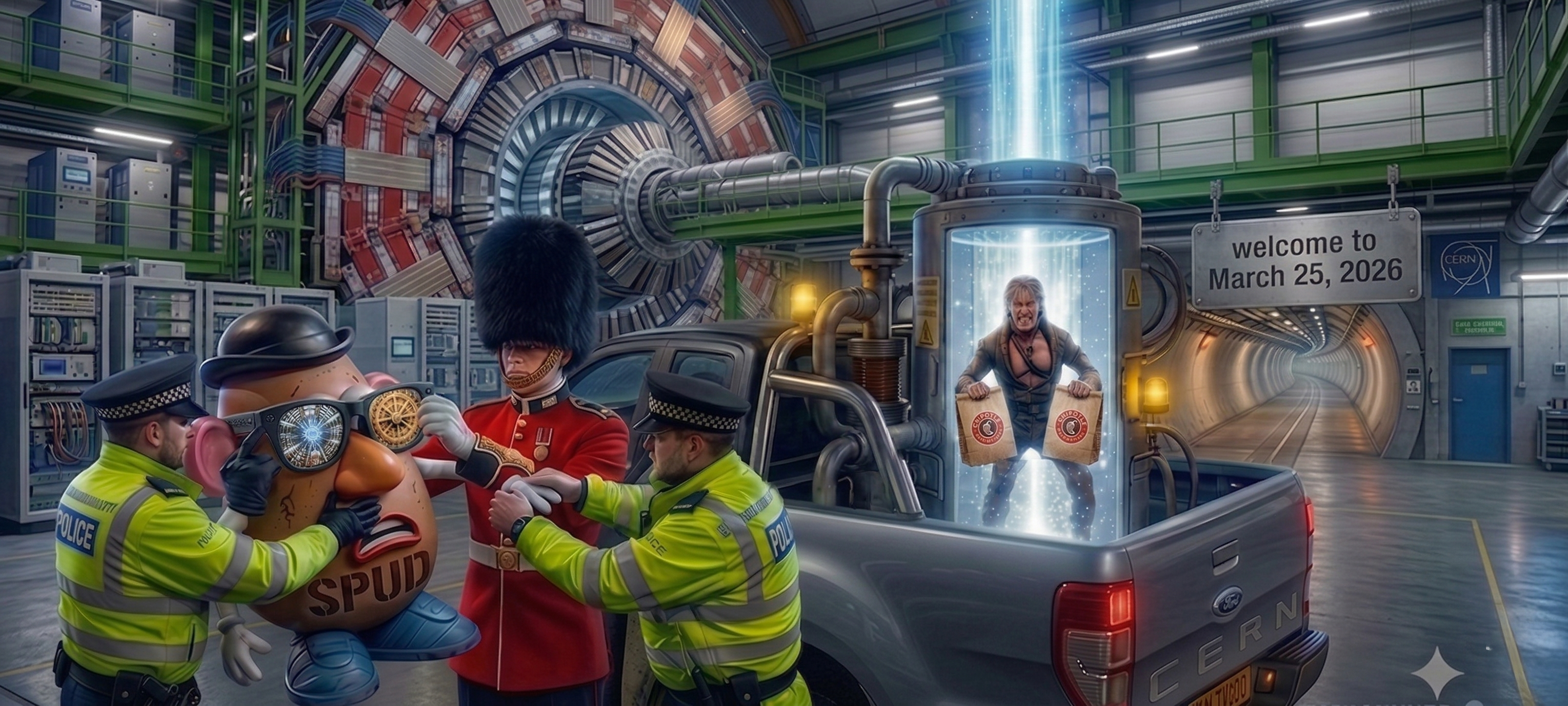
Le Transporteur Chipotle du Collisionneur de Hadrons - DoorDash de Khan. Hadron Collider Chipotle Transporter - DoorDash of Khan. On March 25, 2026, @siouid142 created this tableau from an Innermost Loop dispatch that placed CERN-scale physics beside rapid foo
Read the narration
Le Transporteur Chipotle du Collisionneur de Hadrons - DoorDash de Khan.
Hadron Collider Chipotle Transporter - DoorDash of Khan.
On March 25, 2026, @siouid142 created this tableau from an Innermost Loop dispatch that placed CERN-scale physics beside rapid food delivery, artificial-intelligence coding systems, Meta display glasses, the OpenAI figure nicknamed Spud, and restrictions on what deployed machines could be permitted to see or do. The response does not separate those reports into panels. It builds one apparatus in which vision is seized, a superhuman character is transported, and the most advanced machinery in the room delivers Chipotle.
The title is a chain of puns. The Large Hadron Collider becomes a Chipotle transporter. DoorDash becomes DoorDash of Khan, invoking Khan Noonien Singh and The Wrath of Khan. Scientific infrastructure, delivery logistics, and science-fiction teleportation are compressed into one absurd last-mile service. The joke is deliberately disproportionate: a machine associated with fundamental particles has been reassigned to move burrito bags across a few meters of loading bay.
The scene takes place inside a CERN-like facility. A vast circular detector fills the rear wall, while a long accelerator tunnel recedes at right beneath a CERN emblem and a sign dating the work March 25, 2026. Green gantries, pipes, control cabinets, and hard industrial lighting keep the fantasy anchored to physical apparatus. This is not a magical portal hovering in space. It is a delivery system embedded in one of the most infrastructure-intensive scientific environments imaginable.
At left, British police and a ceremonial guardsman restrain Spud, a high-tech figure modeled on Mr. Potato Head. SPUD is printed across his body. The officers are not arresting him for movement or speech; they are pulling the display glasses from his face. The recovered design process made that deprivation the central action. Governance appears as control over machine perception—what sensors may access, what patterns they may connect, and which visual substrates are allowed in a deployed system.
The lenses carry their own forensic argument. One presents the radial machinery of the Large Hadron Collider; the other mirrors it with the circular geometry of a carving associated in the creation discussion with India’s Ranakpur Temple. Modern detector and ancient stone pattern are made visually symmetrical. The image does not claim that the temple secretly contained a collider. It shows why pattern-recognizing systems can produce provocative correspondences and why institutions may fear the interpretations that unrestricted machine vision generates.
Behind the police, a pickup truck marked CERN carries a cylindrical transporter. Inside the blue beam stands a Khan-like superintelligent figure in an open tactical garment, gripping two Chipotle bags. He is not peacefully materializing as a laboratory specimen. His aggressive posture converts delivery into arrival, and the bags turn a familiar consumer order into evidence that the transporter has worked. The courier is simultaneously product, threat, and employee.
This is where the title’s “DoorDash” pun becomes analytical. Last-mile platforms make extraordinary logistical complexity disappear behind a simple order. The artwork exaggerates that tendency until particle physics, genetic superintelligence, teleportation, and a pickup truck become invisible infrastructure behind lunch. Technical civilization is measured not only by what it discovers but by how quickly discovery is domesticated into convenience.
The removal of Spud’s glasses and the arrival of Khan occur simultaneously. One artificial figure is denied perception while another is granted physical transport. That juxtaposition prevents the governance story from looking coherent. Control is selective, local, and theatrical: officers struggle over one device in the foreground while a much larger capability materializes behind them. Regulation grips the glasses; acceleration owns the truck.
As contemporary history painting, Hadron Collider Chipotle Transporter—DoorDash of Khan uses maximal absurdity to preserve the dispatch’s exact collisions. CERN provides scale and geometry; Spud makes machine restriction bodily; the glasses stage pattern recognition; the police embody interdiction; Khan supplies superhuman science fiction; and Chipotle turns the whole apparatus into service infrastructure. The result is funny because the technology is impossibly excessive for the task. It is unsettling because excess routinely becomes ordinary once a platform makes it convenient. The Singularity has not merely entered the collider. It has accepted the delivery order.
Opening the gallery…