70 Clock Galerie / The Innermost Loop Feed Reply Tableaux
Deux Palmiers
Two Palms
March 24, 2026
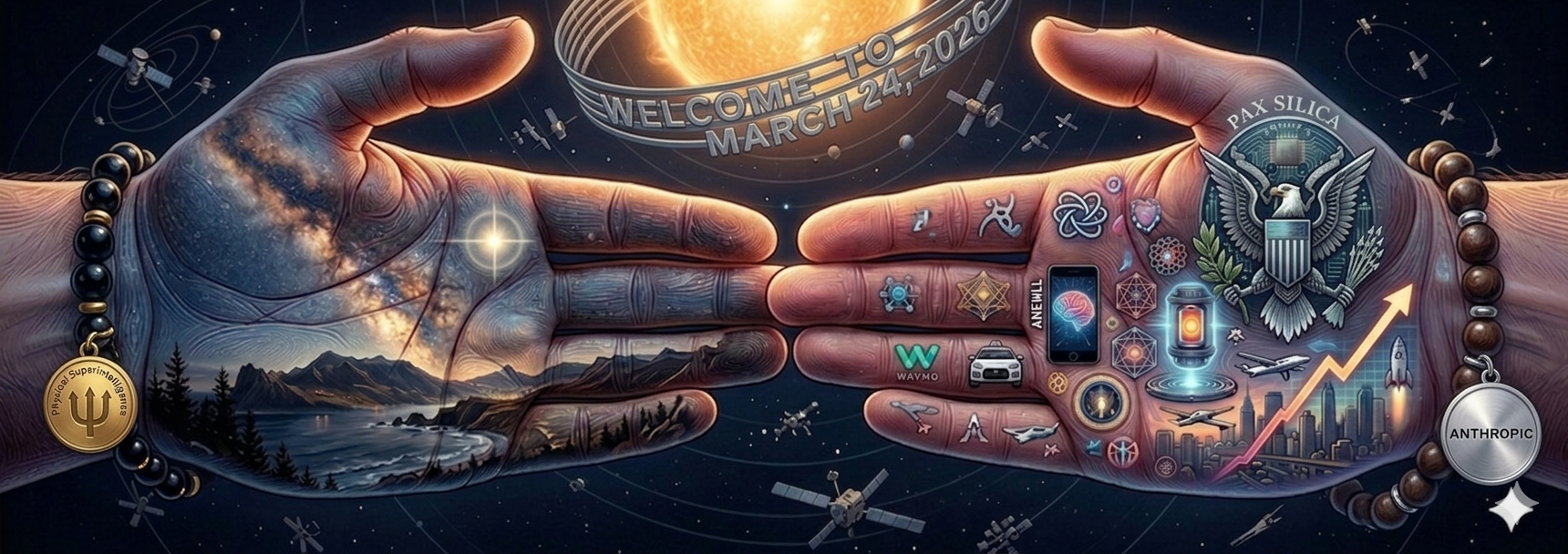
Deux Palmiers. Two Palms. On March 24, 2026, @siouid142 created Two Palms in response to a dense Innermost Loop dispatch that moved from Jensen Huang’s declarations about artificial general intelligence to Pax Silica, powerful models running locally on phones,
Read the narration
Deux Palmiers.
Two Palms.
On March 24, 2026, @siouid142 created Two Palms in response to a dense Innermost Loop dispatch that moved from Jensen Huang’s declarations about artificial general intelligence to Pax Silica, powerful models running locally on phones, humanoid robotics, autonomous vehicles, fusion energy, and unexplained astronomical transients recorded before the space age. Rather than build another crowded landscape, the response turns two open hands into maps on which the day’s signals can be read.
The title invokes palmistry. A palm reader does not manufacture the future; the reader interprets lines already present in the body and assigns them a narrative. The tableau applies that ritual to the Singularity. Each technological development becomes a crease, emblem, device, or celestial mark. The work does not claim that the future is predetermined. It asks why a collection of converging signals can begin to feel like destiny when compressed onto one pair of hands.
The palms face upward in a supplicated handshake, parallel and almost touching. They are offered rather than clenched, and they do not complete a conventional grip. This suspended contact matters. The image is about coordination among systems that may align but have not yet fused: industrial policy and private models, physical and computational intelligence, planetary infrastructure and astronomical mystery. The gap between the hands keeps the synthesis provisional.
The palm on the viewer’s left contains Dr. Wissner-Gross’s own star-filled coastal tableau. A Milky Way sweeps through the skin above mountains, ocean, and a bright celestial point. The hand turns an earlier image into a living palm print, making the Innermost Loop itself one of the lines through which the future is interpreted. At its wrist, a gold medallion names Physical Superintelligence, anchoring the cosmic scene to a company concerned with intelligence operating in the material world.
The palm on the viewer’s right carries the dispatch’s operational cluster. A Pax Silica eagle dominates the upper hand, combining national-industrial symbolism with circuitry. Below it appear a smartphone holding an illuminated model brain, a Waymo vehicle, geometric proof structures, recursive-agent knots, a glowing fusion vessel, aircraft, city infrastructure, and a sharply rising graph crowned by a rocket. The elements are woven into the flesh like tattoos or lines, not arranged as detached logos on a slide.
Specific callbacks preserve the source. The phone refers to large models moving onto local devices and to the shrinking distance between frontier capability and a person’s hand. The fusion glow carries the Helion energy thread. The vehicle and aircraft condense autonomous transport and delivery. The rising line evokes Unitree’s surge and the market excitement around humanoid robotics. Small celestial forms and orbiting bodies recall the Hamburg Observatory plates and the pre-Sputnik transients whose origin remains unresolved.
Above both palms, the sun is encircled by a musical-staff-like band spelling Welcome to March 24, 2026. The recovered revisions deliberately retained the staff appearance while replacing notes with letters. Time becomes an orbit around the largest energy source in the image. The date is no longer a caption beneath the scene; it is part of the cosmological mechanism the hands appear to hold.
The bracelets add a second frame of institutional identity. Physical Superintelligence appears on one wrist and Anthropic on the other. Beads suggest prayer, counting, memory, and repeated practice, while the medallions behave like corporate talismans. The hands are biological and intimate, but their wrists reveal the organizations through which the future is being built and interpreted. Palmistry has acquired sponsors.
The composition refuses to choose between mystical and technical ways of knowing. The icons on the right resemble a systems diagram, while the starry landscape on the left resembles visionary art. The open hands convert both into embodied evidence. This is why the work feels less like an infographic than a devotional object. It recognizes that frontier technology is discussed not only through measurements but also through prophecies, inevitability narratives, origin myths, and signs.
As contemporary history painting, Two Palms organizes a day of heterogeneous developments through one ancient interpretive gesture. It does not reduce AGI, fusion, local inference, robotics, industrial policy, and cosmic transients to a single technical causal chain. Instead, it shows how observers make a chain by reading them together. The image’s beauty comes from convergence; its critical tension comes from the fact that convergence is partly an act of narration. The lines may be real, but the future drawn through them remains a human reading of the hand.
Opening the gallery…