70 Clock Galerie / The Innermost Loop Feed Reply Tableaux
Les Fondateurs Mangent Omakase
The Founders Eat Omakase
March 23, 2026
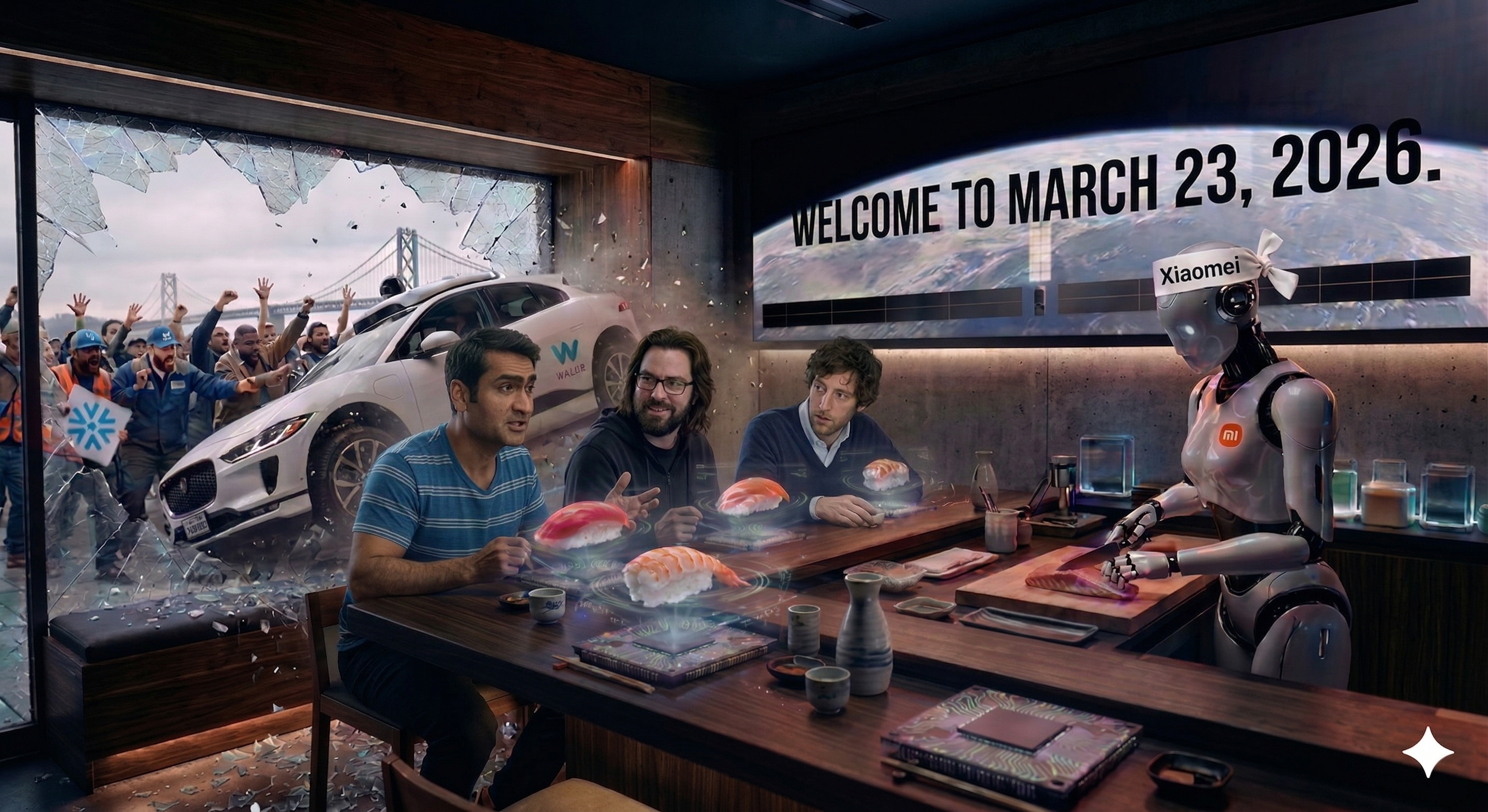
Les Fondateurs Mangent Omakase. The Founders Eat Omakase. On March 23, 2026, @siouid142 created this work from Dr. Alex Wissner-Gross’s Innermost Loop dispatch on robots entering shops and service environments, autonomous-vehicle conflict in San Francisco, sem
Read the narration
Les Fondateurs Mangent Omakase.
The Founders Eat Omakase.
On March 23, 2026, @siouid142 created this work from Dr. Alex Wissner-Gross’s Innermost Loop dispatch on robots entering shops and service environments, autonomous-vehicle conflict in San Francisco, semiconductor roadmaps, and automation continuing to operate while social resistance accumulates around it. The tableau compresses those pressures into a private omakase restaurant where the people associated with startup culture remain seated, the robot chef keeps slicing, and the labor dispute literally breaks through the window.
The diners are the familiar fictional founders and engineers from Silicon Valley. Dinesh, Gilfoyle, and their anxious founder companion sit at the counter in casual clothes, talking among themselves as if the chaos behind them were another problem occurring in a different layer of the stack. Their television identities matter. Silicon Valley turned venture-backed software culture into comedy; placing its characters inside a 2026 automation crisis lets the older satire become a witness to the world it anticipated.
Across the counter, a polished humanoid marked Xiaomei wears a folded sushi-chef headpiece and uses a knife with mechanical precision. The recovered revisions insisted that the company name appear on a chef’s garment rather than float as generic branding. That choice makes the machine part of the restaurant’s labor system. It is not a showroom robot posing near food. It has a station, uniform, tools, ingredients, and a task that continues from one cut to the next.
The sushi in front of the founders glows above computational substrates. Oversized chip-like place settings refer to TSMC’s advanced A16 process and NVIDIA’s next-generation Feynman hardware. Raw fish appears as holographic output from the chips, making omakase a model-serving pun: the diners receive whatever the chef selects, and the chef’s capacity rests on the compute presented as tableware. Elite cuisine and frontier inference become parallel systems of expensive, curated trust.
At the left, a Waymo vehicle crashes through shattered glass. Outside, a crowd carrying Snowflake-associated imagery surrounds and overturns the autonomous car. The recovered creation discussion linked that crowd to workers affected by layoffs. The image therefore does not treat resistance as abstract anti-technology sentiment. The vehicle’s physical intrusion connects job loss, corporate automation, and anger to the space in which founders consume the system’s benefits.
The diners do not flee. They remain absorbed in conversation and food, seemingly oblivious to the crowd and airborne glass. This indifference was an explicit revision choice. It makes the restaurant a protected interior—an elite room in which automation is smooth, personalized, and aesthetically refined—while the street outside bears the conflict over displacement and control. The broken window is the point where those two economies can no longer remain visually separate.
The title The Founders Eat Omakase is thus both literal and accusatory. Omakase means entrusting the selection to the chef. The founders have entrusted the service to a machine, but they have also helped create a society asked to accept whatever automation serves. Their meal arrives as luminous abundance; the workers outside experience the same technological order as exclusion. The artwork does not claim that the fictional characters caused a particular layoff. It uses their cultural identity to stage the asymmetry between designing systems and living under their deployment.
The restaurant’s dark wood, precise lighting, and sparse vessels create an atmosphere of controlled taste. Against that order, the broken window introduces diagonal motion, fragments, bodies, and the tilted Waymo. The image’s two halves speak different visual languages: minimalist luxury inside, documentary riot outside. Xiaomei bridges them by refusing to react. Its continued slicing embodies the operational logic of automation: execute the task despite instability in the human environment.
The autonomous car is simultaneously transport and projectile. Humor permits these incompatible objects to coexist, but it does not soften their conflict. The diners’ calm is funny until the viewer notices that calm is a privilege produced by the room.
The work ultimately asks who gets to experience automation as omakase. For the founders, the system is curated, surprising, and served at a polished counter. For displaced workers, it is something crashing through the boundary of ordinary life. For the robot chef, it is simply the next cut. That three-part division—consumer, protester, executor—makes the image more than a joke about Silicon Valley characters eating sushi. It is a portrait of deployment continuing exactly as designed while society argues, outside and then inside, about the bill.
Opening the gallery…