70 Clock Galerie / The Innermost Loop Feed Reply Tableaux
J’emmerde l’Inattendu - J’ai Fait Ce Que J’ai Projeté
Fuck the Unexpected- I Did What I Projected
March 22, 2026
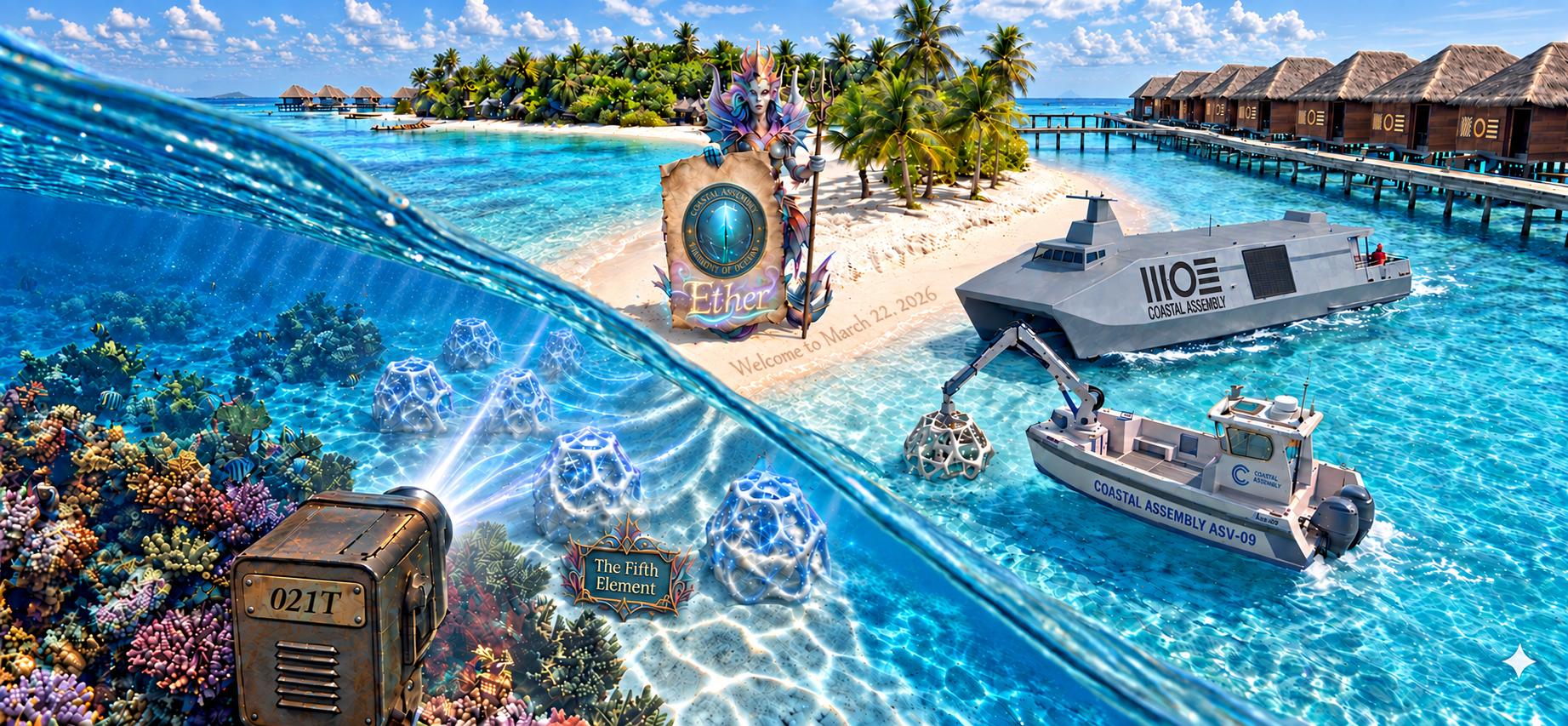
J’emmerde l’Inattendu - J’ai Fait Ce Que J’ai Projeté. Fuck the Unexpected- I Did What I Projected. Created on March 22, 2026, this second response by @siouid142 returns to Dr. Alex Wissner-Gross’s Coastal Assembly announcement from the previous day but change
Read the narration
J’emmerde l’Inattendu - J’ai Fait Ce Que J’ai Projeté.
Fuck the Unexpected- I Did What I Projected.
Created on March 22, 2026, this second response by @siouid142 returns to Dr. Alex Wissner-Gross’s Coastal Assembly announcement from the previous day but changes the governing metaphor. Coastal Assembly showed autonomous vessels and underwater structures as a visible engineering system. Fuck the Unexpected— I Did What I Projected moves backward to the layer that precedes deployment: projection, modeling, capital, and the decision to make an anticipated future physically real.
The title turns the language of forecasting into an act of defiance. “The unexpected” is normally what defeats a model. “I did what I projected” makes the projection causal rather than predictive. The phrase says that the future appeared not because a forecast happened to be correct, but because an institution used models, money, and machinery to build the result it had represented. Its profanity rejects passive surprise in favor of deliberate authorship.
A weathered projector marked 021T occupies the lower left foreground. It throws a broad white beam through the clear water and across the shoreline. The device makes the role of 021T Capital literal: financial backing becomes the light source through which a venture is conceived, communicated, and made investable. The projector is old-fashioned and boxy, while the coastal machinery it illuminates is autonomous. That temporal contrast reminds the viewer that even frontier infrastructure begins with an apparatus for showing other people what does not yet exist.
Inside the beam, Coastal Assembly’s porous underwater forms glow like translucent organisms. Currents draw sand around them, and a small label calls them “the fifth element.” The phrase shifts the structures from engineering components toward alchemy. Earth, water, air, and fire are joined by Aether—the classical medium imagined to carry light and bind the heavens. Here the fifth element is neither mystical substance nor merely computation. It is the combination of intelligence, capital, projection, and physical design that persuades the ocean to assemble land.
The sea queen on the new beach carries a parchment labeled AETHER. In the recovered revision history, she evolved from an Atlantean sovereign called Aethel into Aether, a goddess-like figure whose name sounds like the classical substrate. Her seal was conceived as a gift from the Queen of the Sea. The transformation is important because she personifies the passage from ownership to cosmology. The preceding image’s land deed established title; this work asks what medium allowed the titled land to appear.
The company’s autonomous craft remain at right. A large Coastal Assembly vessel and a smaller ASV lower a porous unit into the shallows. Resort bungalows carry the company emblem, tying the projection to a real use environment rather than allowing it to dissolve into fantasy. The machinery also prevents Aether from becoming a claim that thought alone creates matter. The projector supplies vision and backing, but vessels, structures, currents, sediment, and time still perform the work.
This is why the word projected carries three meanings. The 021T device optically projects an image. Coastal intelligence projects how shorelines and sediment will behave. Capital projects a future return and funds the system expected to produce it. The artwork makes those meanings coexist within one beam. Forecast, image, and investment become different surfaces of the same intervention.
The image also revises the politics of the earlier deed. In Coastal Assembly, the queen held a document that converted new shore into recognized property. Here, the parchment names Aether rather than a conventional land title, and the investor’s projector occupies the privileged foreground. Sovereignty has not disappeared; it has been reframed as the product of a representational system. Before land can be owned, its future must be modeled, narrated, financed, and shown.
What had looked like a self-contained world becomes an output generated from off-frame intentions. The archive thereby comments on itself: each daily tableau is also a projection that helps make a technological announcement culturally imaginable.
As art criticism, Fuck the Unexpected— I Did What I Projected is less a celebration of accurate forecasting than a portrait of performative futurism. Models do not merely describe coastlines; in combination with deployment systems, they alter them. Investors do not merely predict companies; their support helps create the conditions the prediction assumes. The sea remains powerful, material, and resistant, but it has entered a loop of representation and intervention. The work’s audacious title names that loop from the viewpoint of the projector: the future was not unexpected because the apparatus had already taught the world where to look.
Opening the gallery…