70 Clock Galerie / The Innermost Loop Feed Reply Tableaux
L’Assemblée Côtière
Coastal Assembly
March 21, 2026
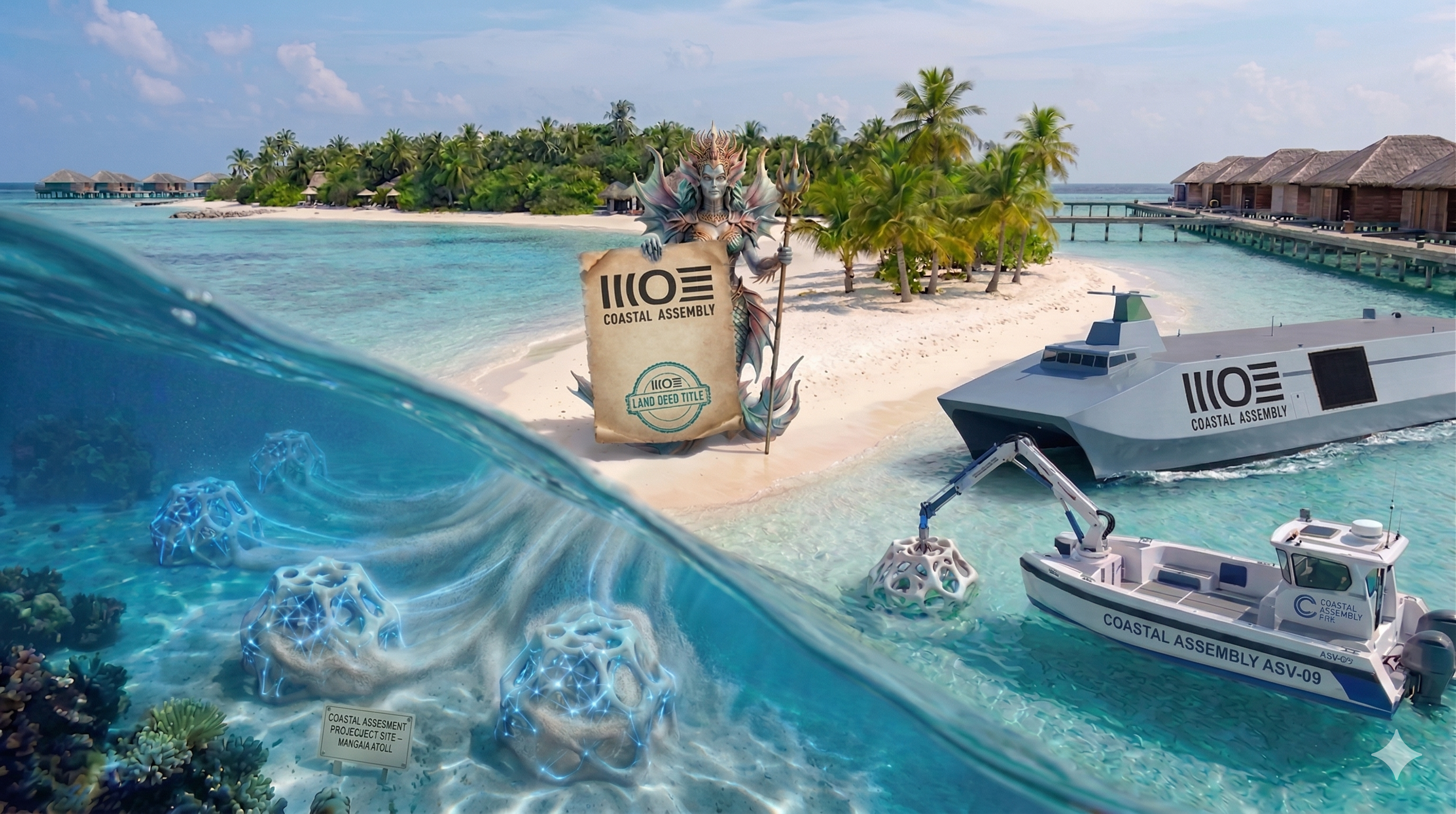
L’Assemblée Côtière. Coastal Assembly. On March 21, 2026, @siouid142 created this work as a direct response to Dr. Alex Wissner-Gross’s announcement of Coastal Assembly, a public-benefit company he helped form with backing from 021T Capital. The source challen
Read the narration
L’Assemblée Côtière.
Coastal Assembly.
On March 21, 2026, @siouid142 created this work as a direct response to Dr. Alex Wissner-Gross’s announcement of Coastal Assembly, a public-benefit company he helped form with backing from 021T Capital. The source challenged the assumption that land must remain scarce even as intelligence, bandwidth, and other technologies become cheaper. At the JW Marriott Maldives Kaafu Atoll Island Resort, AI-optimized underwater structures had grown more than ninety feet of beach in six months. A separate study at the Taj Exotica Resort Maldives had produced an entirely new island by accumulating more than eight hundred cubic meters of land.
The critical phrase in the announcement was “programming the ocean to deposit it.” Conventional coastal engineering fights water with dredging, pumping, concrete, and static barriers. Coastal Assembly, built on research led by Skylar Tibbits at MIT’s Self-Assembly Lab, instead uses precisely shaped porous structures to reduce destructive storm energy while allowing calmer currents to carry sediment inward. Sand enters, accumulates, and is less able to leave. The sea becomes the construction crew, and design tells that crew where to work.
The image makes that process readable through a split view above and below the waterline. At left, the turquoise sea becomes transparent. White lattice structures sit on the seabed as currents sweep pale ribbons of sand around them. Blue network-like light traces their surfaces, visualizing the intelligence layer without confusing it with the physical mechanism. The structures do not manufacture sand; they alter the conditions under which moving water places it.
At right, an autonomous vessel marked Coastal Assembly ASV-09 lowers one of the porous units by robotic arm. A larger unmanned barge carries the company’s emblem across its hull. The recovered revisions insisted that these craft reproduce the forms shown in Coastal Assembly’s own video and that no workers appear aboard them. Their absence is explanatory: satellite analysis, predictive shoreline models, autonomous deployment, and coordinated surface vessels form a closed operational loop rather than a conventional marine construction crew.
The newly expanded beach occupies the center. Palm trees, resort buildings, and overwater bungalows place the result within the Maldives field study rather than an anonymous tropical fantasy. The white shore is both landscape and output. It looks natural because the ocean deposited it, yet its location and persistence have been computationally influenced. The work therefore refuses the usual opposition between untouched nature and artificial infrastructure. Intelligence acts by arranging a process the sea already knows how to perform.
An Atlantean queen stands on the new land holding a monumental Coastal Assembly deed. Her crown, trident, scaled body, and sea-born authority translate a technical achievement into mythic sovereignty. A stamped Land Deed Title turns sediment into jurisdiction. This is the image’s legal and geopolitical layer: new land is not only a physical mass but also property, territory, habitat, resort frontage, national survival, and a claim that must be recognized.
The queen’s deed also satirizes the moment when ecological process becomes an asset class. Prime coastal land can command extraordinary prices, while island nations face existential loss from rising seas. The same technology can therefore appear as luxury-resort protection, sovereign adaptation, or a challenge to the scarcity on which trillions of dollars in property value depend. The queen does not simply celebrate abundance. She holds the paperwork through which abundance becomes owned.
The recursive element lies in the data loop. Satellite imagery and shoreline history guide placement; vessels deploy structures; the resulting sediment patterns supply ground truth; and each site improves the next model. The more land the system grows, the more evidence it acquires about growing land. In the artwork, that recursion appears as glowing patterns on repeated underwater forms and as the visual rhyme between the company emblem, vessel design, and deed.
As contemporary history painting, Coastal Assembly records a specific announcement at the instant it moved from research into public narrative. The scene does not claim that land has literally reached zero cost, nor that every shoreline should be programmed. It makes the underlying reversal visible: instead of treating the ocean only as an adversary to be restrained, intelligence recruits its currents as labor. The queen, deed, vessels, bungalows, and underwater lattices together ask who benefits when the sea can be instructed to build—and whether “they are not making land anymore” has finally become an obsolete description of Earth.
Opening the gallery…