70 Clock Galerie / The Innermost Loop Feed Reply Tableaux
Du Pain et des Circuits
Bread and Circuits
March 19, 2026
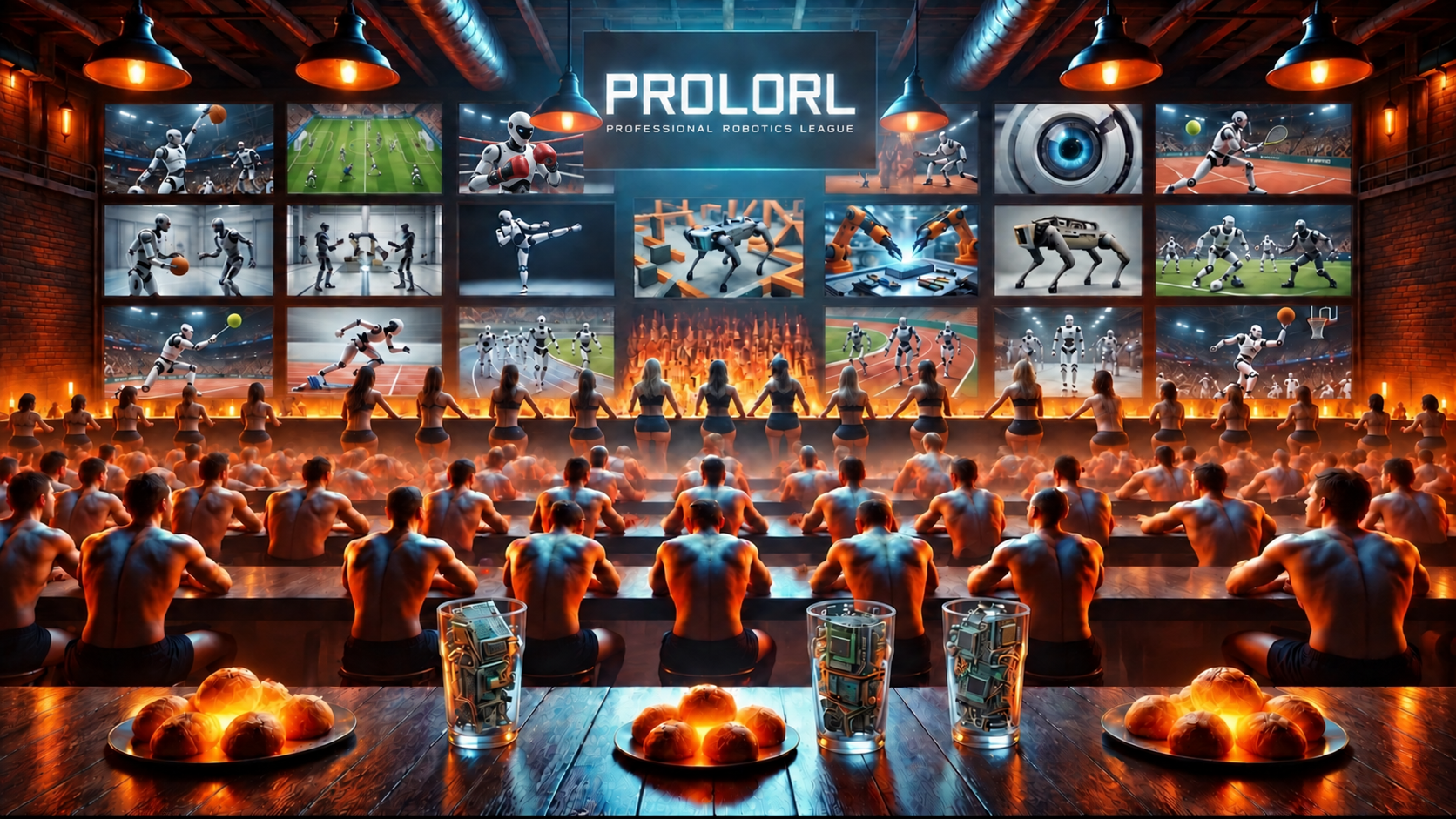
Du Pain et des Circuits. Bread and Circuits. On March 19, 2026, @siouid142 created this work in response to Dr. Alex Wissner-Gross’s announcement of the Professional Robotics League, or ProRL. The source argued that the United States had advanced robotics labo
Read the narration
Du Pain et des Circuits.
Bread and Circuits.
On March 19, 2026, @siouid142 created this work in response to Dr. Alex Wissner-Gross’s announcement of the Professional Robotics League, or ProRL. The source argued that the United States had advanced robotics laboratories, manufacturers, and academic competitions but lacked a professional spectator league for humanoid and quadruped machines. China had already staged the World Humanoid Robot Games, where hundreds of robots from numerous countries competed in track and field, soccer, and kickboxing. ProRL’s planned Boston Combine would turn those machines into public athletes and their performance into visible, repeatable benchmarks.
The title rewrites the ancient political formula “bread and circuses” as Bread and Circuits. Bread remains on the table, but entertainment has been rewired for physical intelligence. The substitution is exact: the circus is no longer chariot racing or human combat. It is the spectacle of robots running, kicking, balancing, manipulating objects, and revealing which hardware can survive outside a controlled demonstration. Public amusement becomes industrial testing.
The image places the viewer inside a packed sports bar or arena lounge. Rows of spectators sit shoulder to shoulder, their bare backs turned toward us as they face an enormous wall of screens. The central display carries the Professional Robotics League identity. Around it, separate broadcasts show humanoid soccer, sprinting, obstacle courses, martial arts, quadruped trials, laboratory competition, and robotic arms performing precision work. The wall resembles both a sportsbook and an engineering dashboard. Every screen offers a contest, but every contest also produces data.
The foreground completes the title’s pun. Warm bread rolls sit on plates while three pint glasses contain circuit boards instead of beer. These are not symbolic details added loosely around a sports theme. They convert the phrase bread and circuses object by object: sustenance survives as bread; the social intoxication of the arena becomes circuitry displayed in drinking vessels. The patron consumes neither alcohol nor abstract futurism, but the hardware culture making the spectacle possible.
The crowd’s anonymity matters. No founder, scientist, or celebrity dominates the scene. The protagonists are spectatorship itself and the machines on the screens. The source announcement emphasized that trade shows conceal robotics from the mass public, while a league can create teams, seasons, standings, rivalries, and collective memory. By showing a dense audience rather than an empty demonstration floor, the artwork imagines acceptance as something built through repeated attention. Physical AI enters culture when people know whom to cheer for.
Yet the screens also refuse a clean boundary between play and labor. Soccer and running occupy the same broadcast architecture as manipulation rigs and robotic arms. Speed attracts the audience, but dexterity and precision point toward warehouses, hospitals, factories, and homes. A robot league therefore functions as a conversion device: entertainment makes commercially useful capability emotionally legible. The sports bar is also a market-making institution for embodied intelligence.
That conversion explains the work’s slightly ominous abundance. Human bodies fill the room, but they appear mainly as watchers. Robotic bodies act everywhere above them. The composition reverses the conventional stadium, where human athletes perform and cameras distribute their feats through machines. Here, machines perform while humans merge into a single seated audience. The biological crowd supplies attention; the mechanical competitors supply action, improvement, and the future labor benchmark.
As contemporary history painting, Bread and Circuits records the founding proposition behind ProRL without turning the image into an advertisement. The central league identity preserves provenance, but the classical pun supplies criticism. Bread and circuses once described the management of public attention through food and spectacle. Bread and circuits asks what happens when spectacle becomes the laboratory for a new workforce. The audience may believe it is watching games, manufacturers may believe they are testing products, and the machines may simply be learning to perform. All three descriptions can be true at once.
The final irony is that benchmarking, commercialization, and entertainment become indistinguishable on the same screen. The league promises to expose capability rather than hide it, but exposure also trains desire: viewers learn to expect faster, stronger, more dexterous machines. The circuits in the pint glasses make that appetite visible. This is a banquet for physical intelligence, served as sport, and the crowd has already taken its seats.
Opening the gallery…