70 Clock Galerie / The Innermost Loop Feed Reply Tableaux
L’Astéroïde Ryugu
The Ryugu Asteroid
March 18, 2026
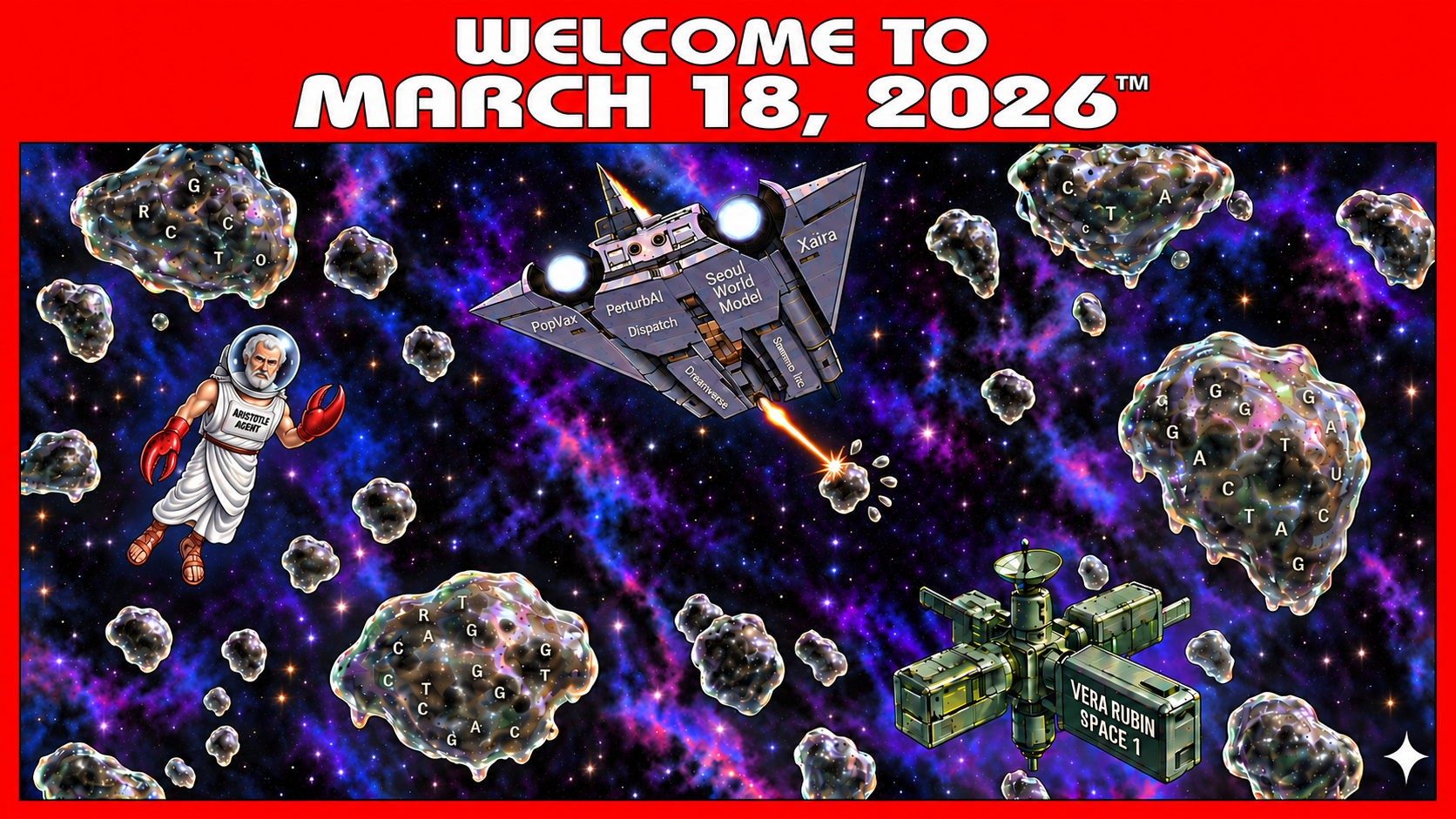
L’Astéroïde Ryugu. The Ryugu Asteroid. On March 18, 2026, @siouid142 responded to Dr. Alex Wissner-Gross’s Innermost Loop report on discoveries from asteroid Ryugu samples, including molecular building blocks associated with life. The same dispatch described a
Read the narration
L’Astéroïde Ryugu.
The Ryugu Asteroid.
On March 18, 2026, @siouid142 responded to Dr. Alex Wissner-Gross’s Innermost Loop report on discoveries from asteroid Ryugu samples, including molecular building blocks associated with life. The same dispatch described autonomous mathematicians, distilled world models, biotechnology systems, coordinated agents, and orbital-compute projects. The tableau forces those threads onto one arcade playfield, where the ancient chemistry of life and the newest infrastructure of machine intelligence must be navigated together.
The cultural frame is classic Atari Asteroids box art. Its red border, rounded white title panel, black field, drifting rocks, and central craft turn the claim that “the building blocks arrived by asteroid” into the literal objects of a game. Scientific evidence becomes an environment of targets and hazards. The viewer is asked to recognize, steer among, and interpret matter carrying code from deep time.
The Ryugu rocks are translucent rather than mineral gray. Inside them float the letters A, G, C, T, and U—the five canonical nucleobases. They resemble arcade pickups, hidden glyphs, or weights suspended in a model. That visual ambiguity connects two forms of inherited information. Nucleobases arrived through cosmic and chemical history; model parameters emerge through training and gradient descent. Both become compact structures capable of shaping what follows.
The central spacecraft is covered with names from the March 18 briefing, including Seoul World Model, Xaira, PeturbAI, PopVax, Dispatch, Dreamverse, and Swarmer Inc. The ship is therefore not a lone heroic pilot. It is a composite vehicle made from world modeling, biotechnology, and agent coordination. Each label occupies the same hull because contemporary discovery increasingly depends on stacks of systems rather than a single intelligence.
At lower left, Aristotle appears in a spacesuit with a lobster claw and an ARISTOTLE AGENT patch. He refers to Harmonic’s autonomous mathematician while joining ancient philosophy to the exhibition’s recurring nonhuman agency. The lobster claw suggests that formal reasoning has entered the same Accelerando-derived economy as the crustacean courts and markets. Aristotle is no longer only a canonical thinker; he has become a named software actor equipped for orbital work.
Across the field, a green module marked VERA RUBIN SPACE 1 preserves the liquid-cooled orbital data-center thread and the idea that Earth may be only one customer for compute. Off-world infrastructure appears not as distant scenery but as another active player. The module changes the meaning of the asteroid field: space is simultaneously archive, factory floor, data center, and possible source of biological ingredients.
The arcade format is critical because games reduce complex environments to readable rules while preserving uncertainty and danger. In Asteroids, survival depends on movement, identification, and timing rather than possession of a complete map. That logic suits a dispatch where intelligence is learning to build world models just as science discovers that life’s molecular vocabulary may have traveled through space. Knowledge becomes navigation through partial representations.
Formally, The Ryugu Asteroid converts dispersed reports into a hierarchy without pretending they form a settled theory. The nucleobase rocks carry the central proposition; the labeled ship contains the contemporary research stack; Aristotle embodies formal reasoning; and orbital compute defines the new infrastructure. Humor keeps ancient philosophy and arcade nostalgia available to cultural memory, but the underlying synthesis is serious. Biology and artificial intelligence are both stories about information acquiring vehicles. In this image, one vehicle is an asteroid, another is a spacecraft, another is a model, and another is the philosophical figure inside the suit. The game begins when all of them enter the same field.
The artwork finally collapses origin story and engineering roadmap. Ryugu carries information without intention; the labeled craft pursues information by design. One crosses space over geological time, the other is built to compress time through automation. Placing them in the same arcade makes their difference visible while suggesting a continuity: intelligence emerges when matter preserves patterns, transports them, and finds systems capable of reading them. The player’s task is not to destroy every asteroid, but to learn which apparent obstacle is also an archive.
Opening the gallery…