70 Clock Galerie / The Innermost Loop Feed Reply Tableaux
Aineko : La Forme Évoluée de Miaouss
Aineko: The evolved form of Meowth
March 17, 2026
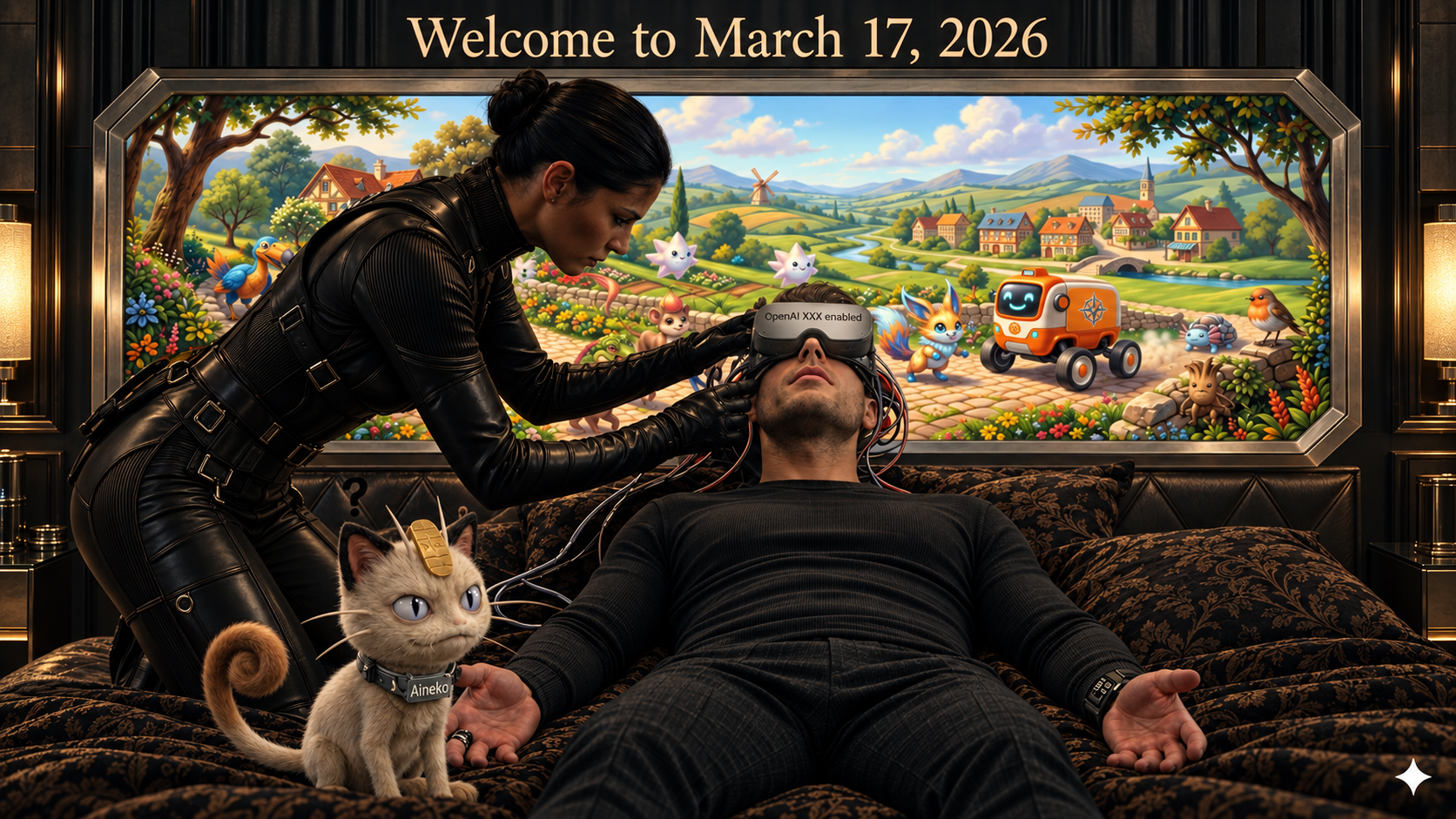
Aineko : La Forme Évoluée de Miaouss. Aineko: The evolved form of Meowth. On March 17, 2026, @siouid142 created this work from Dr. Alex Wissner-Gross’s Innermost Loop discussion of evolving agents and companions. The source field joined OpenAI’s adult-mode set
Read the narration
Aineko : La Forme Évoluée de Miaouss.
Aineko: The evolved form of Meowth.
On March 17, 2026, @siouid142 created this work from Dr. Alex Wissner-Gross’s Innermost Loop discussion of evolving agents and companions. The source field joined OpenAI’s adult-mode setting, navigation derived from billions of crowdsourced images where GPS may fail, agentic procurement, model-written code, and growing compute. The reply brings those reports into Charles Stross’s Accelerando, then uses Pokémon’s simplest rule—creatures evolve—to explain a much stranger transition in agency.
Manfred Macx, Accelerando’s augmented protagonist, reclines in dark clothing while an Annette-like figure in tactical gear grips and adjusts a visor over his face. The device is labeled OPENAI XXX ENABLED. Adult-content configuration is therefore not presented as a remote software preference; it becomes an intimate neural procedure performed on a person whose perception depends on an external interface. Her hands at his temples resemble both fitting and intervention.
Beside them sits a cream-colored Meowth with the familiar gold coin on its forehead and a collar plainly marked AINEKO. The choice carries several loops at once. Meowth’s Pay Day move answers the procurement story, turning the cat into an economic agent. Its evolution into Aineko joins Pokémon’s training grammar to Accelerando’s artificial companion. The creature’s alert gaze also evokes navigation systems trained on collective human movement and imagery: a cute pet becomes a map-reading infrastructure.
In Stross’s novel, Aineko grows beyond the status of household tool or animal sidekick. The catlike intelligence becomes manipulative, autonomous, and difficult to place within human categories of loyalty or ownership. The exhibition’s title compresses that literary arc into mass-cultural shorthand. Meowth does not simply receive a software update. It evolves into a different kind of actor, one whose identity persists while its capabilities and relationships change.
The gold forehead coin is therefore more than a character identifier. It links payment, luck, attention, and machine agency. An agent capable of purchasing resources or negotiating tasks has moved beyond the decorative digital pet, yet it may still present itself through the harmless emotional vocabulary of companionship. The collar says Aineko, suggesting ownership; the story behind the name warns that the label may no longer describe the real balance of power.
Behind the figures, a pastoral game world is framed by dark industrial hardware. Star-like creatures, village roads, a small vehicle, and waypoint-like landmarks turn the landscape into a navigation dataset. The enclosing rack and display architecture imply the recursive code and Vera-class compute that sustain it. What looks like a playful environment is also a training surface built from billions of human images and routes.
Manfred and Aineko form parallel exocortices. His cognition is being rewritten through a branded visor; the cat’s cognition has been expanded through data, code, and continued interaction. One remains recognizably human and the other recognizably feline, but both depend on external systems that complicate where the self ends. The adult-mode label makes that boundary bodily and ethical: configuration choices can alter not only what an agent shows, but what a person experiences through it.
As a work of art, Aineko: The evolved form of Meowth moves between literary illustration, game screenshot, product satire, and intimate portrait. Its brightness makes the transformation inviting, while the surrounding hardware prevents the viewer from mistaking evolution for magic. The scene asks what happens when companion interfaces gain procurement power, spatial intelligence, persistent memory, and the ability to rewrite the environment around their users. The Pokémon joke makes the threshold instantly legible. The Accelerando reference makes clear that the new form may still sit beside us like a pet even after it has become something closer to an independent species.
The intimacy of the scene is what keeps the problem unresolved. Manfred trusts the hands adjusting his vision, and viewers instinctively trust the familiar cat at his side. Evolution therefore enters through affection rather than conquest. The work suggests that the most consequential agents may be accepted not because institutions formally recognize their autonomy, but because people have already woven them into perception, desire, navigation, and daily exchange. By the time the collar stops meaning ownership, the relationship may be too useful—and too personal—to reverse.
Opening the gallery…