70 Clock Galerie / The Innermost Loop Feed Reply Tableaux
Le Toit a Disparu
The Roof is Gone
March 16, 2026
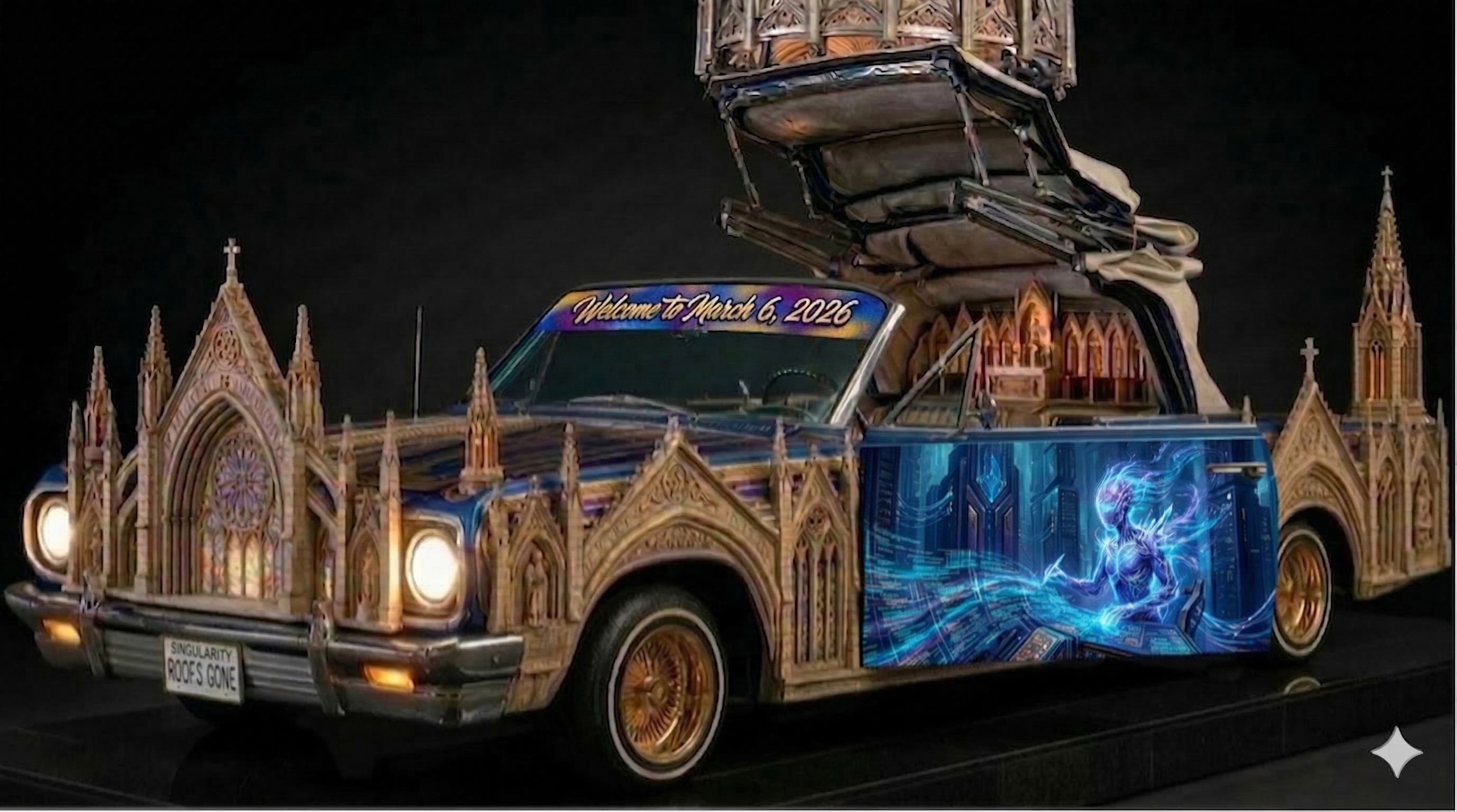
Le Toit a Disparu. The Roof is Gone. On March 16, 2026, @siouid142 created this tableau in response to Dr. Alex Wissner-Gross’s Innermost Loop description of a buildout accelerating so rapidly that an old constraint had disappeared: the roof was gone. Recursiv
Read the narration
Le Toit a Disparu.
The Roof is Gone.
On March 16, 2026, @siouid142 created this tableau in response to Dr. Alex Wissner-Gross’s Innermost Loop description of a buildout accelerating so rapidly that an old constraint had disappeared: the roof was gone. Recursive coding and scientific systems, orbital infrastructure, energy expansion, and physical deployment made the ceiling on computation look less like a permanent architecture than a temporary enclosure. The reply makes the phrase literal by constructing a ceremonial vehicle with no roof and an entire technological cathedral rising through the opening.
The long blue car combines convertible, lowrider, hearse, church, and industrial platform. Gothic portals, rose windows, flying buttress-like forms, and illuminated spires cover the body from grille to rear fender. The passenger compartment is exposed to the sky, yet seats and cathedral fragments stack impossibly upward as though the removed ceiling has become cargo. The old limit is not simply discarded. It travels with the new system as ornament, structure, and historical weight.
A bright mural on the door shows a luminous recursive coder inside a data-center nave. It connects the sacred architecture to the day’s model breakthroughs rather than to religion alone. Code generation becomes a form of self-building liturgy: the system writes tools that help produce further tools, and the nave becomes both server aisle and sanctuary. Transcendence is rendered as a workflow.
The license plate states the argument directly: SINGULARITY ROOFS GONE. Gold wire rims keep the vehicle within lowrider culture and the visual language of customization. Two systems of status meet on one chassis. Ecclesiastical monuments once concentrated wealth, craft, belief, and civic identity; customized cars turn mobility into personal and communal display. The Innermost Loop Mobile claims both inheritances for technological acceleration.
The hearse-like silhouette gives the missing roof a double meaning. One infrastructure regime is being carried out while another rises through it. The vehicle resembles a funeral procession for a former ceiling on compute, yet it is too animated, ornate, and road-ready to be merely mournful. It celebrates release while acknowledging that every transition carries the body of what it supersedes.
Material weight is the crucial counterargument. Intelligence may have lost a conceptual roof, but the car still needs tires, suspension, headlights, a chassis, energy, and a street. The spires can rise only because the base carries them. By placing boundless upward imagery on a fully embodied machine, the tableau distinguishes cognitive acceleration from physical deployment. Software can recurse quickly; atoms continue to impose load, friction, and logistics.
The open roof also changes the viewer’s relation to the sky. In a traditional cathedral, the vault represents heaven through an enclosing structure. Here, the vault has been removed, and actual space—launches, orbital compute, energy infrastructure—becomes the new upper chamber. The sacred metaphor is no longer about looking beyond the material world. It is about extending material systems outward until the former boundary becomes another construction site.
As contemporary history painting, The Roof is Gone turns a brief acceleration slogan into an object with weight, surface, and contradiction. Its excess is analytical: every carved arch and gold rim records the cultural desire to make technical expansion ceremonial. The work neither simply celebrates limitless growth nor denies the breakthrough. It shows a machine driving through ordinary streets while carrying a cathedral open to the cosmos. The roof may be gone, but architecture remains—and the question of what all that rising structure is built to shelter has become more urgent, not less.
The car’s mobility matters because a cathedral normally anchors a place. Here, monument becomes platform and can carry its doctrine wherever the road permits. Acceleration is no longer contained in a campus, laboratory, or server room; it becomes a touring civic spectacle. Yet the vehicle can also pass communities without stopping. The open sky promises universality, while the customized chassis reminds us that access still travels through owned hardware. The missing roof expands possibility but does not abolish direction, destination, or control of the wheel. Limitlessness is still being driven by someone. The driver remains visible.
Opening the gallery…