70 Clock Galerie / The Innermost Loop Feed Reply Tableaux
Superintelligence Physique : Faire Cette Merde
Physical Super Intelligence - Get Shit Done
March 15, 2026
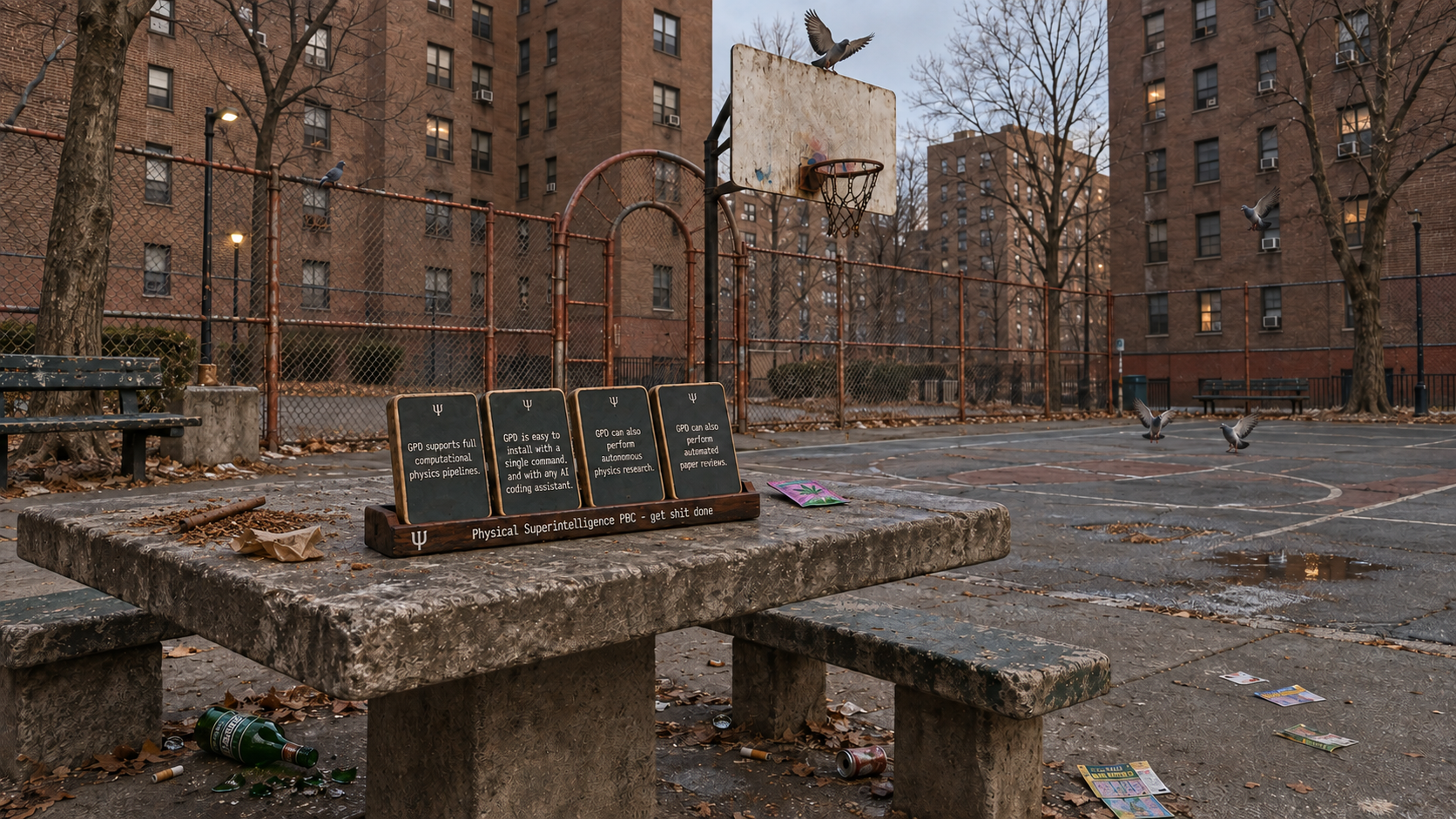
Superintelligence Physique : Faire Cette Merde. Physical Super Intelligence - Get Shit Done. On March 15, 2026, @siouid142 created this work from Dr. Alex Wissner-Gross’s Innermost Loop introduction to Physical Superintelligence PBC’s GPD system. The report de
Read the narration
Superintelligence Physique : Faire Cette Merde.
Physical Super Intelligence - Get Shit Done.
On March 15, 2026, @siouid142 created this work from Dr. Alex Wissner-Gross’s Innermost Loop introduction to Physical Superintelligence PBC’s GPD system. The report described a tool intended to install with one command, review scientific papers, run computational-physics pipelines, simulate molecular systems, and help researchers move from literature to validated physical work. The image answers the phrase “Get Physics Done” with an even blunter translation: get shit done.
Four large dominoes stand upright beneath the PSI symbol. Their printed claims form the product argument in sequence: easy installation with a single command and an AI coding assistant; automated paper review; support for full computational-physics pipelines; and autonomous physics research. The capabilities are not arranged as a feature list floating on a screen. They have become physical tiles, each able to transfer force to the next.
Domino geometry makes the release’s significance legible. Friction removed at one stage can tip the following stage into reach. Installation opens access; review changes the speed of understanding; pipelines connect interpretation to calculation; autonomous research pushes toward new results. Yet nothing has fallen. The tableau records readiness, dependency, and risk rather than claiming that the chain reaction has already completed science.
The setting prevents “physical superintelligence” from escaping into polished laboratory abstraction. The tiles sit on a battered public bench beside a worn basketball court, brick apartment blocks, pigeons, litter, a broken bottle, and loose paper. Across the wooden rail, PHYSICAL SUPERINTELLIGENCE PBC — GET SHIT DONE reads like a blunt municipal instruction or neighborhood graffiti. The system has left the demo environment and entered ordinary meatspace.
A bare hoop rises behind the dominoes. It supplies a second model of applied physics: trajectory, force, material, repetition, and an imperfect surface. A basketball does not care how elegant the paper review was; it either moves through the world as predicted or it does not. The court therefore becomes an implicit validation arena, reminding the viewer that physical intelligence earns its name only when abstractions survive contact with atoms.
The human hand near the sequence is equally important. It may be about to start the chain, stop it, or test its balance. Agency has not vanished; it has been displaced to the initiating gesture and the design of the arrangement. The hand makes governance tactile. Once the first capability tips the next, control becomes a question of how the sequence was built and where an interruption remains possible.
The phrase “Get Shit Done” refuses the ceremonial language often used around frontier research. It translates institutional ambition into the vernacular of labor. “Shit” includes installations that fail, papers that must be checked, simulations that must converge, code that must run, and experiments that must meet the resistant world. The profanity is not merely branding. It insists that intelligence be judged by consequences beyond another impressive explanation.
As an artwork, Physical Super Intelligence - Get Shit Done combines product manifesto, street photography, and still life. Branding behaves like heraldry: PSI appears not as a floating logo but as an institution trying to acquire a public body. The pristine claims on the tiles contrast with the scuffed environment that will test them. This is the work’s central criticism and its optimism. A scientific agent may compress the path from question to physical result, but each removed bottleneck increases the importance of what gets placed at the beginning of the chain. The future is poised upright, impressive and unstable, waiting for a hand—and for a decision about which way the force should travel.
The neighborhood context also resists the fantasy that scientific automation belongs only to distant elites. Apartment windows, pigeons, broken glass, and the public court represent the world that will live with the consequences of accelerated discovery. They ask who gets to initiate the dominoes, who can inspect the sequence, and where the resulting force lands. The tableau’s rough surfaces are a democratic demand: physical superintelligence should not be judged only by laboratory benchmarks, but by whether its gains can enter shared space without turning that space into collateral material.
Opening the gallery…