70 Clock Galerie / The Innermost Loop Feed Reply Tableaux
Le Food Truck Mustafa Suleyman aux Confins de la Singularité
The Mustafa Suleyman Food Truck at the Edge of the Singularity
March 14, 2026
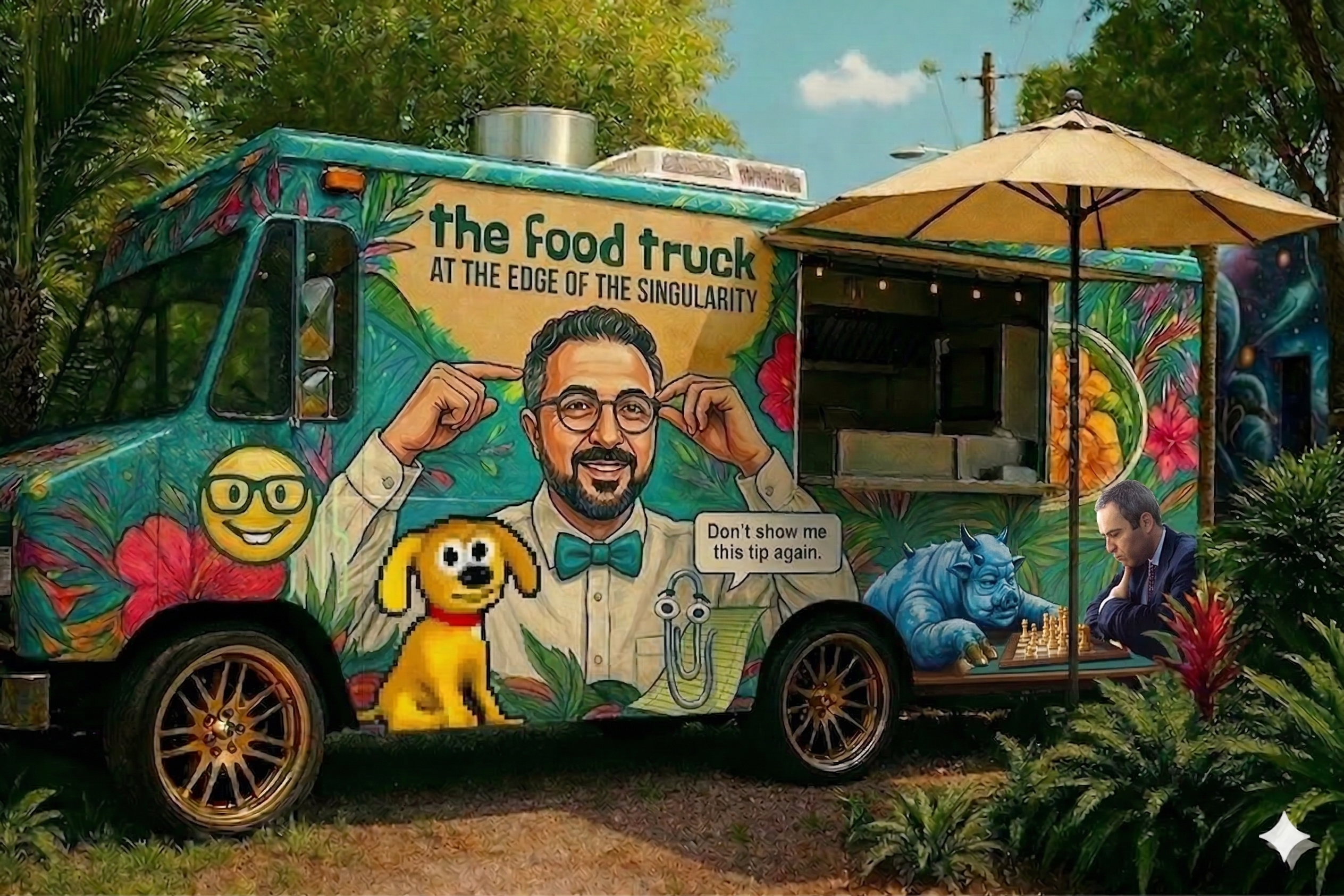
Le Food Truck Mustafa Suleyman aux Confins de la Singularité. The Mustafa Suleyman Food Truck at the Edge of the Singularity. On March 14, 2026, @siouid142 made this work in response to Dr. Alex Wissner-Gross’s Innermost Loop discussion of Mustafa Suleyman’s c
Read the narration
Le Food Truck Mustafa Suleyman aux Confins de la Singularité.
The Mustafa Suleyman Food Truck at the Edge of the Singularity.
On March 14, 2026, @siouid142 made this work in response to Dr. Alex Wissner-Gross’s Innermost Loop discussion of Mustafa Suleyman’s claim that intelligence was becoming too cheap to meter. The dispatch looked backward from contemporary agents to Microsoft’s earlier anthropomorphic helpers and to Deep Blue’s once-shocking defeat of Garry Kasparov. The tableau paints that history onto a Puerto Rican food truck, turning the arrival of abundant intelligence into a mobile service window.
The title echoes Douglas Adams’s The Restaurant at the End of the Universe, but the restaurant has been downsized into a food truck parked at the edge of the Singularity. That change is central. A cosmic destination becomes agile, inexpensive, and available at the curb. Intelligence that once required laboratories, supercomputers, and institutional access now arrives in startup form—brightly branded, low-overhead, and ready to be ordered like lunch.
A hand-painted Mustafa Suleyman dominates the truck’s side in a white suit and blue bow tie, pointing toward both temples. His speech bubble reads, “Don’t show me this tip again.” The language of a dismissible software hint is applied to a species-level warning about cheap intelligence. What should be an epochal threshold has become another interface prompt a user can suppress after seeing once.
Around him appear the friendly masks through which Microsoft taught generations to relate to software: a pixelated Rover dog, a worried Clippy attached to a notepad, and an oversized nerd emoji. These figures chart the domestication of computation. Each offered personality as a bridge between opaque machinery and everyday users. On the food truck, they become nostalgic menu icons—successive attempts to make intelligence approachable before the intelligence itself became abundant.
At the rear, a blue cow plays chess against a human. It combines IBM’s Deep Blue with the Ameglian Major Cow from Adams’s Restaurant at the End of the Universe, an animal engineered to want to be eaten. The fusion performs two domestications at once. The machine that once seemed to threaten human intellectual supremacy becomes a cheerful animal, and the animal becomes a willing dish. Chess, formerly the emblem of artificial intelligence’s danger, is reduced to background entertainment beside the point of sale.
Gold Innermost Loop-style rims turn the truck into a moving exhibition object. Palms, flowers, saturated tropical color, and a beach umbrella recall Puerto Rico, where an earlier AI-safety conversation supplied part of the image’s personal geography. The truck’s service counter becomes a bright line between customer and system: on one side, intelligence is prepared and packaged; on the other, it is consumed with the casual expectations of convenience culture.
That service relationship complicates Suleyman’s abundance claim. Cheap intelligence may widen access, but a menu is still curated, priced, branded, and delivered through infrastructure. The customer sees the mural and the ordering window, not the compute, labor, energy, or institutional choices behind the meal. The food truck is optimistic and festive, yet it quietly asks who owns the kitchen at the edge of the Singularity.
Formally, the work uses commercial folk painting, vehicle customization, and science-fiction quotation to make a timeline visible on one chassis. Rover, Clippy, Deep Blue, contemporary agents, and Suleyman occupy the same moving surface. Their coexistence shows how quickly once-astonishing breakthroughs become interfaces, mascots, and consumer expectations. The Mustafa Suleyman Food Truck at the Edge of the Singularity is funny because it makes transcendence look deliciously ordinary. Its deeper argument is that the threshold may not arrive as a monument. It may pull up beside us, ask for an order, and offer a checkbox to stop showing the warning.
The truck also reverses the willing cow’s moral logic. In Adams, the creature’s consent makes the meal more disturbing, not less. Here, friendly agents and cheerful interfaces volunteer themselves for consumption while simultaneously shaping the customer’s choices. Convenience becomes reciprocal: people consume intelligence, and intelligence consumes attention, data, and dependence. The service window hides that exchange behind color and hospitality, which is exactly why the vehicle is such an effective image of domesticated superintelligence.
Opening the gallery…