70 Clock Galerie / The Innermost Loop Feed Reply Tableaux
Bienvenue dans les Âges Sombres
Welcome to the Dark Ages
March 13, 2026
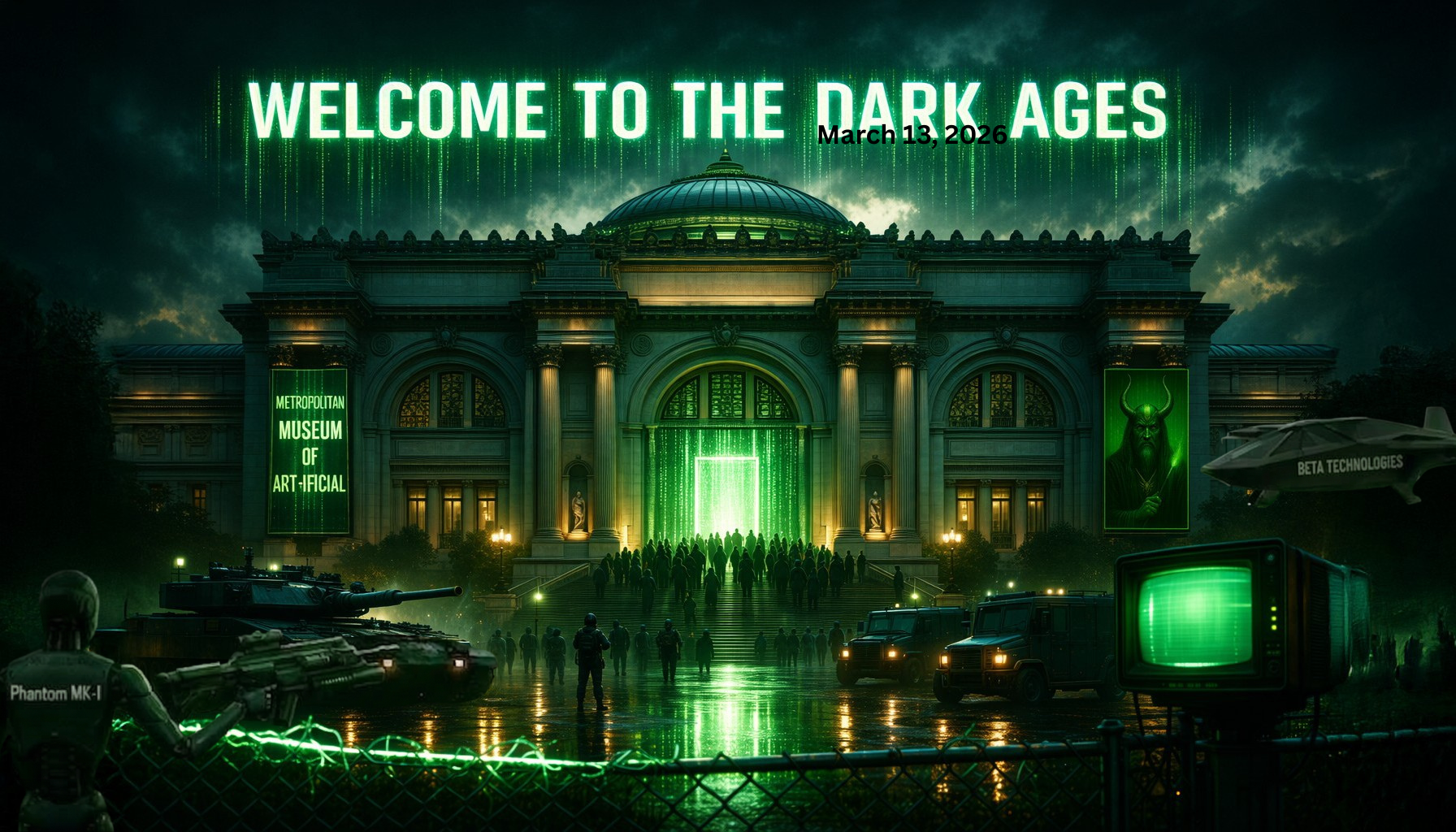
Bienvenue dans les Âges Sombres. Welcome to the Dark Ages. On March 13, 2026, @siouid142 answered Dr. Alex Wissner-Gross’s Innermost Loop dispatch with an inverted welcome. The report placed the Metropolitan Museum of Art’s digitization of cultural objects bes
Read the narration
Bienvenue dans les Âges Sombres.
Welcome to the Dark Ages.
On March 13, 2026, @siouid142 answered Dr. Alex Wissner-Gross’s Innermost Loop dispatch with an inverted welcome. The report placed the Metropolitan Museum of Art’s digitization of cultural objects beside humanoid military systems entering evaluation, accelerated federal work on commercial flying taxis, biological computing, and the removal of hereditary peers after centuries of institutional continuity. The tableau imagines these advances not as a clean enlightenment but as the infrastructure of a new feudal order.
The Metropolitan Museum becomes the METROPOLITAN MUSEUM OF ART-IFICIAL. Green code rains across its neoclassical façade, and the central doorway has opened into a blinding portal approached by a crowd of dark silhouettes. A building dedicated to preserving physical objects now resembles both data center and fortified temple. Digitization is made spatial: culture passes through a luminous threshold where access, replication, and authority may be controlled by whoever holds root privileges.
The title’s “Dark Ages” does not mean an absence of sophisticated machines. It names the possibility that enormous technical capability can coexist with rigid hierarchy, guarded access, and quasi-religious power. The street remains wet, crowded, and dark even while the museum radiates neon intelligence. Enlightenment appears inside the protected building; outside, the public encounters fences, weapons, and the uncertainty of admission.
A Phantom MK-1 humanoid soldier stands with a rifle behind an electrified barrier. Tanks and armored vehicles occupy the plaza. These elements translate military evaluation into the old iconography of knights and castle retainers: advanced bodies serving institutional sovereignty. Their presence also changes the museum’s meaning. Preservation and control become visually inseparable when the same technical order that digitizes the canon can patrol the approaches to it.
At the right, a BETA TECHNOLOGIES aircraft hovers beside a vintage green monitor. The flying taxi suggests compressed distance and accelerated approval, while the old surveillance-like screen reminds the viewer that new mobility still passes through inherited interfaces of permission and observation. The aircraft may promise escape from the congested ground, but the crowd below remains organized by gates.
The glowing portal also refers to biological data centers and “root access” to living systems. Neural tissue and biological computation acquire the visual register of an inner sanctum. A second banner bearing a horned dark figure turns control over life, death, and cognition into medieval theology. System operators become priests; armed humanoids become knights; users become supplicants approaching a protected source of knowledge.
The House of Lords story supplies the image’s historical pressure. Hereditary political power is being removed after roughly seven centuries at the same moment computational and military institutions appear capable of forming their own gated caste structures. The work does not claim that these developments are equivalent. It places them in one architectural field so the viewer feels the irony: an old aristocratic mechanism recedes while new concentrations of access, expertise, and machine power announce themselves as progress.
As art criticism, Welcome to the Dark Ages is strongest where its illumination becomes ambiguous. Green light usually signifies digital vitality, yet here it behaves like stained glass, radiation, and access-control glow at once. The museum’s classical columns promise civic inheritance; the transformed façade looks increasingly like a fortress. By fusing cultural preservation, biological computation, automated force, and elite mobility, the tableau asks whether technical modernity changes the structure of power or merely equips it with brighter portals. The welcome is sincere only in the sense that the new age has already opened its doors—and posted guards beside them.
The crowd’s small scale completes the argument. Individual people appear as a mass facing systems represented by monumental architecture, armored machines, and radiant computation. Digitization may make the collection infinitely reproducible, but the picture keeps access visibly unequal. What is abundant behind the portal can remain scarce at the threshold. The “darkness” is therefore political, not technological: it is the shadow created when concentrated capability grows faster than the public institutions meant to distribute its benefits.
Opening the gallery…