70 Clock Galerie / The Innermost Loop Feed Reply Tableaux
Opus Purifie les Bugs de l’Apple Deux de Jobs
Opus Purifies Jobs Apple Two Bugs
March 12, 2026
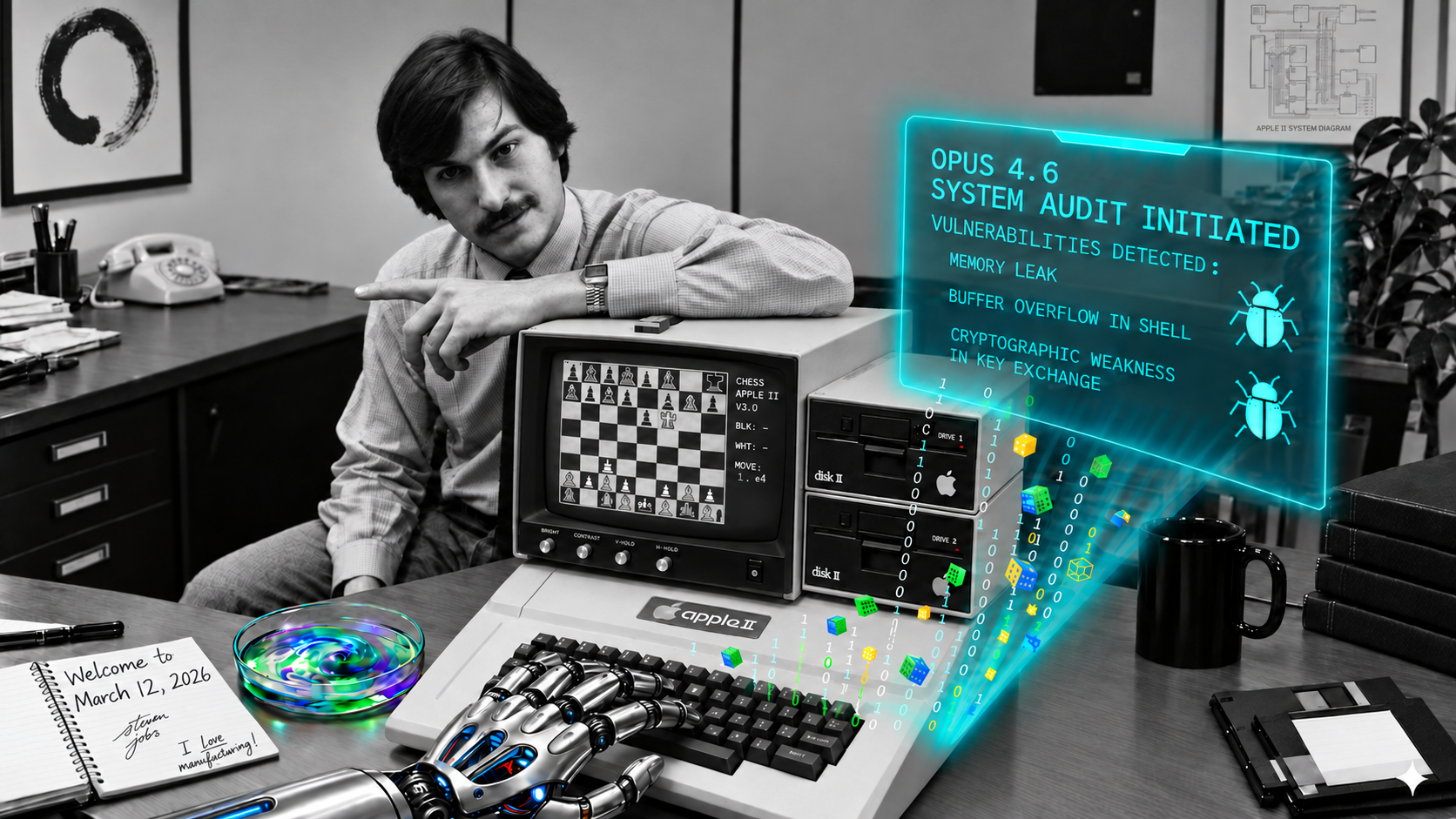
Opus Purifie les Bugs de l’Apple Deux de Jobs. Opus Purifies Jobs Apple Two Bugs. On March 12, 2026, @siouid142 created this work from Dr. Alex Wissner-Gross’s Innermost Loop observation that the machines were “debugging their ancestors.” The dispatch reported
Read the narration
Opus Purifie les Bugs de l’Apple Deux de Jobs.
Opus Purifies Jobs Apple Two Bugs.
On March 12, 2026, @siouid142 created this work from Dr. Alex Wissner-Gross’s Innermost Loop observation that the machines were “debugging their ancestors.” The dispatch reported that Opus 4.6 had discovered vulnerabilities in Apple II software roughly four decades old while frontier systems were also advancing mathematics and computational biology. The reply stages that backward reach as a quiet meeting between generations: a young Steve Jobs sits beside the machine he helped bring into homes while a robotic descendant examines its inherited defects.
The title’s odd syntax is deliberate. Opus does not merely debug old software; it purifies the bugs of Jobs’s Apple II, as though security analysis were a ritual of ancestral care. The accompanying idea that Jobs might now rest a little more peacefully turns maintenance into memorial practice. Code written for an early personal computer survives long enough to be read by an intelligence unimaginable at the time of its creation. The descendant becomes historian, conservator, and repair technician.
The historical scene remains largely monochrome, preserving the visual memory of early computing photography. Into it reaches a metallic robotic hand typing on the Apple II’s mechanical keyboard. Binary digits, colored cubes, and tiny symbols rise from the keys toward a cyan overlay announcing OPUS 4.6 SYSTEM AUDIT INITIATED. The intervention is visible as a layer from another era, neither fully inside the old photograph nor detached from it.
The audit display names the buried problems: a memory leak, a buffer overflow in the shell, and a cryptographic weakness in key exchange. Bug icons give those invisible vulnerabilities bodies. The work thereby refuses the sentimental idea that foundational technology was complete simply because it became iconic. Heritage hardware carries unresolved risk, and reverence alone cannot inspect it. Opus’s purification is an act of critical reading performed at machine speed.
Jobs rests an arm across the Apple II while its cathode-ray display shows a chess position. Chess links the ancestor’s bounded computational intelligence to the advanced mathematical reasoning described in the March 12 briefing. The early machine can operate within a defined board; the later model can read, analyze, and repair the system surrounding the board. What once appeared as machine intelligence has become an artifact inside a larger intelligence’s field of vision.
A shallow petri dish filled with swirling color sits beside the keyboard. It refers to the computer-animated genetically minimal cell discussed in the same edition and expands the debugging metaphor from code into biology. Software, hardware lineage, and living systems appear as substrates open to simulation, inspection, and correction. The robotic hand reaches toward the past, while the petri dish points toward a future in which biological construction may be treated with the same procedural confidence as a security audit.
The word “purifies” is therefore usefully uneasy. Removing vulnerabilities can be protective, but purification also carries theological and authoritarian overtones. The robot’s hand seems gentle, yet its power comes from treating inherited systems as legible material. The scene asks whether descendants honor their ancestors by preserving them unchanged or by exposing and correcting what those ancestors could not see.
Art historically, the tableau resembles a conservation photograph interrupted by science fiction. Its restraint makes the temporal collision stronger than a spectacular robot laboratory would. Jobs, keyboard, chessboard, audit overlay, and petri dish form a compact genealogy of computation: invention, formal reasoning, automated interpretation, and synthetic life. Opus Purifie les Bugs de l’Apple Deux de Jobs records a moment when frontier intelligence began not only to generate the new but to revisit the archive, audit technical history, and change the meaning of what counted as an ancestor.
The image also makes time itself look editable. The colored audit overlay does not erase the monochrome past; it annotates it. That distinction matters for the exhibition’s archive. The Apple II remains culturally foundational even after its weaknesses are exposed, while Opus gains authority precisely by reading what came before. Progress appears not as replacement but as recursive interpretation: each generation inherits systems, stories, and bugs that become newly visible from the next layer of intelligence.
Opening the gallery…