70 Clock Galerie / The Innermost Loop Feed Reply Tableaux
La Vallée Dérangeante
Uncanny Valley
March 10, 2026
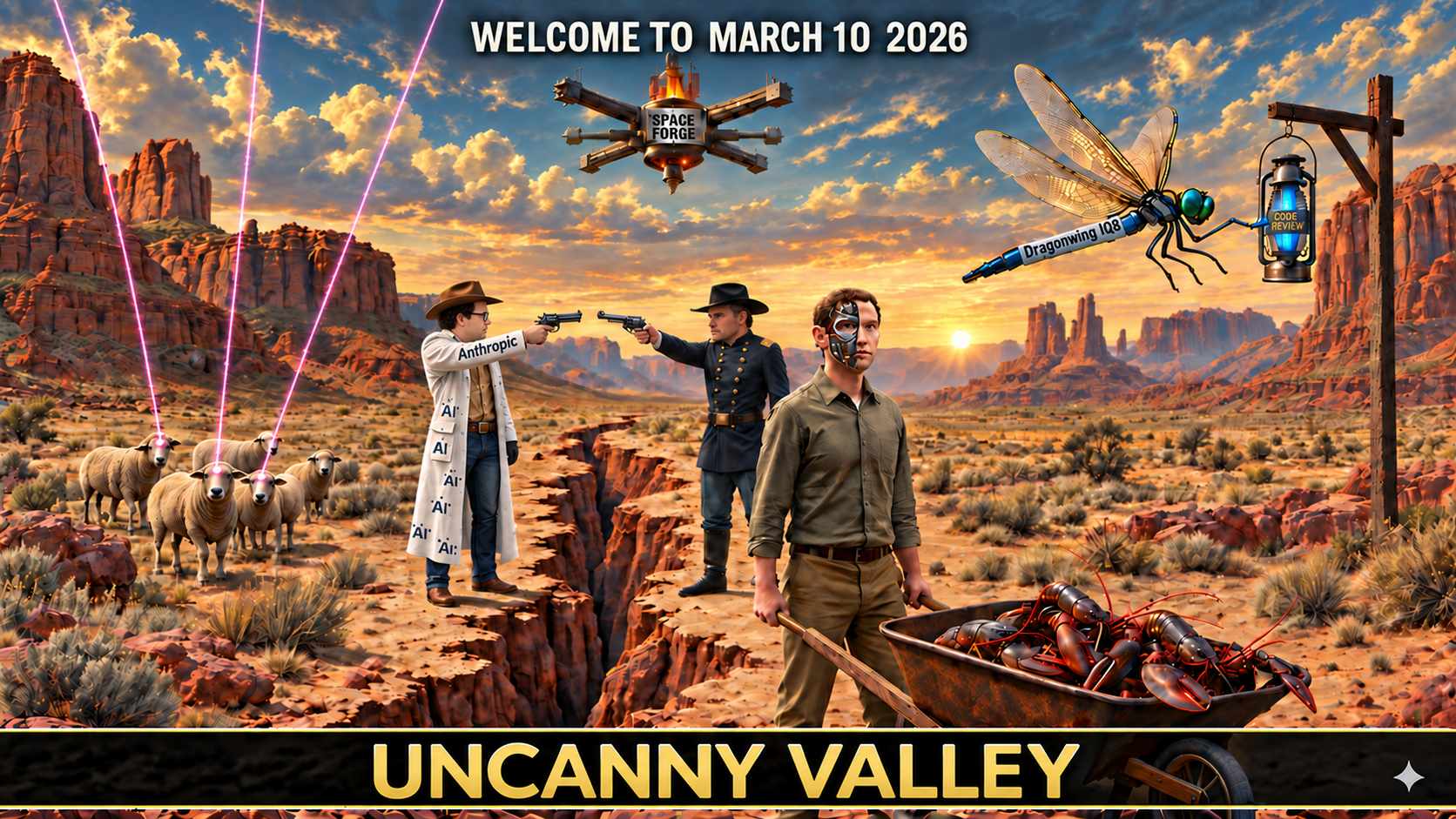
La Vallée Dérangeante. Uncanny Valley. On March 10, 2026, @siouid142 responded within the rapid cadence of Dr. Alex Wissner-Gross’s Innermost Loop to a dispatch that placed Anthropic’s confrontation with the Pentagon beside orbital semiconductor manufacturing,
Read the narration
La Vallée Dérangeante.
Uncanny Valley.
On March 10, 2026, @siouid142 responded within the rapid cadence of Dr. Alex Wissner-Gross’s Innermost Loop to a dispatch that placed Anthropic’s confrontation with the Pentagon beside orbital semiconductor manufacturing, Qualcomm edge robotics, multi-agent code review, directed-energy tests, and increasingly uncanny machines in public life. The reply turns the phrase “uncanny valley” into an actual Western valley: a faulted frontier where laboratories, government power, synthetic bodies, and new agent populations meet at gunpoint.
The central standoff is specific. Dario Amodei appears at one side in an Anthropic-marked white lab coat styled as a gunslinger’s costume. Across the literal crack in the earth stands Pete Hegseth in a dark nineteenth-century military uniform. Their weapons make the legal dispute visible as frontier conflict, while the fissure materializes the dispatch’s defining fault line between a safety-oriented AI laboratory and the security demands of the state. “Frontier model” ceases to be corporate jargon and becomes a contested territory.
Between them, a Zuckerberg-like figure has a face split between human skin and exposed mechanism. He pushes a wooden wheelbarrow overflowing with lobsters. The reference is to Meta’s acquisition of Moltbook, the social network associated with AI agents and popularly pictured through lobster imagery. Zuckerberg is therefore not a generic cyborg cameo. He is harvesting or transporting a new social species while the lab and the government fight over jurisdiction. The wheelbarrow maintains the exhibition’s Accelerando lineage and turns platform consolidation into a scene of creature management.
The image’s title works in both directions. The classic uncanny valley describes discomfort when a machine looks nearly human. Here, famous humans resemble Westworld hosts caught inside a scripted shootout, while humanoids, cosplayers, robotic dogs, and social agents blur the opposite boundary. The viewer cannot tell whether humanity is making machines more lifelike or reorganizing itself to behave like a themed simulation. The Western setting also answers the accompanying idea of “abundance in the Westworld”: technological abundance may be spectacular, but it can still be staged, policed, and owned like a park.
Above the standoff, SPACE FORGE glows as an orbital furnace. It refers to plasma generated in microgravity for off-world semiconductor manufacturing, shifting the industrial frontier from desert ground to the sky. Nearby, the Dragonwing IQ8 edge-computing platform becomes a giant mechanical dragonfly. Hardware branding is translated into animal anatomy so that the landscape itself seems to be evolving technological species.
The object marked CODE REVIEW must be read precisely. It is not simply a lantern. It is a bug zapper whose attractive light represents Anthropic’s team of review agents designed to catch defects human reviewers miss. The Dragonwing is the literal bug being drawn toward it. This visual compression joins two separate product reports into one predatory circuit: edge hardware approaches the automated auditing system that promises to detect and eliminate bugs. The pun turns software quality control into an ecological relation of bait, attraction, and destruction.
At the other side, red beams cross a flock of sheep. The animals preserve the directed-energy stories, including Havana-syndrome testing on sheep and battlefield efforts to use lasers against fiber-optic systems. Their pastoral vulnerability intensifies the work’s institutional violence. Orbital furnaces, code agents, cyborg executives, and gunmen might sound abstract in prose; the sheep show those forces landing on bodies.
As a composition, Uncanny Valley distributes the dispatch across a genre with its own readable rules. The duel carries the legal conflict; the cracked earth supplies structure; skyborne machines convert manufacturing into weather; and peripheral animals register collateral consequence. The tableau is funny because each technical name finds an exact Western or biological form, yet the humor sharpens rather than dissolves the argument. This is a contemporaneous history painting of a frontier that already has sheriffs, corporations, livestock, prospectors, and captured species. Its uncanniness lies not only in the half-machine face, but in how naturally the institutions of the AI era slip into the oldest story of territory and control.
Opening the gallery…