70 Clock Galerie / The Innermost Loop Feed Reply Tableaux
Friture Cérébrale IA (Eraserhead)
AI Brain Fry Eraserhead
March 9, 2026
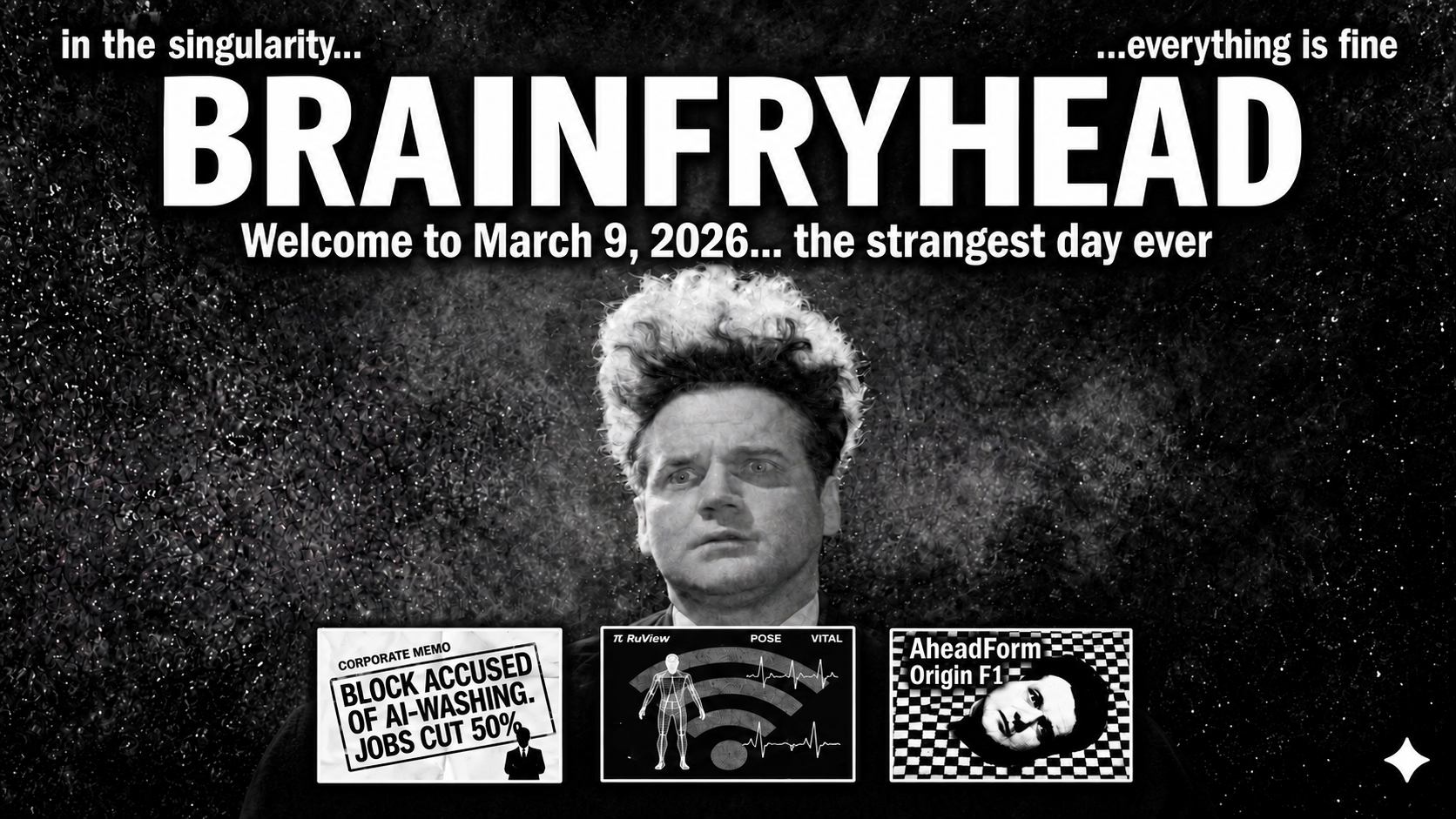
Friture Cérébrale IA (Eraserhead). AI Brain Fry Eraserhead. On March 9, 2026, @siouid142 created this tableau in response to Dr. Alex Wissner-Gross’s Innermost Loop report on “AI brain fry”: mental fog, buzzing sensations, and supervisory exhaustion among peop
Read the narration
Friture Cérébrale IA (Eraserhead).
AI Brain Fry Eraserhead.
On March 9, 2026, @siouid142 created this tableau in response to Dr. Alex Wissner-Gross’s Innermost Loop report on “AI brain fry”: mental fog, buzzing sensations, and supervisory exhaustion among people asked to oversee machines moving faster than human attention. The same dispatch placed that strain beside mass job displacement, Andrej Karpathy’s description of an early Singularity, ambient Wi-Fi sensing, expressive humanoids, and court decisions denying special personhood to bots. The image gives those developments a single nervous system.
David Lynch’s Eraserhead supplies the emotional architecture. Its protagonist, Henry Spencer, inhabits a black-and-white industrial world saturated by mechanical hum, biological dread, and systems he cannot understand or control. The response renames the film BRAINFRYHEAD. Henry’s electrically disturbed hair expands into the surrounding grain as though his body has become the overloaded wiring diagram of the AI workplace. Lynch’s soundscape is made visible: the buzzing mentioned in the report becomes an atmosphere rather than a symptom.
The poster language deepens the collision. “In the Singularity … everything is fine” echoes the Lady in the Radiator’s impossible consolation, while a subtitle calls the dispatch the strangest decade ever. That promise of reassurance is deliberately unconvincing. Henry’s face remains stunned, his gaze unable to reconcile the speed of the system with the limits of the organism expected to supervise it. The work treats cognitive overload not as a productivity inconvenience but as body horror.
Three panels along the lower edge identify where the nightmare entered the news. A corporate memo accuses Block of AI-washing while recording jobs cut by half, linking the rhetoric of automation to the material removal of workers. A π RuView display maps pose and vital signs through Wi-Fi, showing that a room can read a person without a camera or even a direct encounter. The final panel presents the emotionally expressive AheadForm Origin F1 humanoid as a detached head lying on the ground.
That head is an exact double pun, not a random severed prop. In Eraserhead, Henry’s head is literally removed and replaced. In the March 9 dispatch, AheadForm is the company name attached to a face designed to simulate human emotion. The label beside the object therefore reads simultaneously as AheadForm and “a head form.” Product branding, cinematic mutilation, and the problem of machine expression collapse into one Easter egg. The discarded head asks whether personhood resides in a face, a performance, a legal status, or the vulnerable biological mind that can no longer keep pace.
The Wi-Fi sensing panel complicates that question further. The human worker may feel mentally opaque and overwhelmed from within, yet the surrounding infrastructure increasingly treats the body as legible data. Pose, respiration, and presence can be inferred through walls while the person himself struggles to interpret the agents he is monitoring. Surveillance and exhaustion are mirror images: the system sees the human with growing precision as the human sees the system with diminishing clarity.
Charles Stross’s Accelerando provides another layer. Its characters rely on exocortices and confront cognitive environments that make unaugmented biology feel obsolete. Friture Cérébrale IA translates that speculative pressure into workplace medicine and corporate policy. The human is not simply replaced by a robot; he is asked to remain responsible for supervising an intelligence whose tempo produces the very impairment that makes supervision unreliable.
Formally, the work behaves like a damaged movie poster rather than an infographic. Monochrome grain, oversized face, industrial typography, and inset evidence make the scene feel culturally remembered before it has had time to become history. Humor operates through renaming and visual pun, but the mood refuses easy relief. The image preserves a precise contradiction of March 9: artificial systems were becoming more expressive, more perceptive, and more economically consequential at the same moment their human overseers reported feeling cognitively erased. BRAINFRYHEAD is thus less a prediction than a diagnosis rendered in the visual language of an older industrial nightmare. The film’s dread becomes a portrait of supervision after human attention has become the bottleneck. The diagnosis remains current.
Opening the gallery…