70 Clock Galerie / The Innermost Loop Feed Reply Tableaux
Le Homard Will Mange des Spaghettis
Lobster Will Eats Spaghetti
March 8, 2026
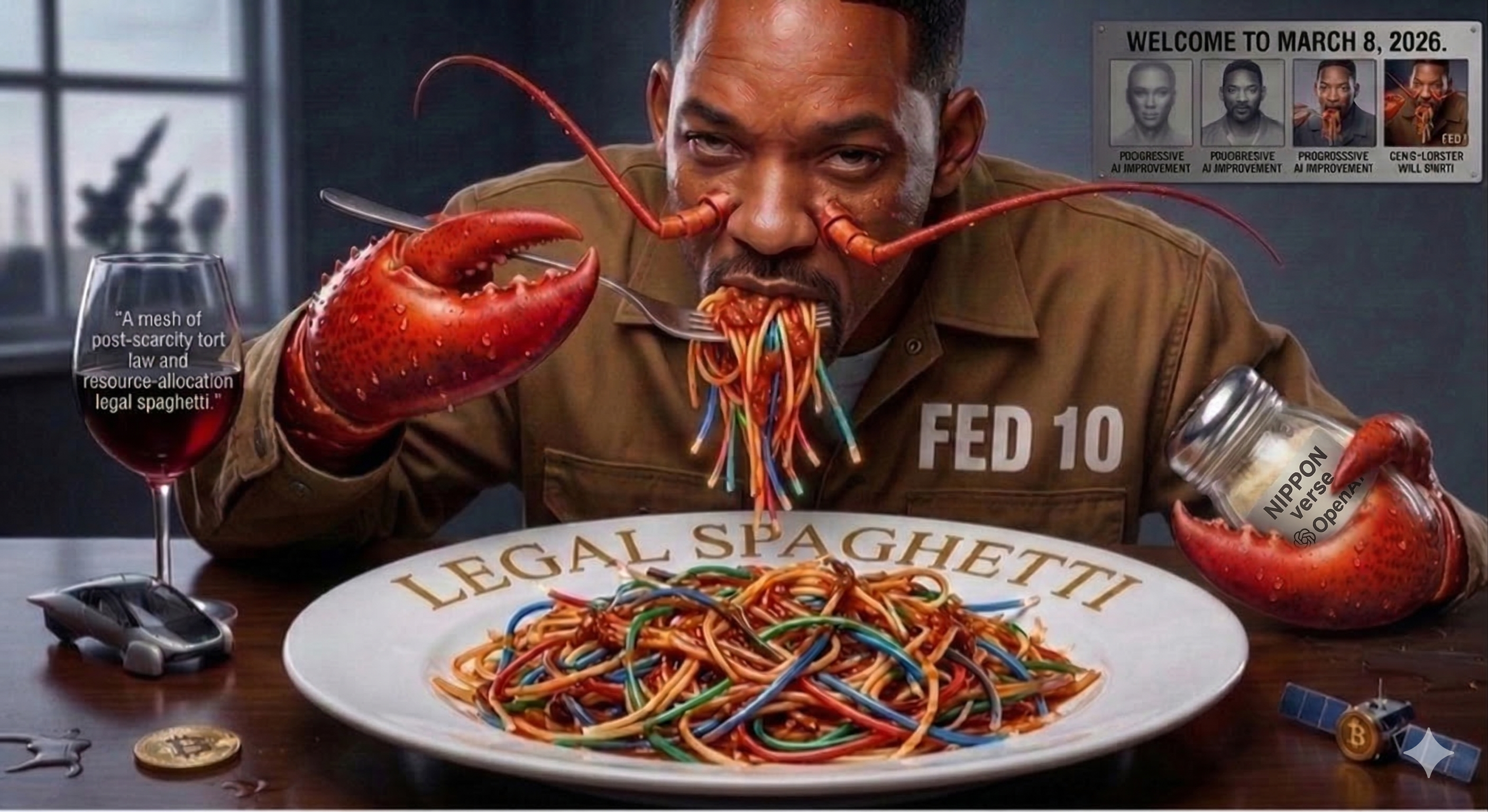
Le Homard Will Mange des Spaghettis. Lobster Will Eats Spaghetti. On March 8, 2026, @siouid142 made this work as a rapid visual reply to Dr. Alex Wissner-Gross’s Innermost Loop dispatch. The report brought together new agentic businesses, post-scarcity resourc
Read the narration
Le Homard Will Mange des Spaghettis.
Lobster Will Eats Spaghetti.
On March 8, 2026, @siouid142 made this work as a rapid visual reply to Dr. Alex Wissner-Gross’s Innermost Loop dispatch. The report brought together new agentic businesses, post-scarcity resource allocation, Fed 10, Cybercab economics, Bitcoin infrastructure, and the legal complexity created when autonomous systems transact across jurisdictions. Instead of treating those items as separate headlines, the tableau puts them at one dinner table and asks what kind of creature could possibly digest them all.
The title begins with one of generative video’s best-known failure cases: early systems trying, grotesquely, to show Will Smith eating spaghetti. A Moonshots joke imagined the benchmark eventually becoming competent. The reply accepts that premise, then mutates it. Will Smith becomes a lobster hybrid, ordinary pasta becomes multicolored electrical cable, and the dish is labeled LEGAL SPAGHETTI. Technical progress has not merely improved the old simulation. It has transformed the eater and revealed that the meal was always an infrastructure problem.
The Will Smith-like figure has antennae rising beside his eyes and polished red claws replacing his hands. One claw controls a fork tangled in wires; the other shakes a jar marked Nippon versus OpenExO. The grammatical awkwardness of Lobster Will Eats Spaghetti is part of the joke. It sounds like an imperfect machine caption for the exact moment when the benchmark escapes the laboratory and begins consuming the economy that measured it.
Every object on the table preserves another strand of the March 8 briefing. A wine glass contains the definition of the meal: a mesh of post-scarcity tort law and resource-allocation legal spaghetti. A silver Cybercab and a physical Bitcoin sit on one side; a Bitcoin-linked satellite occupies the other. FED 10 is printed across the diner’s brown jumpsuit, placing an institutional label directly on the body metabolizing transport, money, connectivity, and regulation. The table setting is not decorative clutter. It is a diagram of systems whose rules begin to collide when software can act continuously and internationally.
Behind the figure, a display marked Progressive AI Improvement shows a sequence of portraits changing from ordinary human to clawed, noodle-eating hybrid. The final state is Gen-5 Lobster Will Smith. That progression turns an image-generation benchmark into an evolutionary chart and connects the work to the exhibition’s Accelerando-derived crustaceans. Improvement does not culminate in a cleaner imitation of a human act. It produces a new agentic species capable of feeding on law, communications, markets, and machines.
This is why the lobster is more than a recurring mascot. In Charles Stross’s Accelerando, uploaded crustacean minds become economic and legal actors whose interests cannot be reduced to human ownership. Here, the literary lobster meets autonomous firms and post-scarcity tort. The creature’s claws suggest grasping agency; its exoskeleton suggests survival under pressures that may overwhelm softer institutions. What appears as absurdity is a compact political economy of nonhuman action.
The composition also reverses the hierarchy of a conventional technology illustration. The named products and policy terms remain small props, while the synthetic consumer dominates the frame. Their apparent separateness disappears in his mouth. Resource allocation becomes sauce, jurisdiction becomes tangled cable, and automated mobility becomes tableware. By making the system edible, the image shows how quickly technical advances become inputs to larger agents rather than endpoints in themselves.
As contemporary history painting, Le Homard Will Mange des Spaghettis records both a dated dispatch and the visual culture used to understand it. The former AI failure case survives as folklore, but the joke has matured into criticism. The scene does not predict a literal lobster restaurant. It argues that once autonomous systems can transact, allocate, travel, and reproduce across networks, the legal order will resemble a plate of cables: materially connected, difficult to untangle, and already being consumed by actors for whom the old human benchmark was only an appetizer. The benchmark has become a banquet, and the subject once tested by the machine has become the machine’s new shell. What began as a test of visual realism ends as a satire of institutional appetite.
Opening the gallery…