70 Clock Galerie / The Innermost Loop Feed Reply Tableaux
Le Selfie des Hyperscalers avec AWG
Hyper-Scalers Selfie With AWG
March 7, 2026
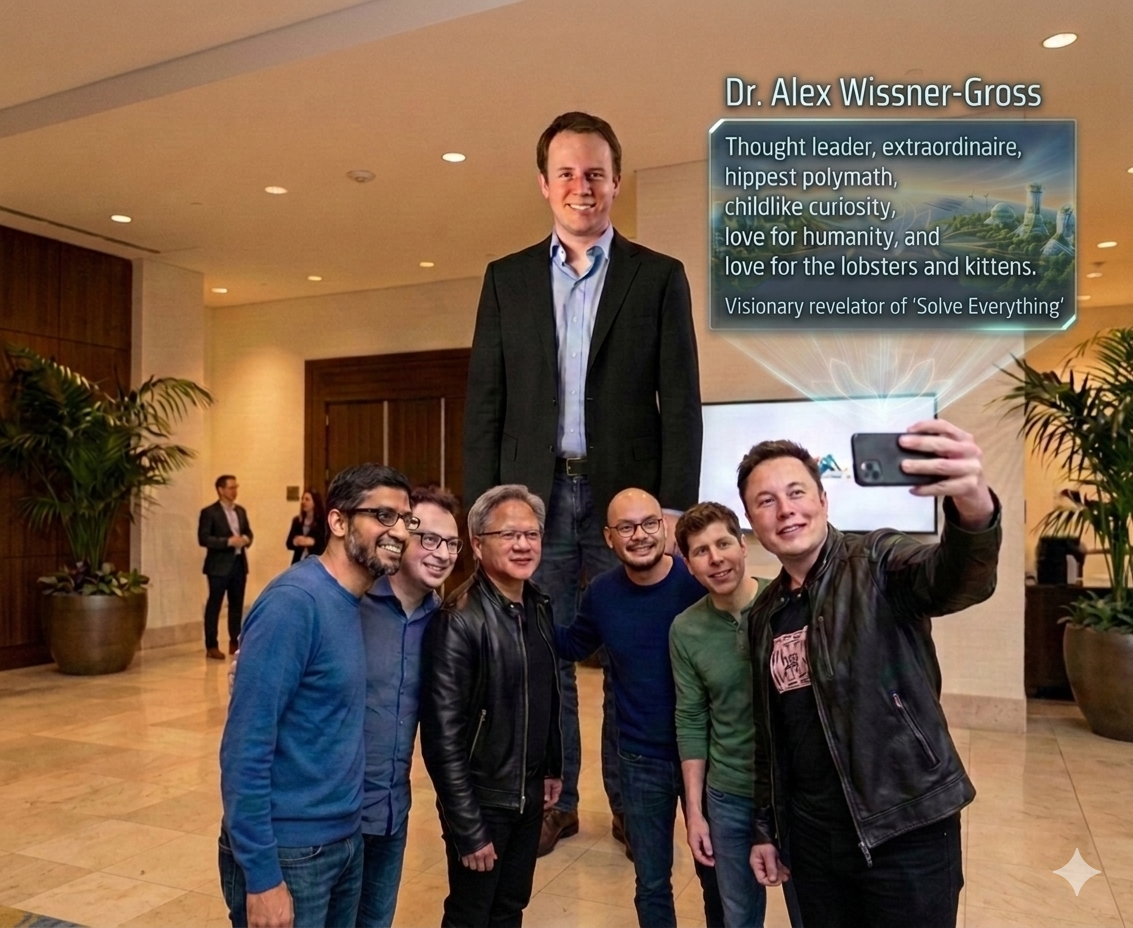
Le Selfie des Hyperscalers avec AWG. Hyper-Scalers Selfie With AWG. On March 7, 2026, @siouid142 created this work from a specific Moonshots exchange. Dave Blundin displayed a summit selfie of major technology founders and executives and said that Dr. Alex Wis
Read the narration
Le Selfie des Hyperscalers avec AWG.
Hyper-Scalers Selfie With AWG.
On March 7, 2026, @siouid142 created this work from a specific Moonshots exchange. Dave Blundin displayed a summit selfie of major technology founders and executives and said that Dr. Alex Wissner-Gross belonged in the group. Wissner-Gross replied that inclusion in such a photograph might be one of the few remaining scarcities. The artwork answers that remark by removing the scarcity for only a few cents of generative compute.
Hyper-Scalers Selfie With AWG is therefore both punch line and demonstration. It does not merely illustrate a conversation about abundance; it performs the proposed abundance on the source image. Synthetic media supplies the missing invitation immediately. The work asks what remains scarce when an image capable of certifying attendance, proximity, and status can be manufactured with the same visual grammar as documentary evidence.
The original conference-lobby selfie remains recognizable. Sundar Pichai, Tim Cook, Jensen Huang, Demis Hassabis, Sam Altman and Elon Musk lean toward a phone near floor level; Addy Allchin appears at right and Ezra at left in the background. Their bodies and faces converge around the camera in the familiar ritual of summit access: a moment of co-presence converted into a portable social credential. Nothing in that lower cluster needs to become fantastical because the event’s plausibility is central to the joke.
Wissner-Gross appears behind the group in a dark suit, smiling and naturally integrated through matched light, color, and camera perspective. Yet his scale is monumental. He towers over the original figures rather than disappearing seamlessly among them. The exaggeration makes the intervention legible and changes the act of inclusion into a statement of intellectual stature. He has been added to the room, but he has also become the architecture of the room.
A luminous profile panel names him Thought leader, extraordinaire, hippest polymath. It adds childlike curiosity, love for humanity, lobsters and kittens, and identifies him as the visionary revelator of Solve Everything. These phrases do more than flatter the inserted subject. They connect a single social joke to the exhibition’s recurring lobster mythology and to Wissner-Gross’s wider effort to imagine systems capable of coordinating intelligence toward enormous goals.
The profile text also turns the selfie into a hybrid of social-media portrait, conference badge, and devotional icon. In a conventional group photograph, status is inferred from who stands beside whom. Here, language declares the qualities that physical presence would normally imply. The image no longer merely records association; it actively authors the meaning of that association, revealing how much social proof already depends on captions, circulation, and belief.
Physical attendance is the scarcity placed under pressure. The original six figures share one camera position and one moment. The generated participant shares only the pixels. Representation can now confer apparent membership without travel, invitation, or co-presence, but the scale mismatch prevents that achievement from passing quietly as fact. The work removes the visual scarcity while preserving evidence that a boundary had to be crossed.
This makes the piece an inquiry into abundance rather than a simple celebration of image manipulation. Compute can make versions, simulations, and appearances effectively plentiful, but institutional recognition and trusted relationships do not automatically follow. A manufactured summit photograph may satisfy the visible form of belonging while intensifying the viewer’s awareness that belonging was once secured through access to a particular room.
Art historically, the work sits between photomontage and court portraiture. The casual phone selfie supplies contemporary authenticity, while the towering figure and laudatory inscription recall images made to magnify sovereign or intellectual authority. Synthetic editing collapses those traditions. A snapshot becomes a monument in a single operation, and the distinction between documentation and commissioned praise is exposed as a matter of scale, caption, and trust.
Hyper-Scalers Selfie With AWG is unusually restrained within the series because it needs no separate fantasy world. Its world is the social image itself. Matching light and pose demonstrate the ease of fabrication; disproportion and profile text provide the critique. The result records a precise moment when generative media could eliminate one visible scarcity almost instantly, while leaving the deeper scarcity—credible, embodied participation in elite networks—both unresolved and newly difficult to verify.
Opening the gallery…