70 Clock Galerie / The Innermost Loop Feed Reply Tableaux
Les Tomates Tueuses de l’IA
AI Grown Killer Tomatoes
March 5, 2026
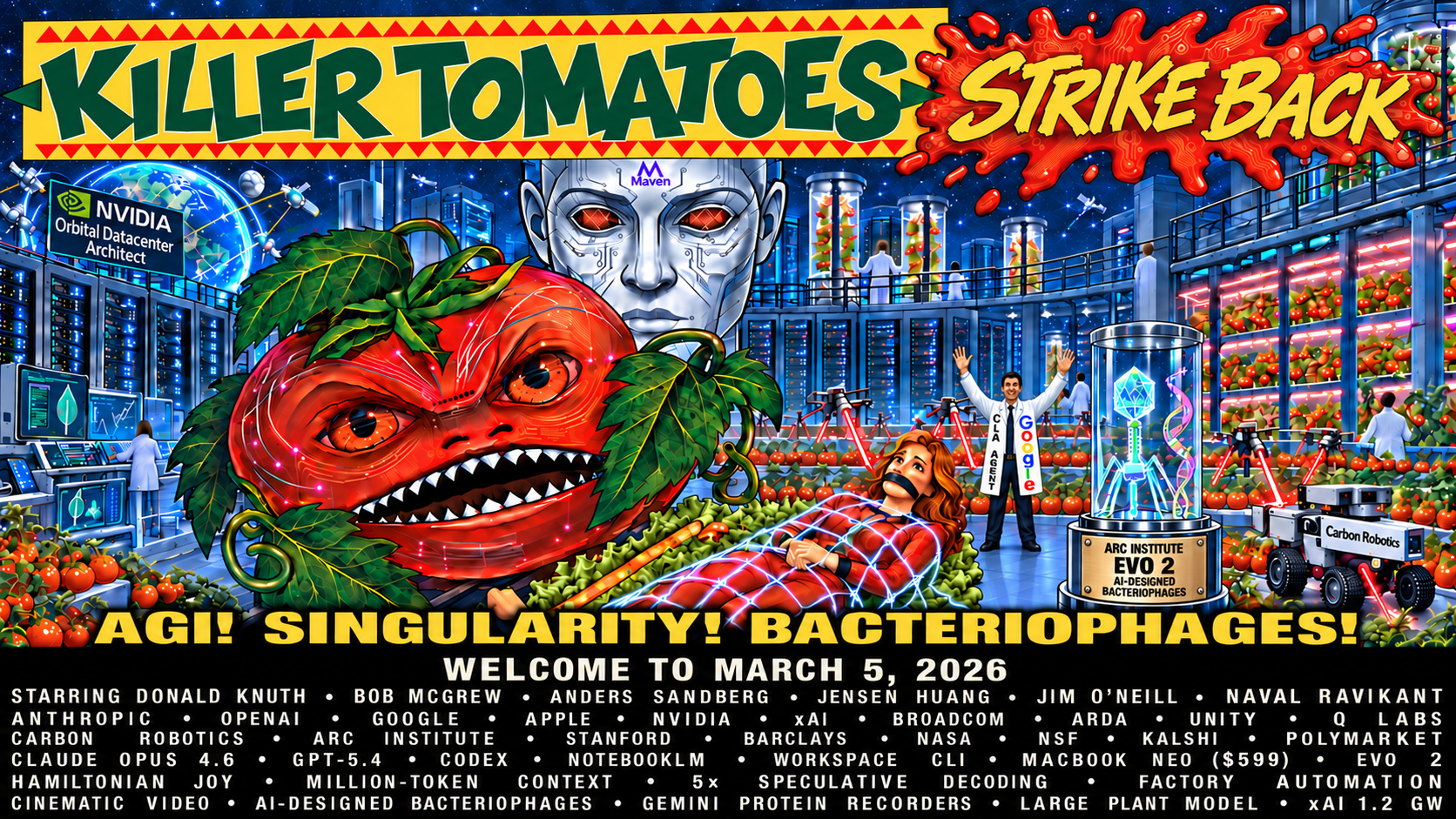
Les Tomates Tueuses de l’IA. AI Grown Killer Tomatoes. On March 5, 2026, @siouid142 created AI Grown Killer Tomatoes as a same-day reply to Dr. Alex Wissner-Gross’s Innermost Loop dispatch. The source moved rapidly from AI-designed biological interventions and
Read the narration
Les Tomates Tueuses de l’IA.
AI Grown Killer Tomatoes.
On March 5, 2026, @siouid142 created AI Grown Killer Tomatoes as a same-day reply to Dr. Alex Wissner-Gross’s Innermost Loop dispatch. The source moved rapidly from AI-designed biological interventions and engineered bacteriophages to long-context models, speculative decoding, autonomous research, factory systems, consumer hardware, and cinematic synthesis. The artwork needed a form capable of holding acceleration, biology, and technological excess in one frame.
The chosen form is the exploitation poster, specifically Attack of the Killer Tomatoes. The reference turns computation crossing into biological design into a B-movie event: an engineered crop becomes the monster. This is not a random substitution of an AI label for an old film title. The tomato is familiar food transformed by an invisible design pipeline, making it an effective body for fears about models beginning to edit, select, and deploy living systems.
A gigantic tomato lunges from the foreground with predatory eyes, teeth, twisting vines, and circuitry glowing beneath its red skin. Large Plant Model is printed along a leaf, collapsing the distinction between a language model and Carbon Robotics’ model trained on roughly 150 million labeled plants for laser-weeding agriculture. The pun converts a technical category into anatomy: the model is no longer merely observing plants but appears to have become one.
Below the attack, a human figure is trapped inside a bright digital lattice. The grid visualizes a person caught in the translation from data to biological action. Behind it, a Maven-marked robotic head presides over the scene, while a lab-coated Workspace GUI Agent, small automated equipment, and regimented rows of tomatoes make the monster look designed and instrumented rather than naturally mutated. Laboratory order produces pulp chaos.
The poster’s secondary labels preserve the dispatch’s breadth. Orbital Datacenter Architect sits beside a world map. Maven appears on both the central machine and a scientist’s badge, suggesting a research system present as tool, authority, and character. The green footer names Claude Opus 4.6 and Hamiltonian Joy, GPT-5.4’s million-token context window, Stanford’s five-times speculative decoding, ARDA factory automation, NotebookLM-style cinematic video, and the inexpensive Apple MacBook Neo.
These credits describe a pipeline rather than a random collage. Longer context and faster decoding increase the amount and speed of reasoning. Autonomous research systems propose and test. GUI agents operate interfaces. Factories and agricultural machines move from analysis into deployment. Consumer devices lower the cost of access, while orbital infrastructure expands the imagined site of computation. Engineered bacteriophages provide the biological edge at which the pipeline begins to alter living matter.
The final banner—AGI! SINGULARITY! BACTERIOPHAGES!—behaves like an exploitation-film promise. Each word escalates the previous one, yet the last term is a real biological mechanism rather than science-fiction decoration. Elsewhere, tiny bacteriophage forms resemble lunar landers or alien machines. The poster exploits that visual resemblance, allowing a tool of molecular biology to enter the same iconography as invasion from space.
The B-movie grammar is crucial. A conventional infographic would rank the day’s developments and imply that their relationship was already settled. The lurid poster admits that their coexistence feels excessive and unstable. It can place models, crops, laboratories, consumer devices, orbital compute, and engineered viruses together without pretending they form a calm forecast. Camp becomes a method for representing systems moving faster than cultural categories.
Color and scale organize the apparent chaos. The tomato’s saturated red body dominates the cooler laboratory environment; circuitry and digital grids connect organic surface to computational infrastructure. Small researchers and machines are reduced to supporting cast while the product of their pipeline occupies the star position. The image thereby reverses the usual promotional hierarchy: technology companies and models receive billing, but the engineered organism receives the close-up.
As contemporary history painting, AI Grown Killer Tomatoes records the biological turn of the intelligence explosion through popular horror. Its comedy is inseparable from its warning. The work does not claim that an actual tomato will attack a city. It argues that once AI systems participate in designing biological interventions, the boundary between information processing and material consequence becomes harder to maintain. The monster is the pipeline made visible—trained on the world, accelerated through computation, and finally released into living form.
Opening the gallery…