70 Clock Galerie / The Innermost Loop Feed Reply Tableaux
Le Guide AWG du Voyageur Galactique
AWG’s Guide to the Hitch-Hikers Guide
March 4, 2026
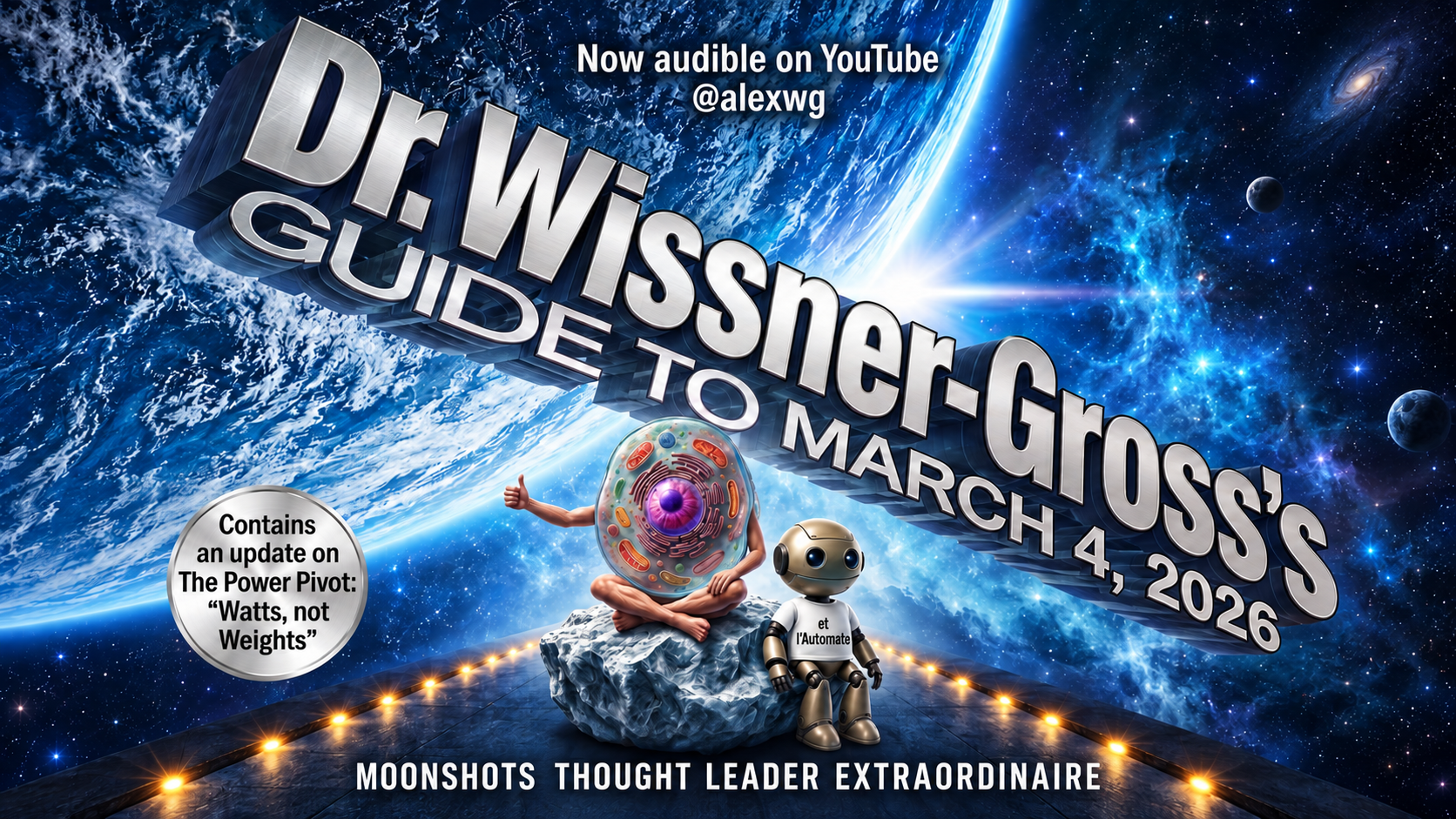
Le Guide AWG du Voyageur Galactique. AWG’s Guide to the Hitch-Hikers Guide. On March 4, 2026, @siouid142 made this work as a visual reply to Dr. Alex Wissner-Gross’s Innermost Loop dispatch. The day’s report connected panspermia, Jacques de Vaucanson’s eightee
Read the narration
Le Guide AWG du Voyageur Galactique.
AWG’s Guide to the Hitch-Hikers Guide.
On March 4, 2026, @siouid142 made this work as a visual reply to Dr. Alex Wissner-Gross’s Innermost Loop dispatch. The day’s report connected panspermia, Jacques de Vaucanson’s eighteenth-century automata, and a changing constraint on artificial-intelligence scaling: less emphasis on the number of model weights, and more attention to the watts required to run intelligence. The artwork treats that unlikely conjunction as travel advice.
AWG’s Guide to the Hitch-Hikers Guide borrows the publishing language of Douglas Adams’s The Hitchhiker’s Guide to the Galaxy. The reference is exact because the dispatch already ranges across cosmic biology, the prehistory of robotics, and the energetics of future computation. A guidebook offers the right cultural container for information that is simultaneously scientific, absurd, and necessary for surviving a world whose operating assumptions have changed.
The central traveler is a transparent cellular life-form seated cross-legged on a drifting rock. It turns panspermia—the possibility that life can travel between worlds on asteroids or other material—into a literal hitchhiker. The meditative pose is comic and serene, but the surrounding cosmos gives it evolutionary scale. Before humans, companies, or machines, biology itself may already have been a passenger moving through an infrastructure it did not build.
Beside the cell sits a small brass robot wearing the label et l’Automate. The phrase points back to Vaucanson, whose flute-playing automaton and mechanical duck belong to the long genealogy of machines designed to imitate living action. The robot is not drawn as a sleek twenty-first-century humanoid. Its antique metal body preserves the historical distance between mechanical simulation and modern artificial intelligence, allowing both to occupy the same waiting rock.
Cell and automaton form a pair of travelers from different origins. One represents life carried by matter; the other represents life-like behavior assembled by craft. Their adjacency asks whether contemporary machine intelligence is an unprecedented break or another stage in a much older traffic among biology, mechanism, and environment. Neither figure drives the asteroid. Both depend on a substrate whose movement and energy exceed them.
The silver jagged seal provides the practical update: The Power Pivot—Watts, not Weights. Styled like a promotional badge pasted onto a bestselling paperback, it reframes an infrastructure constraint as the essential warning a galactic traveler must read before departure. Model architecture may dominate public discussion, but power generation, transmission, cooling, and physical capacity determine how much intelligence can actually be deployed.
The diagonal metallic title wraps around a planet, preserving the recognizable visual grammar of a cosmic guidebook. Smaller inscriptions date the volume March 4, 2026, advertise that it is now audible on YouTube at @alexwg, and identify Wissner-Gross through the Moonshots language of thought leadership. The Douglas Adams author line remains as a cultural anchor. Newsletter, audio channel, literary parody, and technical update become competing layers of publication metadata.
The composition operates across three timescales. Panspermia reaches toward life’s cosmic origin; Vaucanson supplies an eighteenth-century ancestor of robotics; the watts-versus-weights seal names an immediate industrial bottleneck. Binding those scales into one cover prevents the present from appearing self-contained. Today’s energy problem belongs to a journey that began before electronics and perhaps before Earthly life.
As a work of art, the Guide converts a list of heterogeneous facts into a hierarchy the eye can navigate. The cell and robot carry the philosophical question, the asteroid carries panspermia, the seal carries the engineering constraint, and the cover apparatus explains how the viewer should read their collision. Humor is analytic because each absurd detail preserves a source relationship. The image does not reduce the dispatch to a slogan; it builds a portable interface for its temporal and conceptual scale.
The deeper joke is that a civilization capable of debating cosmic life and artificial minds remains constrained by an electricity bill. AWG’s Guide to the Hitch-Hikers Guide places that mundane physical limit on the cover of a galactic adventure. In doing so, it turns power infrastructure into destiny: wherever intelligence travels—inside cells, clockwork bodies, neural networks, or future machines—it still requires a ride, a substrate, and enough energy to continue.
Opening the gallery…