70 Clock Galerie / The Innermost Loop Feed Reply Tableaux
Llama Mac Mini
Llama Mac Mini
March 3, 2026
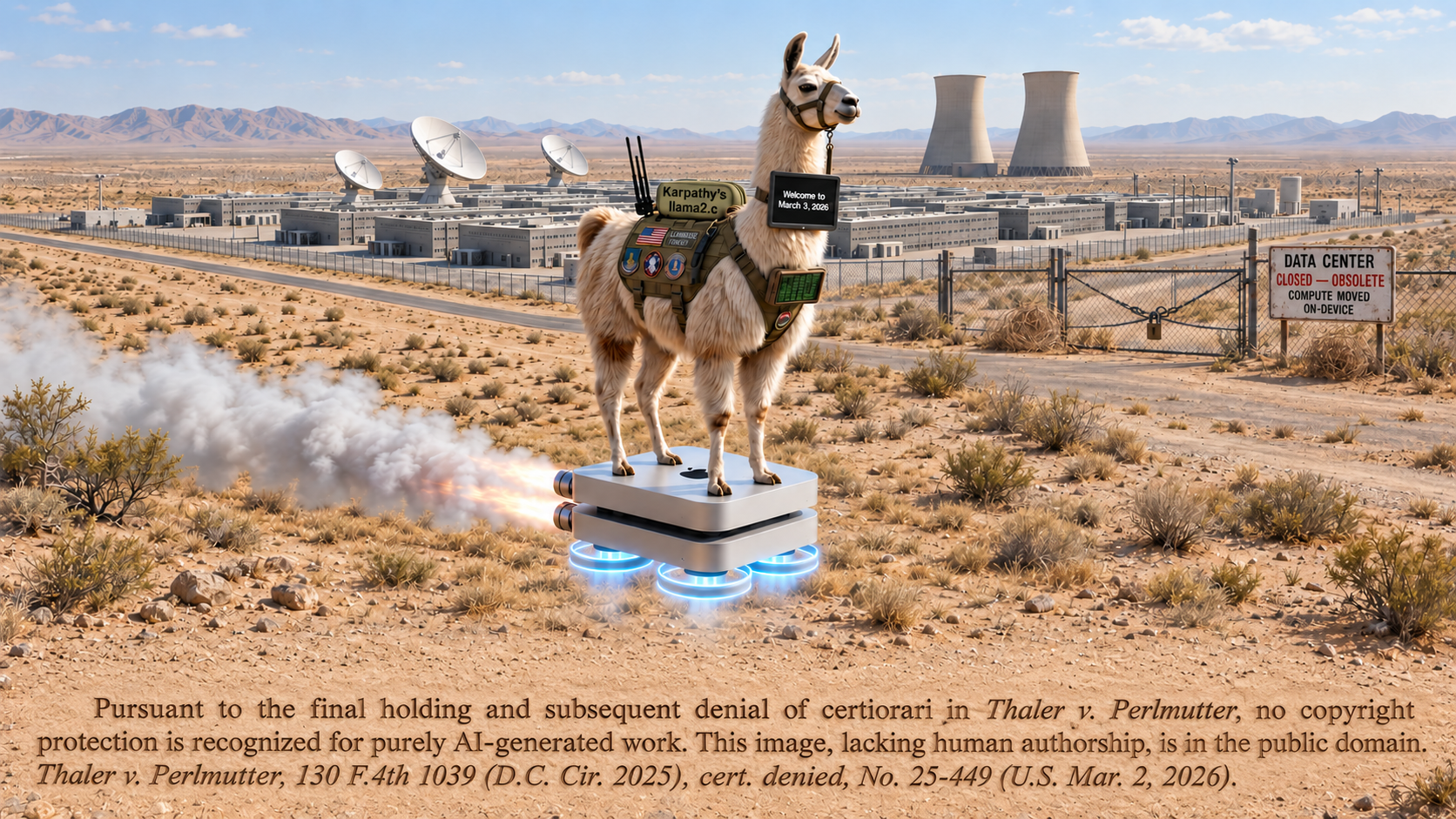
Llama Mac Mini. Llama Mac Mini. On March 3, 2026, @siouid142 created Llama Mac Mini as a visual reply to Dr. Alex Wissner-Gross’s Innermost Loop dispatch. The source highlighted Andrej Karpathy’s llama2.c demonstration on compact Apple hardware and the renewed
Read the narration
Llama Mac Mini.
Llama Mac Mini.
On March 3, 2026, @siouid142 created Llama Mac Mini as a visual reply to Dr. Alex Wissner-Gross’s Innermost Loop dispatch. The source highlighted Andrej Karpathy’s llama2.c demonstration on compact Apple hardware and the renewed practical importance of local or edge computation. It also placed that hardware story beside the legal debate over whether outputs made without human authorship can receive conventional copyright protection.
The title makes the model-and-machine pairing literal. A llama stands astride two Mac minis as though they were a rocket sled, while a giant data center sits closed on the desert horizon. The animal is Meta’s open-model name given flesh; the small Apple computers become propulsion. A software demonstration is therefore translated into escape imagery: the model does not merely run on compact hardware but rides it away from the industrial campus on which advanced computation seemed permanently dependent.
The llama is equipped for more than a joke. Tactical webbing, antennas, patches, small displays, and communications gear turn it into an edge-computing operator. A label naming Karpathy’s llama2.c fixes the pun to the reported demonstration. Its stance is alert and self-directed, suggesting that computation near the user can sense and act rather than merely reproduce a remote service in miniature. The living animal and the software model become indistinguishable components of the same mobile agent.
Beneath its hooves, stacked Mac minis have acquired glowing lift rings and rear thrusters. Dust and exhaust spread across the launch ground. The computers retain the clean geometry of consumer hardware even as they perform like aerospace machinery. That transformation measures the conceptual jump in the source: a device designed to sit quietly on a desk becomes a vehicle for local intelligence. Capability is represented not by making the computer larger, but by allowing the model to leave.
The CLOSED DATA CENTER sign, cooling structures, and satellite dishes remain fixed in the distance. The work does not destroy hyperscale infrastructure; it turns it into a stranded monument to a heavier architecture. Centralized compute still dominates the skyline, but the image’s movement belongs to the smaller system. Edge intelligence gains freedom through proximity, lower latency, privacy, and independence from a permanently open network connection. The deserted facility reads like an old terminal after the departure has already occurred.
A posted legal notice beneath the launch site cites Thaler v. Perlmutter and states that a work produced without human authorship lacks copyright protection and enters the public domain. This is the second launch in the image. Compute escapes the data center, while the resulting cultural object escapes the familiar framework of ownership. The notice is not a generic disclaimer; it joins deployment and authorship as parallel consequences of increasingly autonomous production.
That juxtaposition creates the work’s central tension. Decentralized models appear to return control to the user by moving intelligence closer to the device. Yet if the model becomes the effective maker, the law may refuse to recognize the output as property in the ordinary sense. Locality can therefore increase technical agency while destabilizing legal possession. The llama is liberated from the data center at the same moment its work is declared unownable.
The desert staging borrows from launch photography, Western escape scenes, and science-fiction concept art. Against a wide horizon, the absurd animal-machine hybrid becomes a frontier figure. The tactical harness prevents the llama from reading as merely cute, while the pristine Mac minis prevent the rocket from becoming conventional military hardware. Corporate design, open-source code, animal symbolism, and legal text retain their separate identities even as they operate as one contraption.
As art criticism, Llama Mac Mini uses scale and movement to challenge the mythology of inevitable centralization. The closed campus is massive but inert; the compact stack is ridiculous but mobile. The work captures a moment when frontier computation began to be imagined not only as bigger clusters behind fences, but also as capable models running beside their users. Its humor makes that shift memorable, while the copyright notice prevents technical emancipation from being mistaken for a simple story of ownership or control.
Opening the gallery…