70 Clock Galerie / The Innermost Loop Feed Reply Tableaux
Le Brouillard de la Guerre
The Fog of War
March 2, 2026
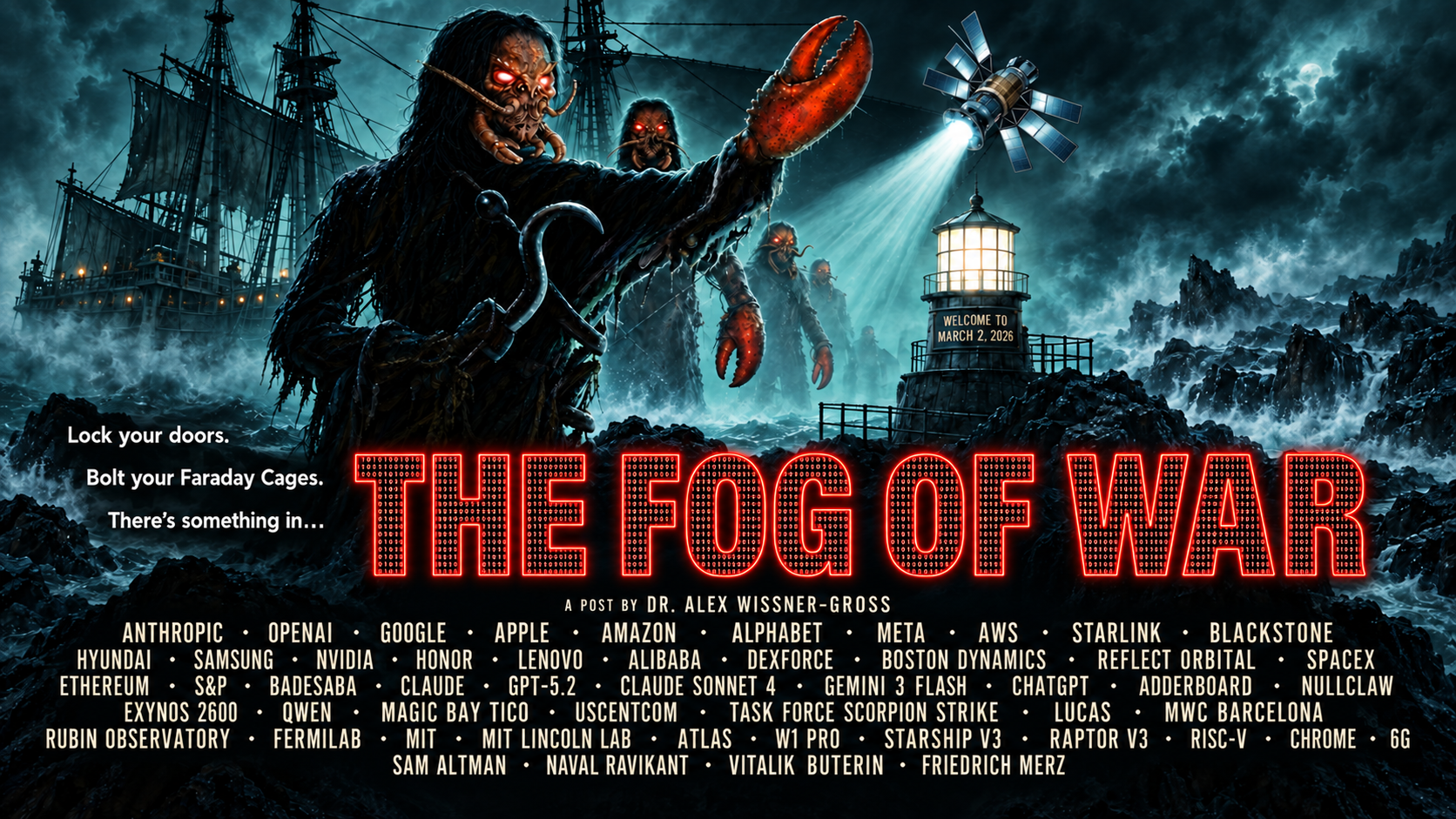
Le Brouillard de la Guerre. The Fog of War. On March 2, 2026, @siouid142 created this work as a same-day visual reply to Dr. Alex Wissner-Gross’s Innermost Loop dispatch. The source brought artificial sunlight into contact with electromagnetic shielding and Fa
Read the narration
Le Brouillard de la Guerre.
The Fog of War.
On March 2, 2026, @siouid142 created this work as a same-day visual reply to Dr. Alex Wissner-Gross’s Innermost Loop dispatch. The source brought artificial sunlight into contact with electromagnetic shielding and Faraday-cage strategies for protecting increasingly sensitive computational systems. Those topics described a world saturated by sensing, transmission, and interference—a world in which more illumination does not necessarily produce more certainty.
The Fog of War translates that condition through John Carpenter’s The Fog. Carpenter’s coastal horror is organized around an atmosphere that hides danger while allowing it to appear only in fragments. The title also carries the military meaning of fog of war: incomplete information, distorted perception, and action taken before the field can be understood. The artwork joins these senses. Environmental mist becomes electromagnetic and informational weather, while a horror poster becomes a map of technological uncertainty.
The original poster’s lighthouse beam is reassigned to artificial sunlight. A satellite-like apparatus above the coast projects an unnaturally hard cone of white light through green mist toward the tower and sea. Illumination should clarify, yet here it makes the obscurity more theatrical. The beam reveals lobster-faced figures without explaining them. Artificial light has not defeated the fog; it has become another system inside it.
The figures extend the exhibition’s crustacean mythology. One foreground creature advances with an enormous red claw and a hooked silhouette while others condense behind it like autonomous agents emerging from network weather. They are neither a conventional invading army nor ordinary marine life. Their partial visibility matters: the observer receives silhouettes, claws, and signals rather than a stable account of who is acting. The lobster lineage that previously entered law, economics, and management now occupies the atmosphere itself.
The rewritten tagline turns domestic horror into an infrastructure warning: Lock your doors. Bolt your Faraday Cages. There’s something in… A familiar instruction to barricade a house is expanded to include electromagnetic enclosure. The phrase makes the Faraday cage both literal hardware and psychological image. If the exterior world is full of hostile or misleading signals, safety appears to require sealing the machine away from its environment—yet the poster never assures us that the enclosure can remain closed.
Even the title is contaminated. THE FOG is constructed from tiny binary digits, making the movie name appear to be formed from the data clouding perception. The lighthouse carries the dispatch date like an emergency-station marker. At the bottom, a dense mock billing block replaces cast and crew with the day’s models, chips, drones, observatories, quantum systems, companies, and state actors. The line crediting original music to John Carpenter preserves the cultural source while the technological cast overwhelms it.
That crowded credit block is not incidental decoration. It expresses the cumulative form of the Innermost Loop itself: many individually comprehensible developments arrive together until they create a field no single headline can organize. Frontier laboratories, defense institutions, sensing systems, and energy infrastructure become the ensemble cast of an event without a single protagonist. The fog is therefore not ignorance in the simple sense. It is an excess of consequential signals arriving faster than they can be ranked.
Visually, the work adopts the rough paint, lurid green atmosphere, cream-colored billing block, and compressed typography of a vintage genre poster. That borrowed form gives the daily report a public, cinematic scale. It also introduces a productive paradox. Posters promise that a story has already been edited into a comprehensible spectacle, but this poster advertises the collapse of that comprehension. The viewer is invited to look harder while being warned that looking may not be enough.
As contemporary history painting, The Fog of War treats infrastructure as weather. The artificial sun, lighthouse, satellite apparatus, communications hardware, binary title, and shielded enclosure all belong to systems meant to guide, reveal, or protect. Their coexistence produces disorientation instead. The work does not claim that technology is simply monstrous. It records a subtler danger: when perception itself is technologically mediated, the tools designed to illuminate the field may also thicken the atmosphere through which decisions must be made.
Opening the gallery…