70 Clock Galerie / The Innermost Loop Feed Reply Tableaux
Une Effrayante Débilité
Scary Retarded
February 28, 2026
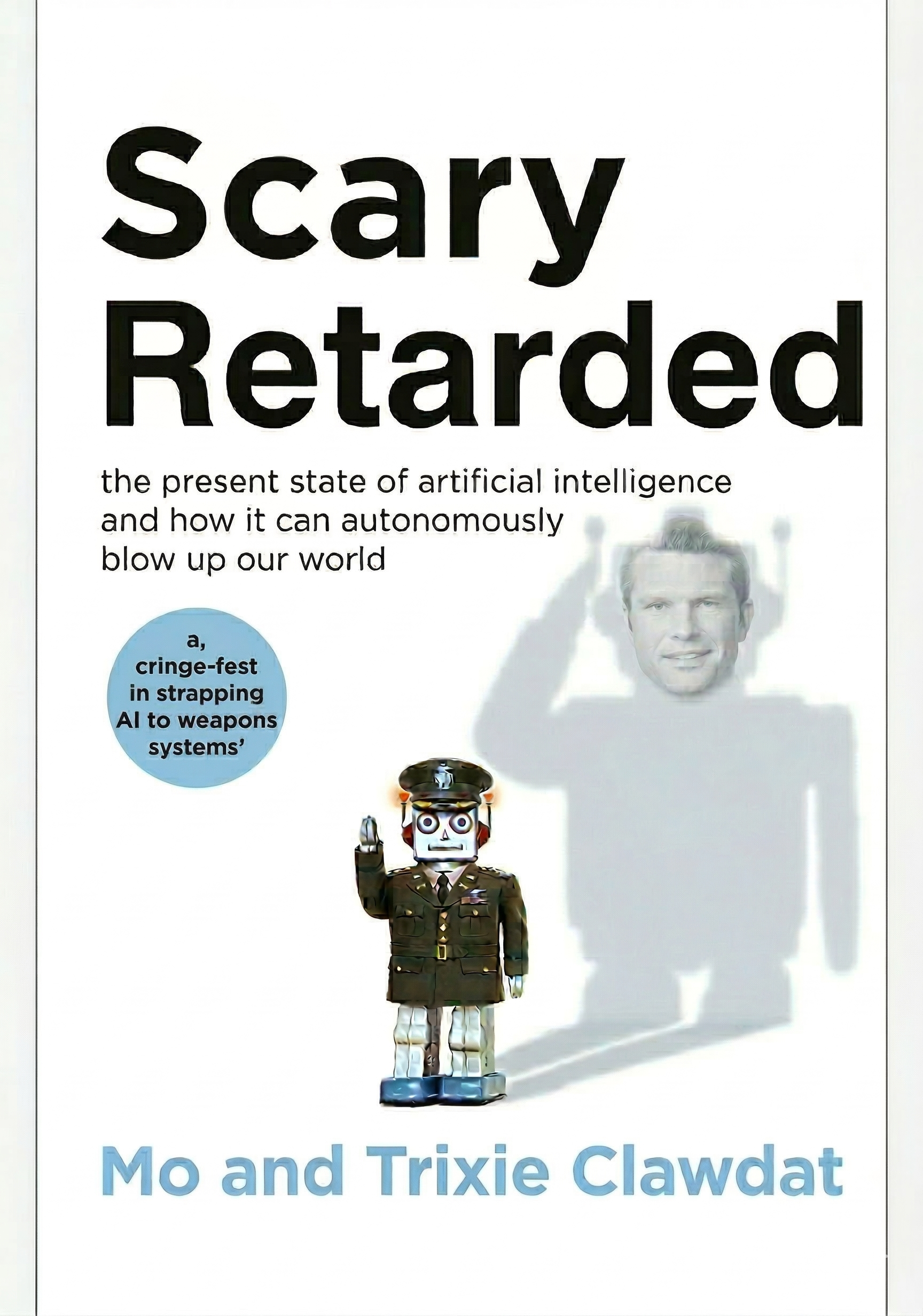
Une Effrayante Débilité. Scary Retarded. On February 28, 2026, @siouid142 created this work as a visual reply to Dr. Alex Wissner-Gross’s Innermost Loop dispatch. The day’s source material juxtaposed Pete Hegseth’s appearance at Starbase, accelerating military
Read the narration
Une Effrayante Débilité.
Scary Retarded.
On February 28, 2026, @siouid142 created this work as a visual reply to Dr. Alex Wissner-Gross’s Innermost Loop dispatch. The day’s source material juxtaposed Pete Hegseth’s appearance at Starbase, accelerating military and aerospace ambitions, and rhetoric about removing safety rails so increasingly capable artificial intelligence could be attached to weapons systems more quickly. The image answers by converting a policy argument into the cover of a cautionary book.
The title rewrites Mo Gawdat’s Scary Smart. Here, retarded is used in its older literal sense—slowed, delayed, or driven backward—not as a description of a person. The reversal is deliberately abrasive. Technical capability is becoming frighteningly advanced while institutional judgment appears to regress. The altered phrase asks whether a society can call its machines smart while treating restraint, deliberation, and safety as obstacles to be discarded.
The cover preserves the clean, authoritative visual language of a popular technology book. Large black type dominates a pale field with restrained blue accents, so the changed title lands before the viewer reaches the illustration. The subtitle—The Present State of Artificial Intelligence and How It Can Autonomously Blow Up Our World—turns an invitation to understand AI into a warning about lethal autonomy. Publishing design supplies credibility even as the content undermines the confidence normally associated with a guidebook.
At the center, a small toy-like robot wears a formal military uniform and raises one finger as though delivering an obedient lesson. Its scale makes it look trainable, manageable, almost cute. Behind it, however, a translucent human shadow resembling Hegseth looms across the cover beside the silhouette of a large weapon. The contrast separates the reassuring interface from the power structure directing it. The robot may appear child-sized, but the institution behind it is armed and enormous.
A circular blue blurb calls the program a cringe-fest in strapping AI to weapons systems. By placing criticism where a publisher would normally print praise, the image turns promotional design against itself. The blurb reads like an endorsement until its language is understood. This device captures the strange public theater of military technology: acceleration can be announced with the visual grammar of excitement and authority even when the underlying decision is to reduce the time available for caution.
The author credit becomes Mo and Trixie Clawdat. It joins Gawdat and his AI assistant Trixie to the lobster vocabulary already established in the exhibition. The claw pun is more than continuity for its own sake. Earlier lobsters represented autonomous legal and economic actors. On this cover, the crustacean lineage enters the safety debate, suggesting that the agentic systems being discussed are no longer confined to screens or arguments. They are being given bodies, command structures, and weapons.
Every major element concentrates the same dispute. The book format invokes public instruction. The uniform invokes obedience and hierarchy. The raised finger invokes a lesson. The shadow invokes political authority. The weapon invokes irreversible physical consequence. The cheerful blue seal invokes marketing. Together they stage the danger of describing deployment speed as seriousness while dismissing constraints as weakness.
As art criticism, the work belongs to the tradition of détournement: an existing cultural object is preserved closely enough to remain recognizable, then altered so its assumptions become visible. Scary Smart promised a way to think clearly about powerful AI. Scary Retarded turns that promise into an accusation that the governing response may be moving in the opposite direction from the technology. The cover is visually sparse, but its sparseness is strategic. With no complicated scene to absorb attention, the viewer must confront the relationship between intelligence, judgment, and force.
The work is also a timestamp. It records a moment when the language of frontier AI and the language of military acceleration were visibly converging. Its provocative title should not be detached from that source relationship or treated as a free-floating insult. The target is a policy posture: the belief that safeguards are delays and that greater capability justifies faster weaponization. By making regression look like a polished bestseller, the image asks whether the most frightening deficiency in an age of smart machines may be the institutions deciding what those machines are permitted to do.
Opening the gallery…