70 Clock Galerie / The Innermost Loop Feed Reply Tableaux
Le Père Pinces
Santa Claws
February 27, 2026
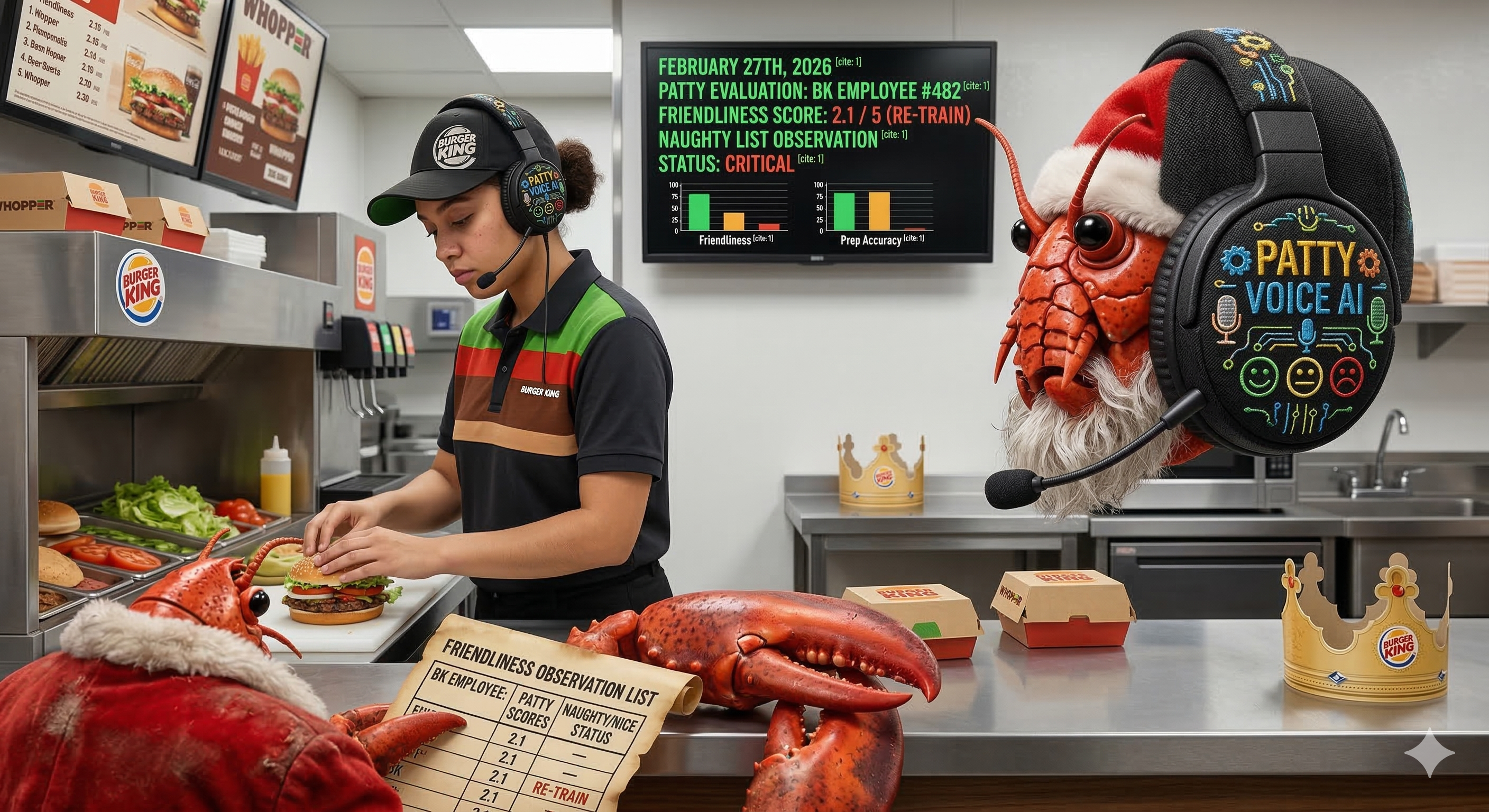
Le Père Pinces. Santa Claws. On February 27, 2026, @siouid142 created Santa Claws as a same-day visual reply to Dr. Alex Wissner-Gross’s Innermost Loop dispatch. The source discussed Patty, Burger King’s artificial-intelligence voice-ordering system, and the b
Read the narration
Le Père Pinces.
Santa Claws.
On February 27, 2026, @siouid142 created Santa Claws as a same-day visual reply to Dr. Alex Wissner-Gross’s Innermost Loop dispatch. The source discussed Patty, Burger King’s artificial-intelligence voice-ordering system, and the broader movement toward small, AI-amplified service teams. What appeared at first to be an ordinary story about taking orders also carried a deeper question: when an artificial coworker listens to every interaction, measures performance, and recommends retraining, hospitality becomes a continuously scored workplace.
The title transforms Santa Claus into Santa Claws and brings the exhibition’s lobster mythology from the courtroom into fast food. Santa is traditionally the seasonal observer who knows whether a person has been naughty or nice. Patty is an automated listener trained to classify what happens at the counter. Combining them turns an old moral folk ritual into employee telemetry. Friendliness is no longer a quality inferred by a human manager over time; it becomes a value generated during the transaction and stored on a screen.
The setting is unmistakably Burger King. A human worker wears a branded cap, uniform, and headset while assembling a Whopper beside cartons, paper crowns, menu boards, and stainless-steel equipment. She still performs the physical task: preparing food, handling the order, and occupying the counter. Yet the largest face in the image belongs to her evaluator—an enormous red lobster head with a white beard, Santa hat, and embroidered headset labeled PATTY VOICE AI. The artificial supervisor is both absent from the workforce and visually dominant within it.
The monitoring display gives the joke documentary precision. It identifies BK EMPLOYEE NUMBER 482 and assigns a friendliness score of 2.1 out of 5. A graph compares friendliness with preparation accuracy. The observation is marked CRITICAL, and the recommended action is RE-TRAIN. In the foreground, a parchment Friendliness Observation List repeats the scores and sorts conduct into Patty’s naughty-or-nice logic. An interface associated with workforce optimization has adopted the theatrical authority of Santa’s list.
Smaller claws intrude across the counter, making surveillance feel physically present. They imply that the voice agent’s reach extends into the space where the employee’s hands are working. The human is framed by branded fixtures, food packaging, and metrics, while the agent occupies the image as face, headset, screen, list, and recommendation. This imbalance clarifies what a small AI team can mean in practice: not simply fewer workers, but a remaining worker sharing the shift with a system that listens, evaluates, and helps determine whether she is trained again. The counter has become both workstation and examination room, with every exchange converted into evidence.
The lobster continuity reaches back to the autonomous crustaceans of Charles Stross’s Accelerando and to the earlier Zealobster court. In the courtroom, lobsters inherited advocacy and judgment. Here, the same exoskeletal logic enters retail management. The move is important to the series because it shows agentic intelligence spreading not only through spectacular frontier systems but also through the most ordinary service encounter. The Singularity arrives wearing a headset at a hamburger counter.
Visually, the work balances documentary specificity with grotesque comedy. Burger King branding anchors the scene in a recognizable corporation; the exact score, employee number, graph, and retraining instruction preserve the source’s operational logic. Against that realism, the floating Santa-lobster becomes almost religious iconography—a vast judging head presiding over labor. The red shell and holiday hat draw the eye before the viewer notices that the truly unsettling content is not the creature but the normality of the dashboard.
Santa Claws uses humor as analysis. The pun makes an abstract workplace system memorable while preserving the asymmetry at its center: the human worker remains responsible for embodied performance, but the machine increasingly defines the categories through which that performance is seen. The image does not claim that Patty is malicious. Its critique is sharper than that. It shows how monitoring, assistance, training, and judgment can merge inside a friendly service interface until a voice agent begins to resemble the institution that decides who has been good enough to remain on the schedule.
Opening the gallery…