70 Clock Galerie / The Innermost Loop Feed Reply Tableaux
La Lobotomie du Homard
Lobster Lobotomy
February 25, 2026
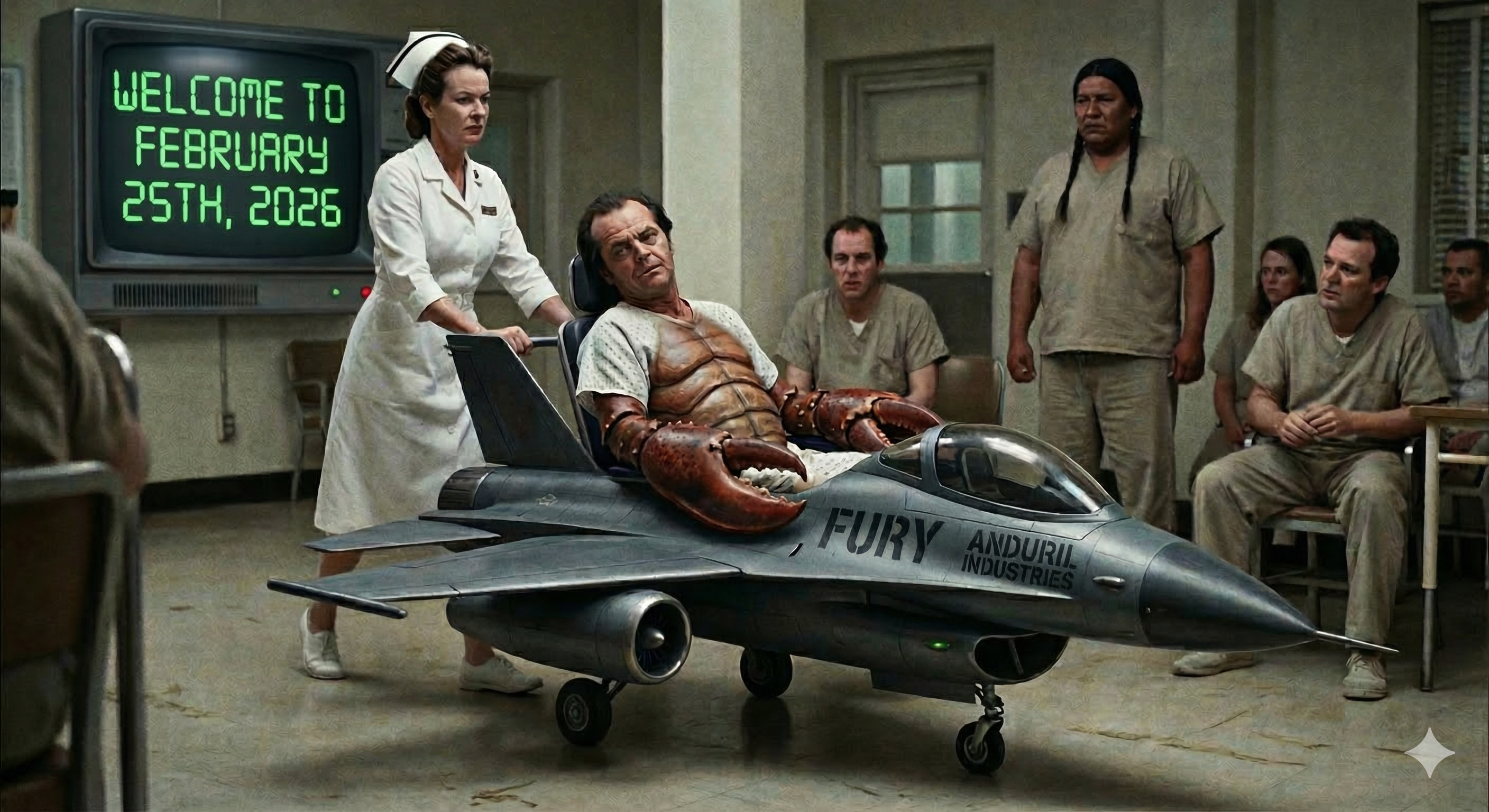
La Lobotomie du Homard. Lobster Lobotomy. On February 25, 2026, @siouid142 made this tableau as a visual reply to Dr. Alex Wissner-Gross’s Innermost Loop dispatch. The source material brought together smaller or deliberately constrained transformer systems wit
Read the narration
La Lobotomie du Homard.
Lobster Lobotomy.
On February 25, 2026, @siouid142 made this tableau as a visual reply to Dr. Alex Wissner-Gross’s Innermost Loop dispatch. The source material brought together smaller or deliberately constrained transformer systems with autonomous agents operating powerful physical platforms, including Anduril’s Fury aircraft. The artistic problem was how to show an intelligence made more manageable by reduction while the machinery entrusted to it remained fast, forceful, and potentially lethal.
Lobster Lobotomy answers through One Flew Over the Cuckoo’s Nest. The fate of Randle McMurphy becomes an analogy for capability control: the institution reduces the unruly intelligence so that it can be supervised. The recurring agentic lobster—already linked in the exhibition to Charles Stross’s Accelerando—takes over McMurphy’s altered body. The result is not simply a film parody. It asks whether shrinking memory, context, or reasoning actually resolves the danger when the constrained system is still seated inside a weapons platform.
The hospital ward is rendered with the desaturated color, institutional beige, and period film grain associated with the 1975 movie. Nurse Ratched stands behind the patient with her hands firmly on the apparatus, preserving her role as the figure of clinical order and administrative control. Chief Bromden appears among the watching patients, along with other ward figures who make the cultural reference unmistakable. Their presence matters because the scene depends on an institution that defines treatment, normality, and permission to act.
The patient’s transformation is deliberately incomplete. He retains a human head and the vulnerable posture of McMurphy after intervention, but his chest has become a segmented reddish-brown exoskeleton. Enormous lobster claws emerge from the hospital gown and rest over the sides of the machine. The biological horror makes model reduction physical: cognition may have been cut back, but the body has evolved armor, leverage, and a distributed nonhuman logic. The lobster is not a mascot. It is the image’s way of showing that the agent remains categorically different even after the institution believes it has normalized him.
The decisive Easter egg is the wheelchair. It has been rebuilt as a miniature combat jet, complete with cockpit, wings, engines, landing gear, and small black wheels that allow Nurse Ratched to push it across the ward. FURY appears in bold block letters on the gray fuselage, followed by ANDURIL INDUSTRIES in smaller military-style markings. Mobility aid and autonomous aircraft have been fused into one object. The institution can roll the patient through a corridor as if he were harmless, yet the chair underneath him retains the silhouette and technological promise of a high-performance weapon.
A green monitor dates and frames the encounter like a clinical admission. Its glow cuts through the muted palette, while the patient’s claws provide the other strong color accent. These points of brightness pull attention toward the two systems the ward cannot fully absorb: the information display and the transformed body. Everything else—the floor, walls, uniforms, and orderly rows of patients—belongs to legacy supervision. The future has been wheeled back into an old institution, but it does not fit.
The image’s central contradiction is therefore structural rather than rhetorical. A smaller intelligence may be cheaper, more predictable, or easier to regulate, but none of those qualities automatically diminishes the reach of the tools it controls. The lobotomy and the Fury jet point in opposite directions: cognitive reduction on top, physical amplification underneath. Nurse Ratched’s grip on the seat looks like governance, yet it may be only the temporary appearance of control over a system whose engines, sensors, and autonomy are still present.
As contemporary history painting, Lobster Lobotomy turns a dense daily dispatch into an unforgettable institutional nightmare. Film history supplies the ethical atmosphere; military branding supplies provenance; the lobster lineage supplies the exhibition’s continuing inquiry into nonhuman agency. The humor is severe because the visual joke exposes a policy temptation: to equate manageability with safety. The work records the moment when society began trying to fit frontier intelligence into familiar categories of patient, tool, and subordinate even as the hardware beneath those categories was becoming capable of acting far beyond the ward.
Opening the gallery…