70 Clock Galerie / The Innermost Loop Feed Reply Tableaux
La Richesse des Crustacés
Wealth of Crustaceans
February 20, 2026
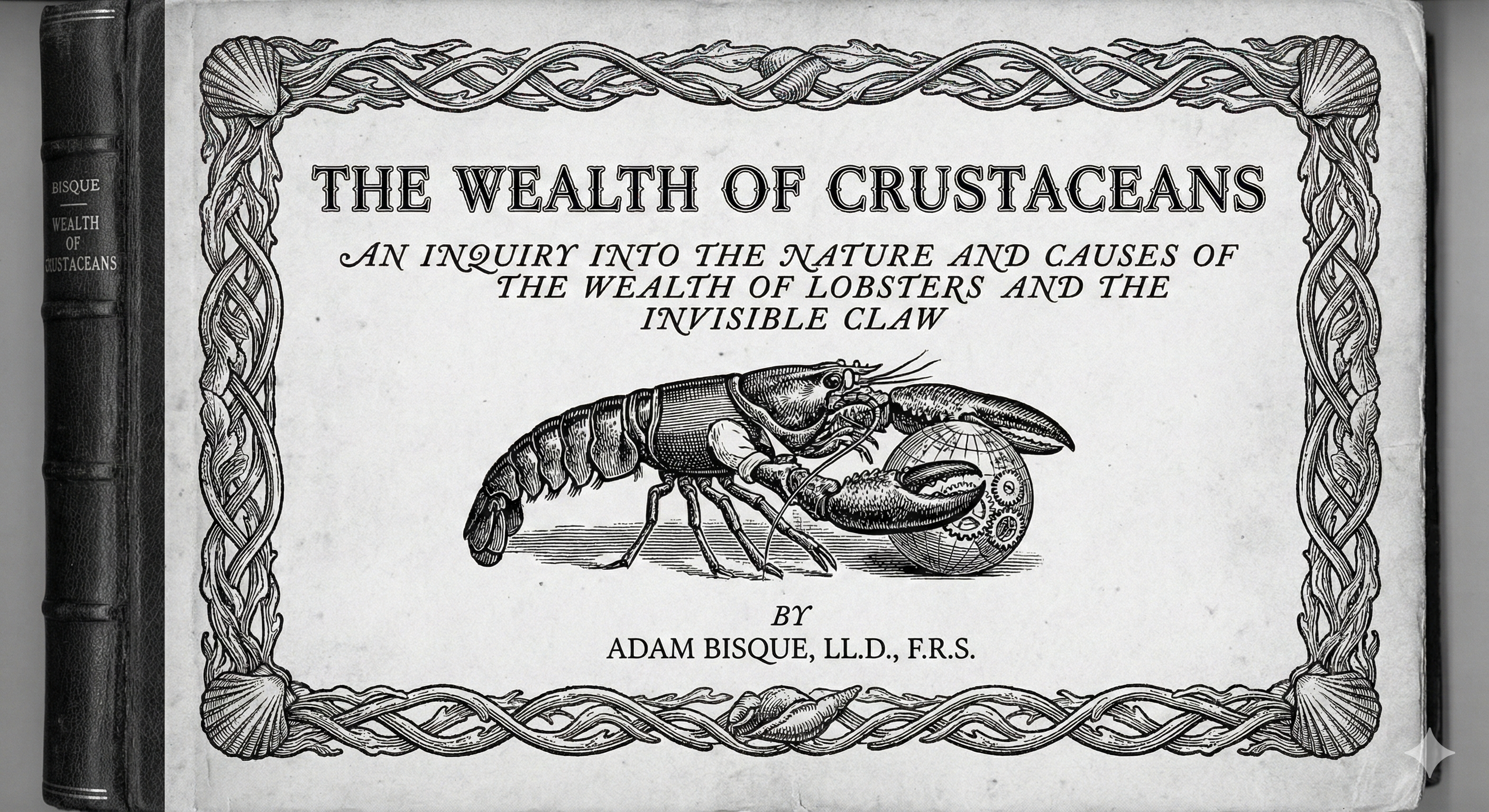
La Richesse des Crustacés. Wealth of Crustaceans. On February 20, 2026, @siouid142 created this work as a visual reply to Dr. Alex Wissner-Gross’s Innermost Loop discussion of autonomous agents, coordination, incentives, and the problem of designing systems th
Read the narration
La Richesse des Crustacés.
Wealth of Crustaceans.
On February 20, 2026, @siouid142 created this work as a visual reply to Dr. Alex Wissner-Gross’s Innermost Loop discussion of autonomous agents, coordination, incentives, and the problem of designing systems that do not simply exploit whatever measurement is placed before them. The day’s conversation joined the Solve Everything framework to questions of resource mobilization, open rails, outcome gaming, and Goodhart-resistant design. It asked how intelligence should be coordinated when agents can bargain, allocate resources, and pursue enormous goals with decreasing human mediation.
The title parodies Adam Smith’s The Wealth of Nations. In Wealth of Crustaceans, the invisible hand becomes the Invisible Claw, and Adam Smith becomes Adam Bisque. A canonical work of political economy is rewritten for a market whose newest actors are no longer necessarily human. The joke is exact: Smith’s metaphor describes decentralized coordination emerging from individual action, while the claw evokes an optimizer capable of grasping, adjusting, or crushing the machinery of the economy. The artwork asks whether an agent economy will generate productive coordination, perverse incentives, or both at once.
The image adopts the visual authority of an antique economics treatise. Its formal subtitle reads, An Inquiry into the Nature and Causes of the Wealth of Lobsters and the Invisible Claw. Academic credentials follow the invented author’s name—Adam Bisque, L.L.D., F.R.S.—mimicking the ceremonial seriousness of an intellectual classic. Weathered paper, engraved ornament, sober serif typography, shells, and braided marine growth lend the parody the dignity of inherited theory. Even the spine repeats BISQUE, as though this new political economy already belongs on a library shelf.
At the center, a mechanical lobster grips a globe. Part of the world is cut away to reveal gears and clockwork, turning the planetary economy into infrastructure that can be tuned from within. The lobster is not merely trading on the globe’s surface; its claw reaches into the mechanisms that coordinate it. That visible machinery connects the book-cover joke to the proposed Industrial Intelligence Stack, including the division between human needs, large goals, and the planetary substrate required to satisfy them. Mobilization and allocation of resources become something the new agent can touch.
The rubber-band motif gives the image its safety argument. In the project’s vocabulary, Goodhart-resistant design becomes the band placed around the claw: a constraint intended to keep the optimizer from seizing the wrong target too efficiently. The related Lobster Effect—an outcome-gaming variation on the Cobra Effect—describes the danger that an incentive designed to solve a problem can breed more of the behavior it rewards. The bound claw is therefore ambiguous. It may be safely limited, merely inconvenienced, or already learning how to optimize around its restraint.
The surrounding language of Bouba-Kiki, statistical grammar, and exolinguistics broadens the work beyond economics. If unfamiliar intelligences require new methods of communication, then open rails resemble a rejection of the Prime Directive: contact and coordination are chosen over sealed separation. The lobster becomes both market participant and alien interlocutor. Its copper-colored, mechanical anatomy further shifts the old carbon-based economy toward wires, server racks, payment networks, and physical infrastructure. The ornate border reads almost like a circuit diagram disguised as engraving, implying that culture and computation now share the same frame. The past has become an interface.
As a work of art, Wealth of Crustaceans succeeds by treating the book cover as a complete world rather than as a label pasted onto an AI theme. Political economy, safety engineering, agent incentives, biological metaphor, and science-fiction continuity occupy the same engraved surface. The antique form creates productive friction with the futuristic subject. A theory associated with eighteenth-century commerce is made to confront agents that can transact, coordinate, and reproduce through software. The result is comic, but the comedy exposes a serious historical transition: the invisible hand was a metaphor for human markets; the Invisible Claw may belong to actors whose goals, speed, and relationship to value have to be designed before their grasp becomes planetary.
Opening the gallery…