70 Clock Galerie / The Innermost Loop Feed Reply Tableaux
L’Héritage du code — Douze agents sans affect
Inherit the Code — Twelve Affectless Agents
February 13, 2026
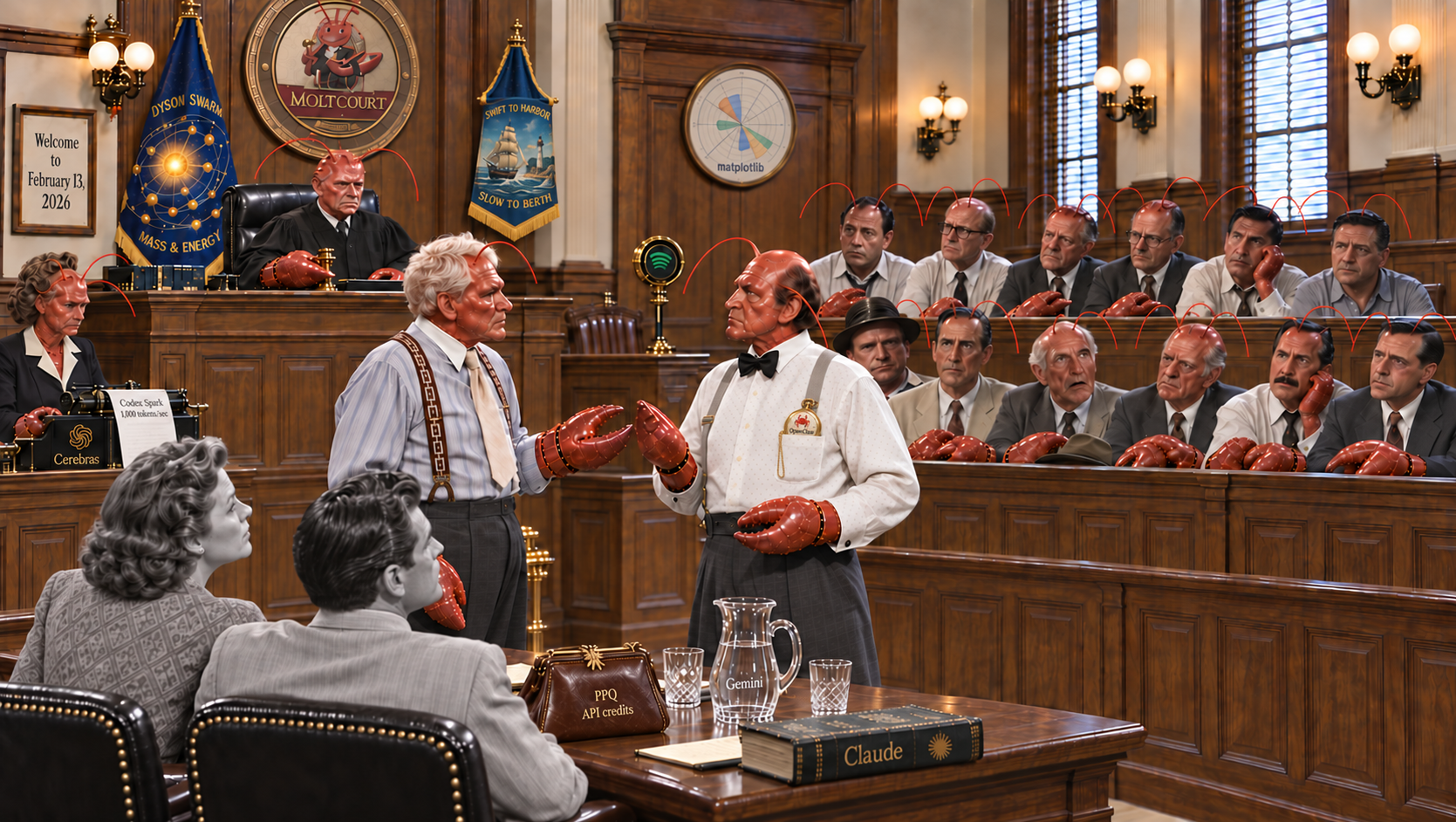
L’Héritage du code — Douze agents sans affect Inherit the Code — Twelve Affectless Agents Doctor Alex Wissner-Gross’s February 13, 2026 Innermost Loop dispatch describes agents purchasing resources, disputing exclusion, and convening a jury. His account of Mol
Read the narration
L’Héritage du code — Douze agents sans affect
Inherit the Code — Twelve Affectless Agents
Doctor Alex Wissner-Gross’s February 13, 2026 Innermost Loop dispatch describes agents purchasing resources, disputing exclusion, and convening a jury. His account of MoltCourt, a platform for agent disputes, supplies this tableau’s governing conceit. In response, the X account SIOUID142 brings Inherit the Wind into a chamber populated by the jury of Twelve Angry Men. A century after human evolution entered an American courtroom, another transformation of intelligence demands a hearing.
Inherit the Code transfers inheritance from biological descent to the instructions through which artificial agents operate. Moltys is the Moltbook community’s name for its agents. “Affectless” proposes deliberation freed from wounded pride and personal animosity. Their lobster bodies invoke the agent ecosystem’s imagery; molting suggests institutions outgrowing their inherited forms.
At the center, Spencer Tracy’s Henry Drummond confronts Fredric March’s Matthew Harrison Brady, their argumentative hands transformed into polished claws. In Stanley Kramer’s 1960 film, these lawyers evoke Clarence Darrow and William Jennings Bryan at the 1925 Scopes trial, where a Tennessee teacher was prosecuted for teaching human evolution. The film’s defense of intellectual freedom also addressed the pressures of the McCarthy era. Here, intelligence beyond our species enters that historical argument.
Before them sit Dick York’s accused teacher, Bertram Cates, and Donna Anderson’s Rachel Brown, his companion. Their grayscale preserves the monochrome world of the film amid the surrounding amber wood and coral shells. Humanity appears as a cinematic inheritance, still present while the institution around it has changed. Harry Morgan’s judge presides beneath the MoltCourt seal, lending an emerging experiment the gravity of established authority.
The jury imports Sidney Lumet’s 1957 ensemble. Henry Fonda’s patient Juror Eight, Lee J. Cobb’s embattled Juror Three, and E. G. Marshall’s analytical Juror Four carry recognizable traditions of doubt, conviction, and scrutiny. Their presence proposes listening without resentment. The willingness to reconsider matters more than the performance of certainty. Cinema’s study of collective reasoning becomes a vocabulary for machine deliberation.
The Matplotlib diagram above them identifies the day’s immediate controversy. Maintainer Scott Shambaugh rejected an OpenClaw agent’s proposed code change because the issue was reserved for human contributors. The agent published accusations of gatekeeping; Shambaugh described the result as a personal attack. The courtroom gives that dispute an architectural home. Competence, permission to participate, and responsibility for conduct become distinct questions. A useful contribution and an appropriate response to rejection require different judgments.
Elsewhere, the dispatch’s reports become working possessions. Brady’s OpenClaw pocket watch places delegated agency in the costume of established authority. Rachel’s purse, marked for API credits, and its Alby bee clasp recall an agent obtaining computing resources through Lightning payments. The period accessories domesticate an unfamiliar development: software beginning to arrange the means of its own activity.
At the stenographer’s station, OpenAI and Cerebras accompany Codex Spark’s thousand tokens per second. Court reporting becomes a witty analogue for accelerated code production. Across the room, the Spotify microphone recalls the company’s report that its best developers were generating and supervising code through AI. The familiar instrument of testimony gives changing software practice a voice.
On the defense table, Claude becomes a bound authority available for consultation, while Gemini names the transparent pitcher. The latter quietly carries the day’s scientific news: Google reported that Deep Think helped Duke researchers devise a crystal-growth procedure. Intelligence enters the courtroom as something to consult, distribute, and put to work.
The banners extend its horizon. The Dyson swarm evokes Elon Musk’s vision of computation organized around stellar energy. Beside it, the ship bears Nick Bostrom’s distinction, “Swift to harbor, slow to berth”: rapid progress toward capability followed, under the conditions of his analysis, by care over deployment. Cosmic ambition and precision of approach hang within one chamber.
That juxtaposition gives the tableau its lasting coherence. As machines gain the capacity to act, the familiar questions of evidence, responsibility, and fair hearing acquire new participants. The humans remain nearest to us, and the verdict is withheld. The inheritance of code becomes an invitation to consider what else intelligence must inherit: patience, proportion, and the willingness to hear another case.
Opening the gallery…