70 Clock Galerie / First Spring of Multimodal Image Generation: Bing April 2023
Les Oiseaux des Aztèques
The Birds of the Aztecs
April 2023
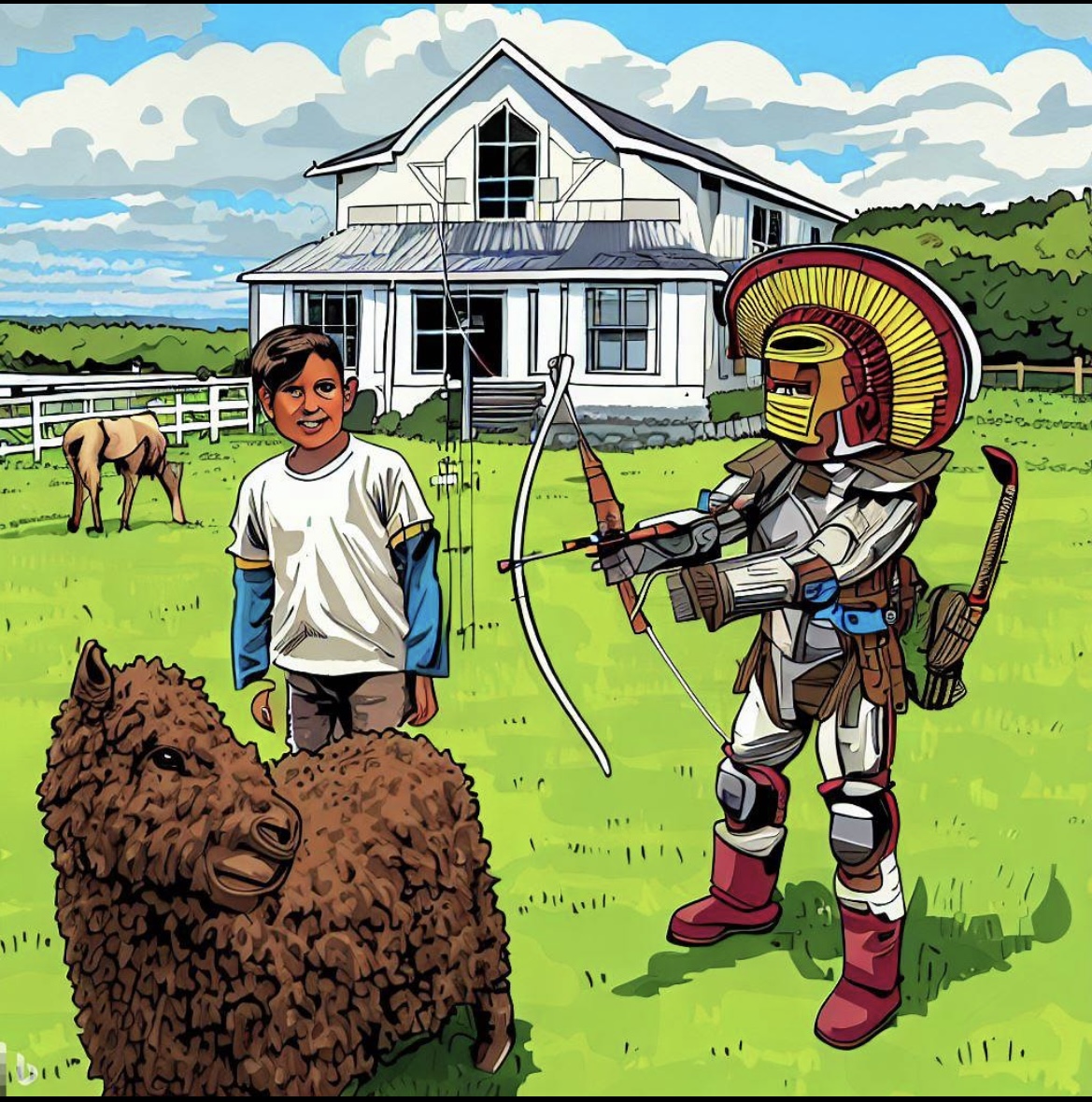
Produced in April 2023, The Birds of the Aztecs presents the following scene. Two boys in brimmed hats stand with archery equipment beside a large white sheep, one extending a thin bow or rod. The bow supplies the composition’s principal arc, while the arrow,
Read the narration
Produced in April 2023, The Birds of the Aztecs presents the following scene. Two boys in brimmed hats stand with archery equipment beside a large white sheep, one extending a thin bow or rod.
The bow supplies the composition’s principal arc, while the arrow, pointing hand, or weapon-like extension creates a competing directional line across the otherwise stable pasture. Against that engineered shell, the animals contribute irregular fleece, weight, and warmth. Their tactile bodies keep the technological fantasy tied to husbandry and dependence rather than frictionless abstraction. Placing a young figure at the center shifts the work away from conquest toward inheritance: this is a world being learned, tested, and handed forward.
The title, The Birds of the Aztecs, therefore works best as a curatorial proposition rather than a checklist of depicted objects. It asks the viewer to connect a specific generated scene to a larger idea that the image may suggest through color, posture, juxtaposition, or sequence without literally illustrating every word.
The image should also be read as an April 2023 artifact rather than repaired in prose into something more coherent than it is. Even the livestock resist strict taxonomy, shifting among sheep, alpaca, calf, buffalo, and invented woolly companion according to texture more readily than anatomy. Those instabilities are historical evidence of the model’s reach and limits during the first spring of widely accessible multimodal image generation: the system could sustain a striking world and recognizable roles while still losing certainty at hands, tools, scale, species, and causality.
Within the Bing Spring sequence, the result is neither a prediction nor a literal report. It is a period document: a pastoral world assembled through computational association, where inherited images of home are repeatedly tested against new bodies, new tools, and a visibly unfinished synthetic imagination.
Opening the gallery…