70 Clock Galerie / First Spring of Multimodal Image Generation: Bing April 2023
La gardienne blindée and le jeune archer en patrouille
The Armored Guardian and Young Archer on Patrol
April 2023
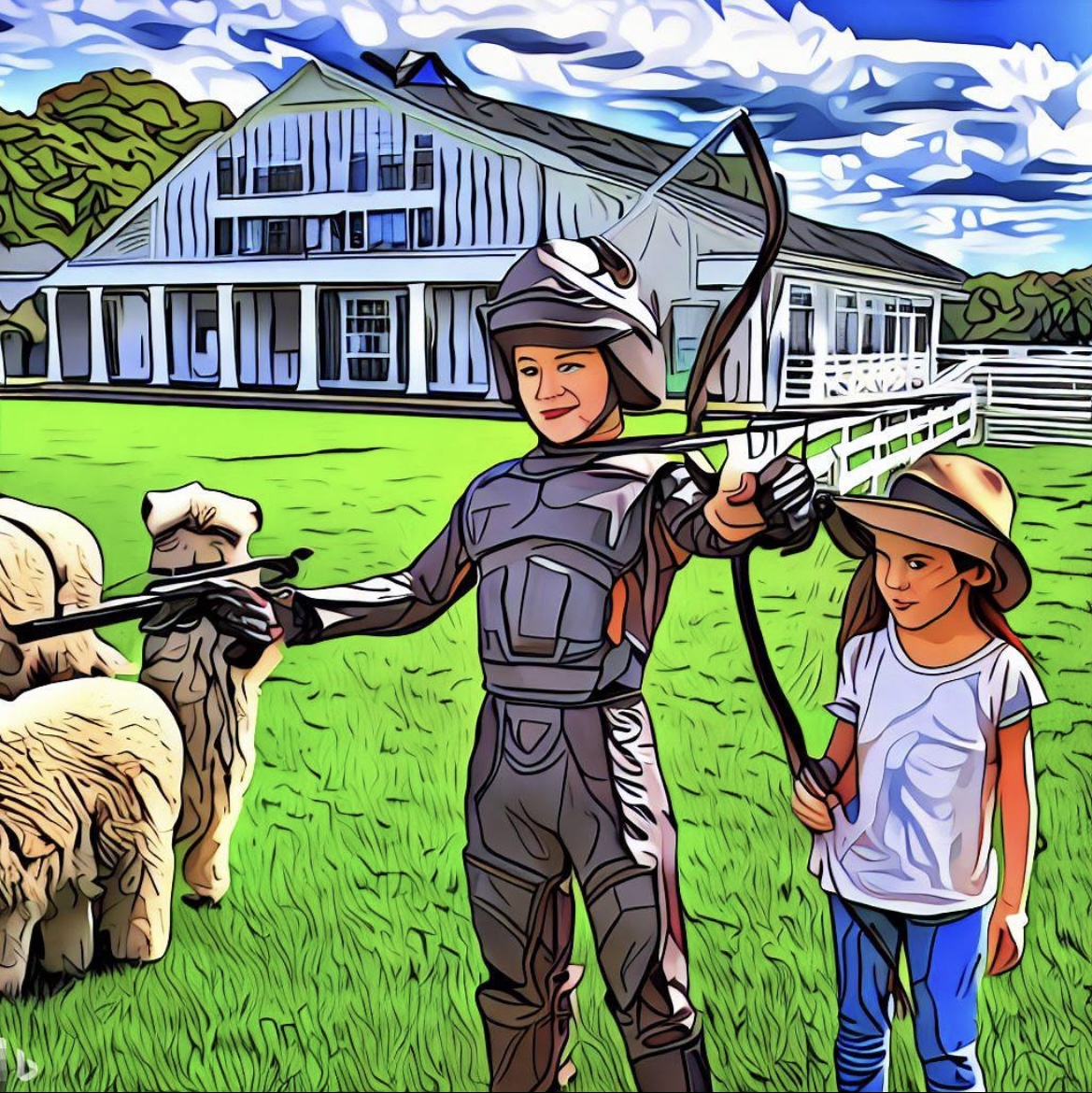
Produced in April 2023, The Armored Guardian and Young Archer on Patrol presents the following scene. A boy in a purple shirt holds a bow beside a gold-armored guardian and an enormous dark woolly animal. A white farmhouse anchors the field. The bow supplies t
Read the narration
Produced in April 2023, The Armored Guardian and Young Archer on Patrol presents the following scene. A boy in a purple shirt holds a bow beside a gold-armored guardian and an enormous dark woolly animal. A white farmhouse anchors the field.
The bow supplies the composition’s principal arc, while the arrow, pointing hand, or weapon-like extension creates a competing directional line across the otherwise stable pasture. Helmet and armor turn the body into an interface: identity is partly protected, partly concealed, and partly rewritten through reflective plates, dark screens, and segmented surfaces. Against that engineered shell, the animals contribute irregular fleece, weight, and warmth. Their tactile bodies keep the technological fantasy tied to husbandry and dependence rather than frictionless abstraction. The farmhouse and white fencing stabilize the scene with an inherited American pastoral grammar: property, shelter, cultivation, and an apparently orderly horizon.
The title, The Armored Guardian and Young Archer on Patrol, concentrates attention on the encounter staged here. Its language transforms the pictured relationship into an emblem, allowing an ordinary gesture, costume detail, animal, or line of sight to carry the work’s broader speculative charge.
The image should also be read as an April 2023 artifact rather than repaired in prose into something more coherent than it is. Even the livestock resist strict taxonomy, shifting among sheep, alpaca, calf, buffalo, and invented woolly companion according to texture more readily than anatomy. Those instabilities are historical evidence of the model’s reach and limits during the first spring of widely accessible multimodal image generation: the system could sustain a striking world and recognizable roles while still losing certainty at hands, tools, scale, species, and causality.
Within the Bing Spring sequence, the result is neither a prediction nor a literal report. It is a period document: a pastoral world assembled through computational association, where inherited images of home are repeatedly tested against new bodies, new tools, and a visibly unfinished synthetic imagination.
Opening the gallery…